
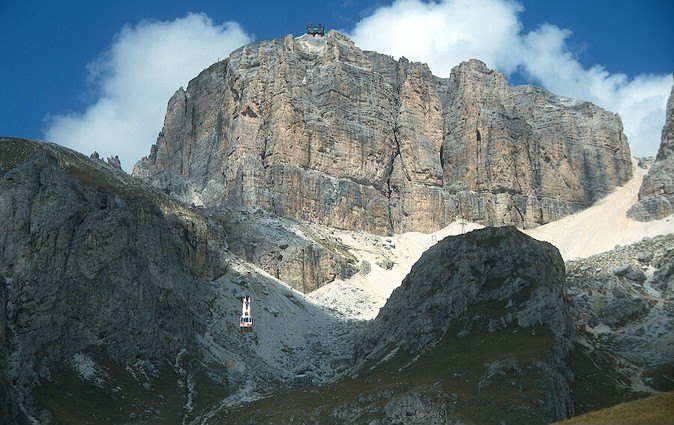
"The terrace of the Dolomites"
While the Marmolada is traditionally called the queen of the Dolomites, the Sass Pordoi has earned over time the title of "terrace of the Dolomites", an expression that describes its morphology with precision. The summit is a broad plateau inclined towards the north-west, terminating on three sides in sheer walls. The contrast is radical: on the northern flank the relief slopes away gradually, while on the southern flank the drop reaches 800 metres with a gradient exceeding 80%.
Morphology and position within the Sella Group
The Sass Pordoi belongs to the Sella mountain group and forms its southernmost spur. The three vertical flanks overlook Val Lastìes, Pian de Schiavanèis and the Passo Pordoi respectively, creating a system of walls that almost completely surrounds the base of the mountain. Only the northern flank offers a different morphology, with a profile that slopes away gradually rather than breaking off abruptly.
The cable car, trail 627 and the ancient Via Maria
The Sass Pordoi cable car — manufactured by Hölzl and built over a much older installation dating from the early twentieth century — allows an elevation of 2,950 metres to be reached. Trail 627 is the on-foot alternative: it climbs a scree gully to the Forcella refuge before continuing to the summit. Among the many rock routes ascending the Sass Pordoi, the ancient Via Maria is the best known: it was created by the so-called Devil of the Dolomites, an expression used in the sources to denote a leading alpinist of this massif, with no further biographical details available in the consulted materials.
A plateau suspended over the void
The distinctive quality of the Sass Pordoi lies not only in figures — 800 metres of southern overhang, gradients above 80% — but in the way the summit visually contradicts the structure of the flanks. Those who reach the top find themselves on an almost horizontal surface, from which the gaze ranges across the surrounding Dolomites, while the edges of that plateau coincide with some of the most vertical walls in the entire Sella Group. This morphological discontinuity makes the Sass Pordoi one of the most legible examples of Dolomitic geology, where the differential resistance of the rocks produces forms that appear constructed.