
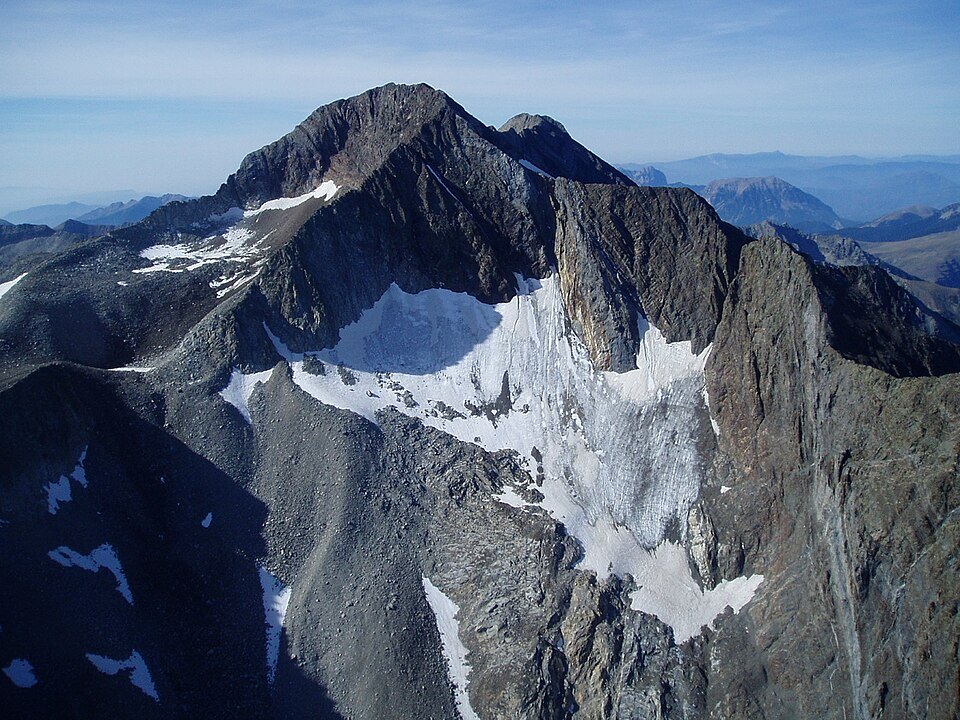
The name of the "burnt land"
The alternative name "Punta Llardana" deserves attention: according to sources, Llardana is said to mean "burnt land," likely a reference to a rocky ridge bare of vegetation and/or to a particular tendency to attract lightning. This vernacular name, rooted in direct experience of the terrain, contrasts with the administrative designation of Posets and is a reminder that the great Pyrenean ridges were named long before they were measured.
Natural setting and position in the range
Pico Posets lies at the very centre of the Posets-Maladeta Natural Park, in the Spanish Pyrenees. The culminating point of the Posets massif, it crowns a mountain group that constitutes the second-highest massif in the entire Pyrenean chain. Its position, slightly set back from the most frequented areas, gives it a stature less immediately visible than that of the neighbouring Aneto, while maintaining a defining presence in the landscape of the high Aragonese mountains.
At 3,375 m — with the uncertainty of a few metres depending on Spanish cartographic surveys — Posets occupies a singular rank: second Pyrenean summit, but also fifth summit of Spain, surpassed only by peaks situated in radically different geographical settings, from the Canarian volcano to the Andalusian heights.
Ascent history
The first official ascent of Pico Posets took place on 6 August 1856, accomplished by the Briton Henry Halkett accompanied by his guides from Luchon, Pierre Redonnet and Pierre Barrau. This date is noteworthy: it came long after that of Aneto, a summit that is nonetheless higher. The history of Pyrenean first ascents does not follow strict altitudinal hierarchy — other factors, such as perceived accessibility or known approaches, guided the priorities of the early Pyrenean climbers.
The first winter ascent was not achieved until nearly twenty-five years later, by Roger de Monts and Célestin Passet. This gap between the summer ascent and its winter counterpart reflects the particular difficulties of the high Pyrenees under snow conditions, and the gradual progression of technique and boldness among mountaineers of the late nineteenth century.