
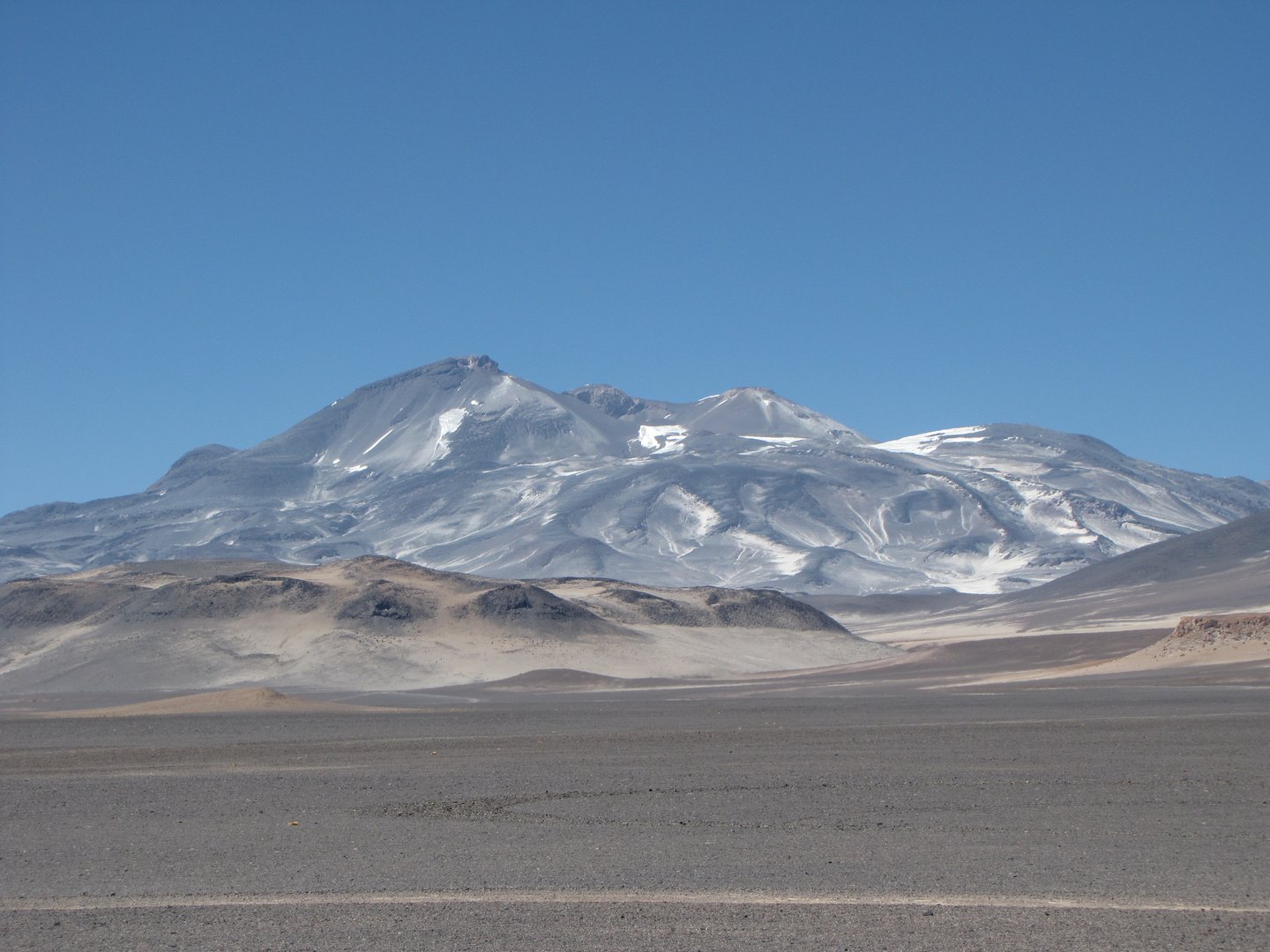
The Highest Volcano in the World
The Smithsonian Global Volcanism Program classifies Ojos del Salado as the highest volcano in the world above sea level, a distinction that the GVP itself explicitly separates from the concept of volcanic height measured from the base. This precision matters: the status of "highest volcano" refers to the summit's elevation above sea level, not to the topographic prominence of the volcanic edifice itself. The absence of any eruption recorded in historical times does not, according to GVP criteria, permit the volcano to be classified as extinct; rigorous classification requires distinguishing between documented inactivity and geological extinction.
Geography of the Puna: Salt, High-Altitude Lakes, and Neighbouring Summits
Andeshandbook places the massif in the Puna de Atacama, an arid high plateau where salt flats, high-altitude lakes, and summits exceeding 6,000 m shape the volcano's immediate landscape. The complex has several distinct summits; ascent accounts mention rock towers oriented both to the east and to the west, though it is not established that these towers share the same elevation. The juxtaposition of high-altitude snow and the desert lowlands stretching at the foot of the massif is one of the most striking visual features of the surroundings, although available reports do not allow for confirmation of specific permanent glaciers.
First Documented Ascent: 1937
According to Andeshandbook, the first documented ascent of Nevado Ojos del Salado took place on February 26, 1937, carried out by Polish mountaineers Justyn Wojsznis and Jan Szczepański. The expedition approached the massif from the Argentine side, that is, from the east. This eastern approach would serve as a reference for subsequent ascents that, over time, would also explore the rocky structures of the western flank. The chronology of these early explorations documents the moment when the mountain transitioned from being a geographical border landmark to becoming an objective of international mountaineering.