
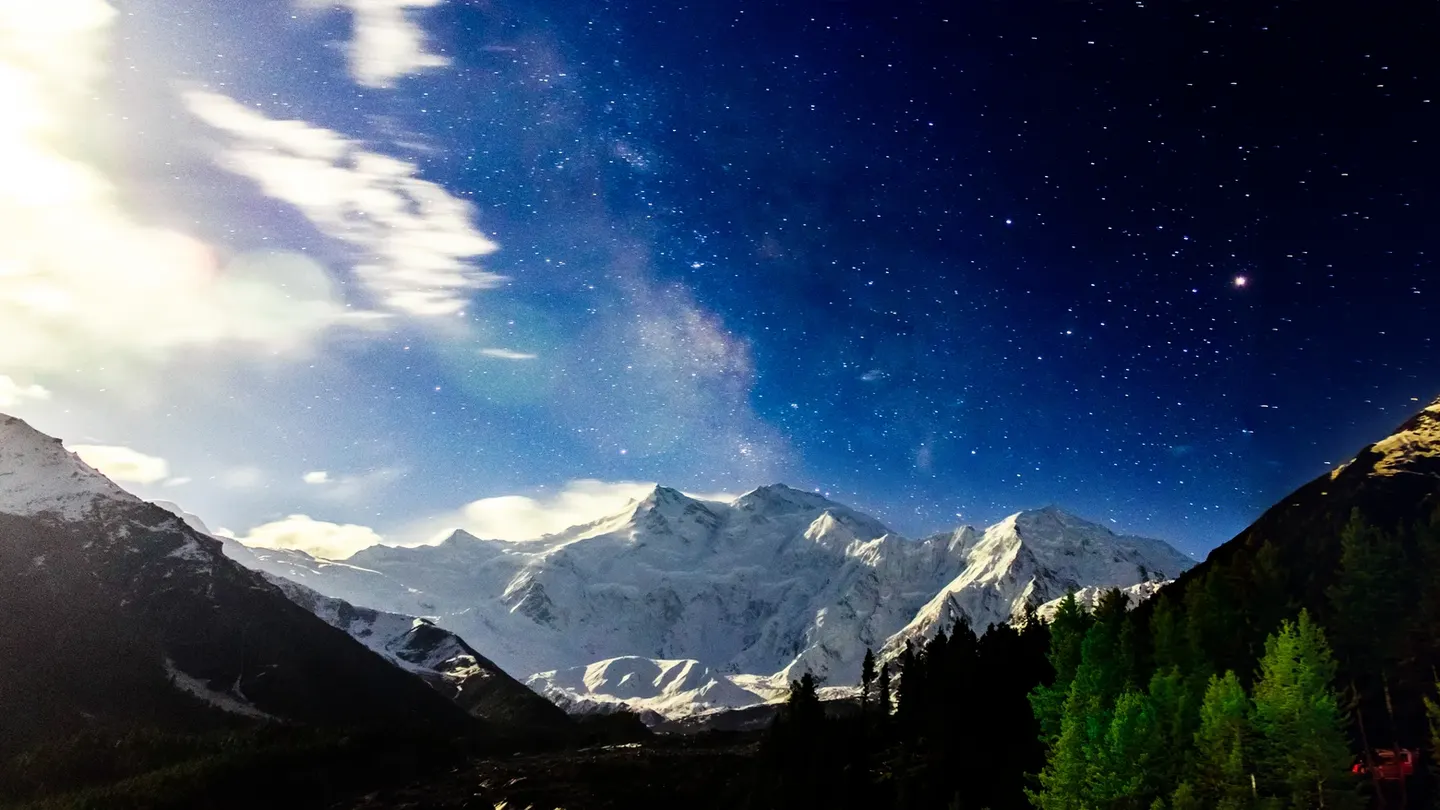
The Rakhiot Approach and the First Ascent
The first ascent came on 3 July 1953, when Austrian climber Hermann Buhl completed the final summit stage alone, approaching from the Rakhiot side as part of a German–Austrian expedition led by Karl Herrligkoffer. The broader effort was a collective one: four Hunza porters helped the team establish the high camp below the ridge from which Buhl and Otto Kempter began their summit push. Kempter turned back, and Buhl continued alone, reaching the top at around 7 p.m. — a time recorded in his own contemporary account. Without shelter and unable to descend in darkness at that altitude, he spent the night standing on the upper mountain before making his way down the following day.
Buhl's written account supplies detail of the solitary final stage and the high bivouac, standing as the primary contemporary evidence for what unfolded during those final hours. It is important to hold the distinction clearly: the solo leg was the summit stage alone, not the expedition as a whole. The achievement was the culmination of multiple earlier expeditions that had probed the Rakhiot approach over previous decades, with the final push carried out by Buhl alone after his teammates turned back.
The Diamir Face and the Second Ascent
Nine years separated the first and second ascents of Nanga Parbat, and the second came by an entirely different route. The 1962 expedition succeeded via the Diamir face, the western flank of the mountain, opening a line that had not been used in any of the earlier attempts concentrated on the Rakhiot side. The Diamir face presents its own distinct character — a broad, heavily glaciated wall that descends toward the Diamir valley — and its ascent in 1962 established that the mountain could be climbed by more than one path.
The Rupal Face and the Messner Descent
The south side of Nanga Parbat is dominated by the Rupal face, which rises from the Rupal valley in one of the largest continuous mountain walls in the Himalaya. The first ascent of this face came in 1970, when Reinhold Messner and his brother Günther reached the summit. Their descent did not retrace the Rupal route: the brothers came down toward the Diamir side of the mountain, linking two faces in a single traverse. Günther Messner died during that descent, though the precise circumstances remain a matter of historical dispute and are not fully settled by the expedition records available.
The sequence of the 1953, 1962, and 1970 ascents traces a geographical arc around the mountain — from the northeastern Rakhiot approach, to the western Diamir face, to the great southern Rupal wall. Each breakthrough opened a distinct face of the peak to climbing, expanding the known terrain and demonstrating that routes on different aspects of the mountain were achievable.
The Mountain's Name and Geographical Setting
Nanga Parbat sits at the western terminus of the Himalayan range, geographically distinct from the central and eastern Himalaya both in its setting and in the approaches it offers. The Rakhiot, Diamir, and Rupal faces are the three primary topographic identities of the peak, each presenting a different character and scale to those who have attempted it.