
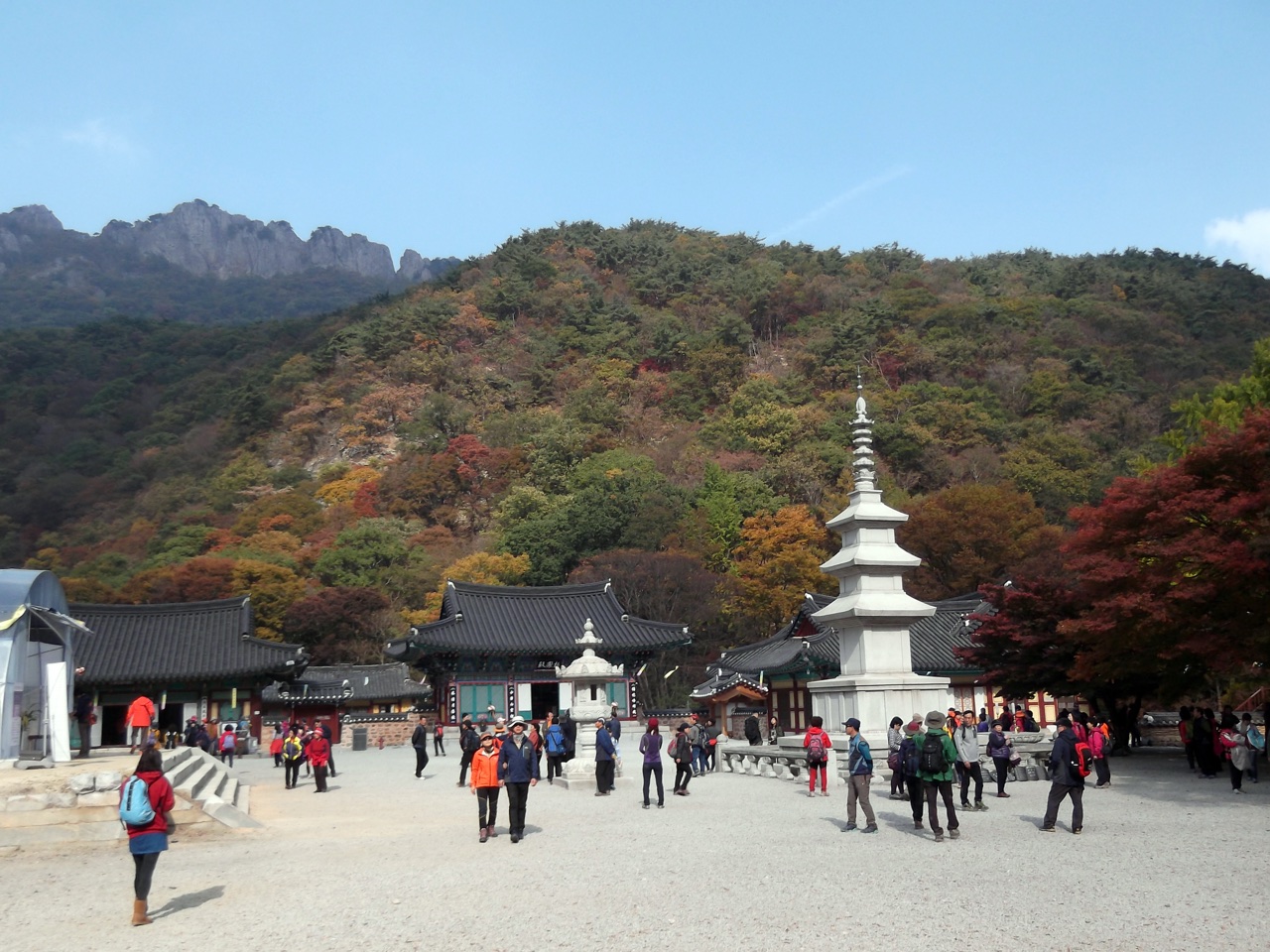
Sinseongbong and the Nine Peaks
The highest point of Naejangsan is Sinseongbong, at 763.5 m above sea level. The mountain as a whole is not structured around a single summit but forms a chain of nine peaks, each arranged so as to encircle valleys and slopes from different directions. This topographical structure is also the key to Naejangsan's scenery. Wonjeok Valley, running between peak and peak, lies deep within the mountain, and Naejangsa Temple stands along the valley floor.
Wonjeok Valley and Naejangsa Temple
Wonjeok Valley is formed by the embrace of Naejangsan's many peaks on all sides. Naejangsa Temple, situated inside the valley, is a space intimately connected to the mountain's terrain, positioned in accordance with the flow of its ridges. The autumn foliage display also unfolds around this valley, and Korea Forest Service materials specify that the foliage should be appreciated with both the ridgelines and the valley in view. This also means that viewing the mountain's seasonal scenery from the peaks alone, or from the valley alone, makes it difficult to grasp the full picture.
The Extent of Naejangsan National Park
Naejangsan National Park encompasses both the Naejangsan zone and the Baegamsan zone within a single park. The two mountains share the same national park but are each independent mountains with different summits and terrain. The highest point of Naejangsan is Sinseongbong, while Baegamsan has its own distinct summit and topography. The fact that they lie within the same park cannot serve as grounds for treating the two as one and the same mountain.