
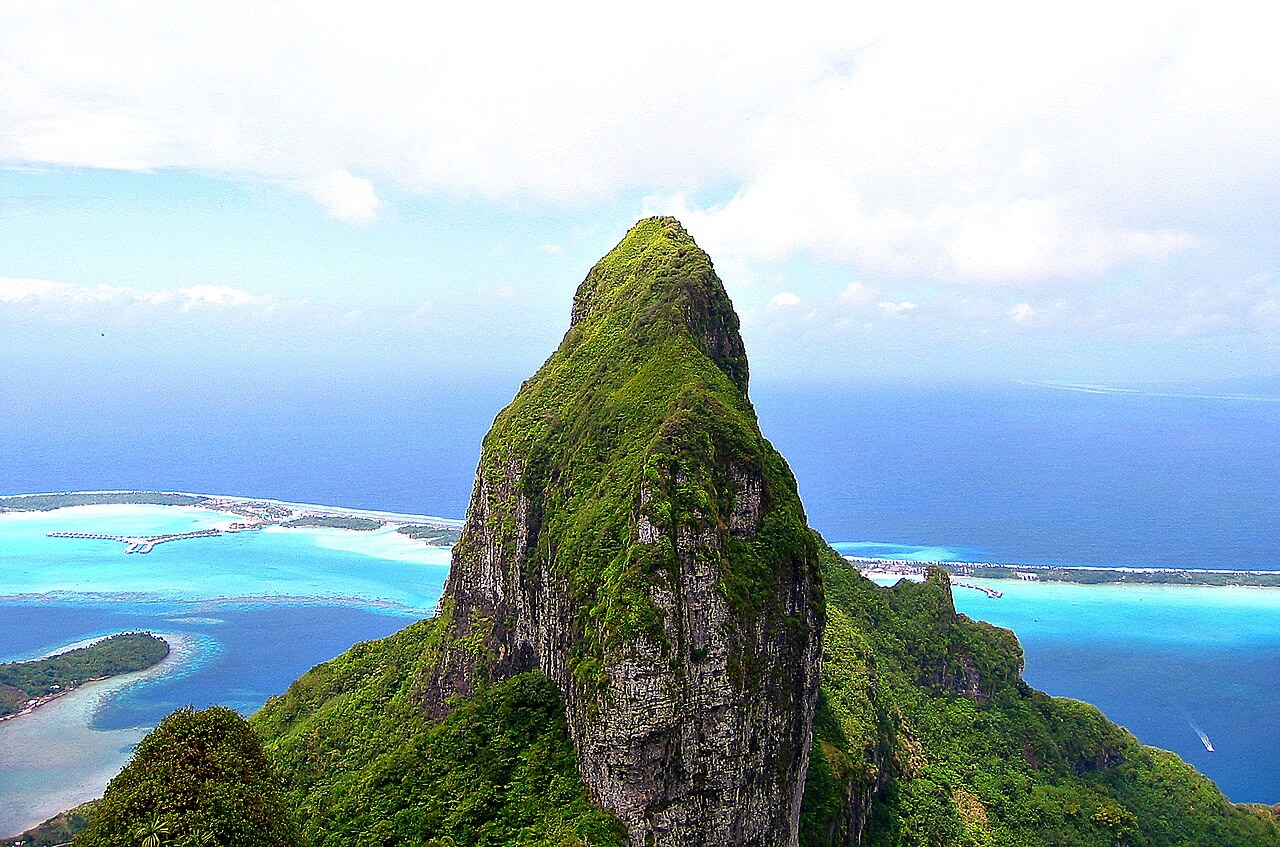
A name laden with meaning
According to Tahiti Tourisme sources, the name Otemanu is locally translated as "the peak that draws beings to it." This phrasing, handed down through Polynesian oral tradition, gives the summit a symbolic dimension that goes beyond its simple geographical reality. The precise origin and age of this name are not established by the available sources; it should therefore be reported as an attested local translation, without inferring either its age or the circumstances of its creation.
This nominal relationship between the summit and a form of attraction — or drawing — of beings towards it resonates strikingly when one observes the silhouette of Otemanu from the lagoon: the rocky mass, steep and compact, does indeed exert a visually dominant presence over the entire landscape of Bora Bora.
Geology of a revealed shield volcano
The geological mapping of Bora Bora, published in the Comptes Rendus de l'Académie des Sciences, identifies the island as the emergent portion of a shield volcano. The edifice is composed of superimposed alkaline basalt flows, within which hawaiites — a slightly more differentiated volcanic variety — are intercalated more rarely. Otemanu is therefore not an active or recent eruptive cone: it represents the central rocky core of this shield, exposed by erosion after the cessation of volcanism.
This profile — a residual landform rather than a constructional one — explains the summit's dissected and precipitous appearance, very different from the gentle morphology normally associated with shield volcanoes during their active phase. The entirety of the island visible today is merely the upper portion of a massif that continues for the most part beneath the sea surface.
Three structures, one landscape
One of the defining characteristics of Bora Bora lies in the coexistence, within a confined space, of three clearly distinct geological structures. The volcanic island proper, of which Otemanu is the highest point, is surrounded by the waters of the lagoon — the interior marine space enclosed between the island and the barrier reef. At the periphery of this lagoon there develops a belt of motu, those low coral islets that punctuate the barrier reef.
Research published in Quaternary International collected samples from motu situated on both sides of Bora Bora's barrier reef, confirming the coral nature of these formations and their structural independence from the volcanic basement. This distinction is fundamental to understanding Bora Bora: the basalt of Otemanu, the lagoon and the motu share neither the same origin nor the same chronology, even if the eye takes them in as one from any vantage point on the island.