
Bourgeau, Hector, and the Name Windy Mountain
On 12 August 1858, James Hector's journal for the Palliser Expedition records that botanist Eugène Bourgeau intended to cross Windy Mountain in the country around Lac des Arcs. Alberta's names coordinator has identified the great central massif as the feature Bourgeau most likely called Windy Mountain — a designation that endured, in modified form, when officials adopted Wind Mountain in 1911. That name applied to the same general landform for more than a decade before political circumstance redirected it.
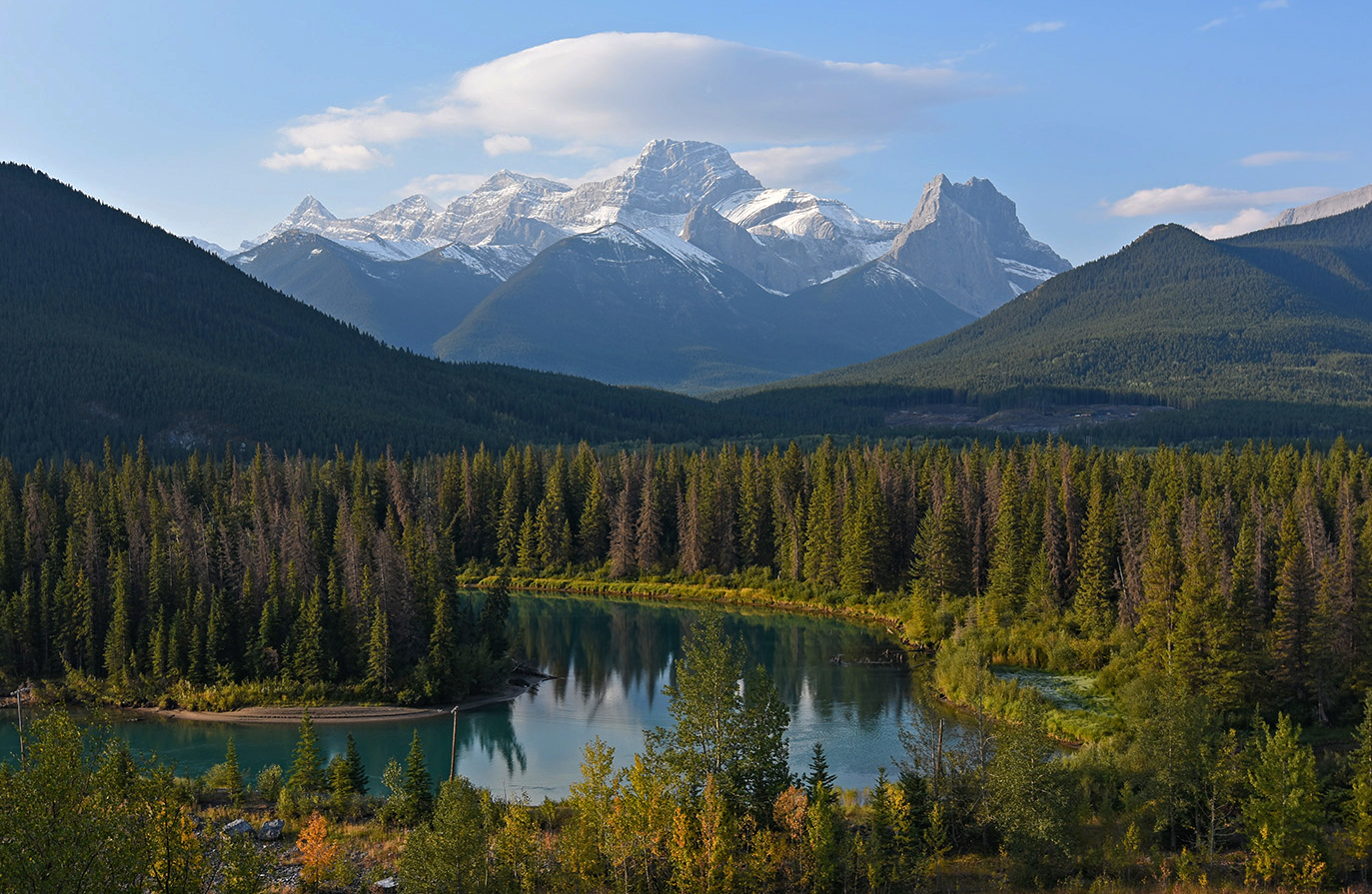
The photograph taken on 17 September 2017 by Jan Mosimann from the Bow River valley shows the full skyline in a single frame: Wind Mountain's pointed summit appears on the far left, the broad snow-covered Mount Lougheed group occupies the centre, and Windtower's rocky profile stands on the right. Reading that ridgeline left to right maps the sequence of naming decisions across adjacent but separate terrain.
From a Banff Peak to the Kananaskis Massif
When Calgary senator Sir James Alexander Lougheed died in 1925, a peak in what later became Banff National Park was named for him in 1926, with the consent of his widow, Lady Isabella. It lay near Mount Bourgeau, northwest of the present Mount Lougheed. His son Clarence petitioned to move the name to the more imposing mountain in Kananaskis. In February 1928, Mount Lougheed became the official name of the massif previously known as Wind Mountain.
Mount Lougheed and Wind Mountain continued to appear for the same massif on different maps. The federal names committee reaffirmed the Lougheed name in 1972, and Alberta confirmed it in 1982. In January 1985 the older name gained its own place on the map when Wind Mountain became the official name of a separate peak to the southeast.
Competing Accounts of the 1889 Ascent
The Canadian Rockies mountaineering database records competing accounts from an 1889 survey party. W. S. Drewry and A. St. Cyr reported reaching the summit that year. Their guide and fellow survey assistant, Tom Wilson, recalled reaching it two days earlier.
Peter Lougheed on the Mountain
A photograph in the Alpine Club of Canada’s biography of guide Lloyd Gallagher shows then Alberta Premier Peter Lougheed and his family on the mountain in 1975. Nearly five decades after the name moved to Kananaskis, the grandson of Senator James Lougheed stood on the massif his uncle Clarence had chosen.