
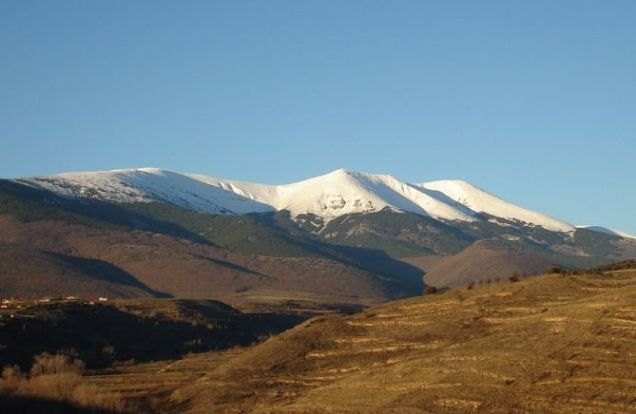
The roof of the Iberian System
Moncayo reaches 2,315 m a.s.l. and holds the position of highest summit in the Iberian System, the great mountain alignment separating the Castilian plateau from the Ebro basin. It is simultaneously the highest peak in the province of Zaragoza and in the province of Soria, a dual orographic distinction that underscores its character as a hinge between Aragon and Castile. Around it stand other significant summits of the same massif: Peña Negra or Moncayo de Castilla (2,118 m), Lobera (2,226 m), San Juan (2,283 m) and Morca (2,273 m), among other secondary peaks.
Glacial cirques and the structure of the massif
The Moncayo massif preserves three glacial cirques formed during the Quaternary, known locally as hoyas: Hoya San Miguel, San Gaudioso and Morca. These semicircular depressions are the most visible testimony to the action of Pleistocene ice on a landscape whose profile today looks very different. The three principal summits of the massif — Moncayo proper, Peña Negra and Lobera — exceed 2,000 metres in altitude and define the characteristic silhouette of the sierra as seen from the plains of Zaragoza and Soria.
Nature protection on the Aragonese slope
Since 1927 the Aragonese slope of Moncayo has enjoyed some degree of official protection: that year it was declared a Site of National Natural Interest. Subsequently, in 1978, a sector of the mountain became the Dehesa del Moncayo Natural Park, a designation that over time evolved into the present Parque Natural del Moncayo. This protected area covers 11,144 hectares and includes the so-called "Hidden Face of Moncayo", a sector of the southern slope dominated by holm oak woodland and aromatic plants typical of Mediterranean scrubland on rocky substrate. At Agramonte there is a Nature Interpretation Centre associated with the park.
Alternative names
The mountain appears in sources under three names: Moncayo, Pico del Moncayo and Pico de San Miguel, the last of which it shares with the best-known glacial cirque in the massif, the Hoya San Miguel. The coexistence of the civil and religious names reflects a widespread tradition in Iberian topography, where dedications to saints served for centuries to designate summits and passes of reference for local communities.