
Elevation and Survey Readings
The Zerafshan Tourism Development Association lists Mirali at 5,120 m. The St Petersburg climbing federation gives 5,106 m, Khovar, the national information agency of Tajikistan, gives 5,132 m, and Artem Martyanov’s team logged a summit GPS reading of 5,110 m in August 2016. The field party recorded Mirali Pass separately, at 5,029 m. The saddle lies south of the summit and leads toward the north ridge of Chimtarga.
North-Face Climbing History
The St Petersburg climbing federation lists A. Zayonchkovsky’s 1968 climb on the left buttress of the north face and V. Onishchenko’s 1976 line along its edge. Photographs from Oleg Shumilov’s archive document the Artuch team’s 1978 first passage through the centre of the north face. The Moscow State University Mountaineering Club’s account credits the team, which Shumilov coached, with first place in the technical climbing class.
The Artuch Alpine Camp opened in 1971 in the Urech valley at around 2,200 m. Researchers surveying the Fann Mountains’ lakes and wetlands describe Artuch’s Soviet-era role as an alpine centre. A later recollection published by Khovar describes how it was still the range’s only permanent mountaineering camp in the busy summer of 1990.
The 2016 Ridge Traverse and Terrain Observations
In August 2016, Martyanov’s group approached from Don Pass, climbing rock bands and stretches of firm snow and ice. A ridge point at 5,066 m looked deceptively like the summit. The group reached the peak from Mirali Pass that evening and spent two nights at the saddle after strong winds set in. They climbed neighbouring Chimtarga before descending toward Right Zindon. Their record describes glacially smoothed bedrock below an ice tongue and a valley floor stepped by gravel flats and boulder blockages.
Landscape Setting and Regional Context
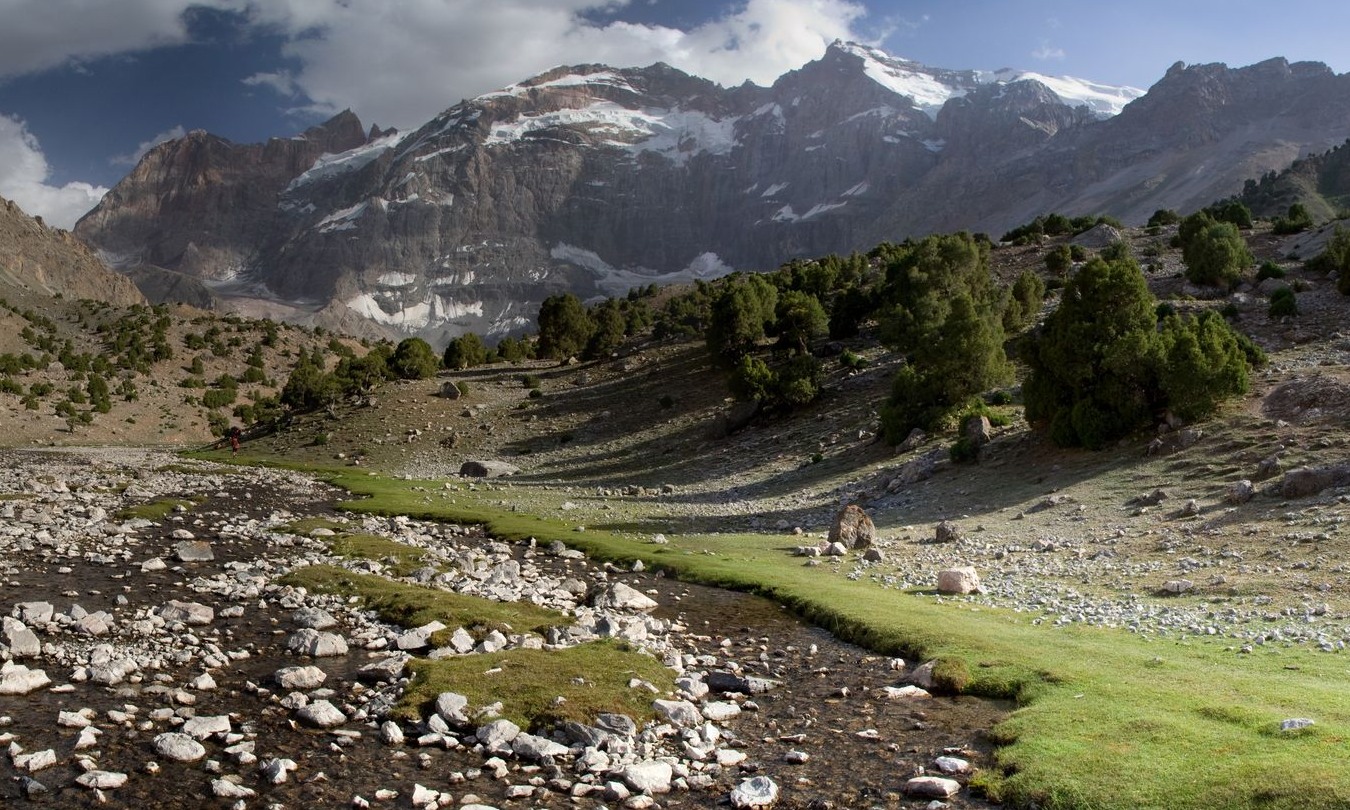
Oleg Brovko’s photograph from August 2008 frames Mirali’s skyline across the stony Kulikalon Lakes valley, with junipers scattered in the foreground. A later field study documented a mosaic of lakes and wetlands on the Kulikalon Plateau. Tajikistan’s 2006 World Heritage Tentative List submission for the wider Fann Mountains identifies lakes, glaciers and juniper woodland as features of the proposed site.