
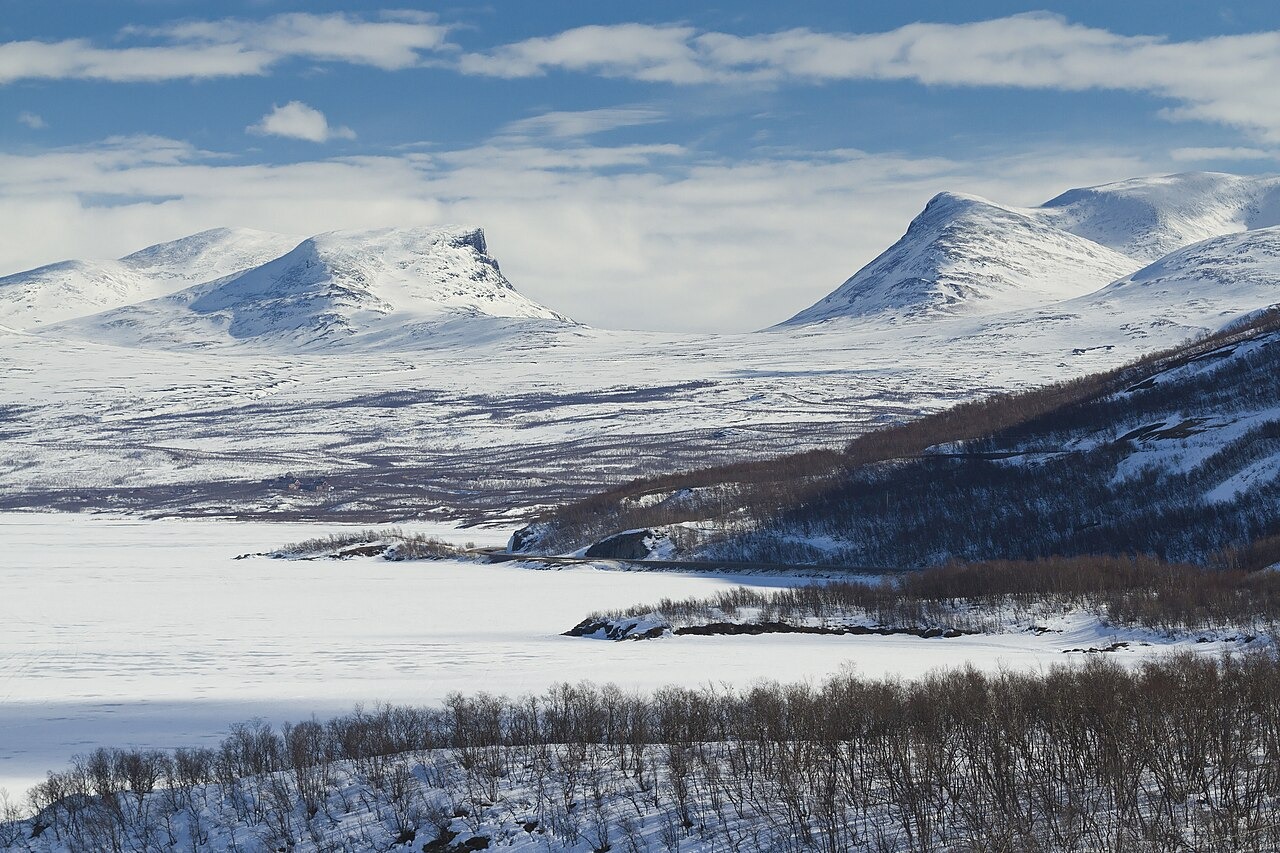
Glacial Form and Valley Geometry
The Municipality of Kiruna describes the valley as a northwest-to-southeast trough, its broad, open profile the result of sustained glacial erosion that widened and deepened the original drainage channel into a shape distinctly visible from the shore of Lake Torneträsk. That geometry — steep flanking walls rising from a relatively flat floor — is the defining characteristic of a true U-shaped valley, produced when moving ice removes material laterally as well as downward. Lake Čuonjájávri sits on the valley floor at approximately 950 metres, a figure documented by Fjällen.nu and reflecting the high base elevation of this part of Norrbotten's mountain terrain.
Sámi Name and Cultural Geography
The County Administrative Board of Norrbotten records Čuonjávággi and Lapporten as names for the same valley. The Northern Sámi toponym belongs to a geographic and cultural framework that predates the Swedish name, and the two should not be treated as simple equivalents carrying identical meanings. The valley has long functioned as a landmark within Sámi land use in the region, and its recognition in official county documentation reflects an ongoing effort to preserve original place-name forms alongside later Swedish usage.
Artistic Record
The Swedish painter Helmer Osslund depicted the valley's U-shaped profile in the early twentieth century. Art-historical research at Stockholm University identifies the two bounding mountains visible in his composition and situates the perspective south of Abisko, where the gap between Nissunjårro and Tjuonatjåkka frames the view. That study links the painting's geometry to the actual landform without asserting a precise vantage point, and it treats Osslund's image as a record of how the valley's silhouette was understood and reproduced within Nordic landscape art of the period.