
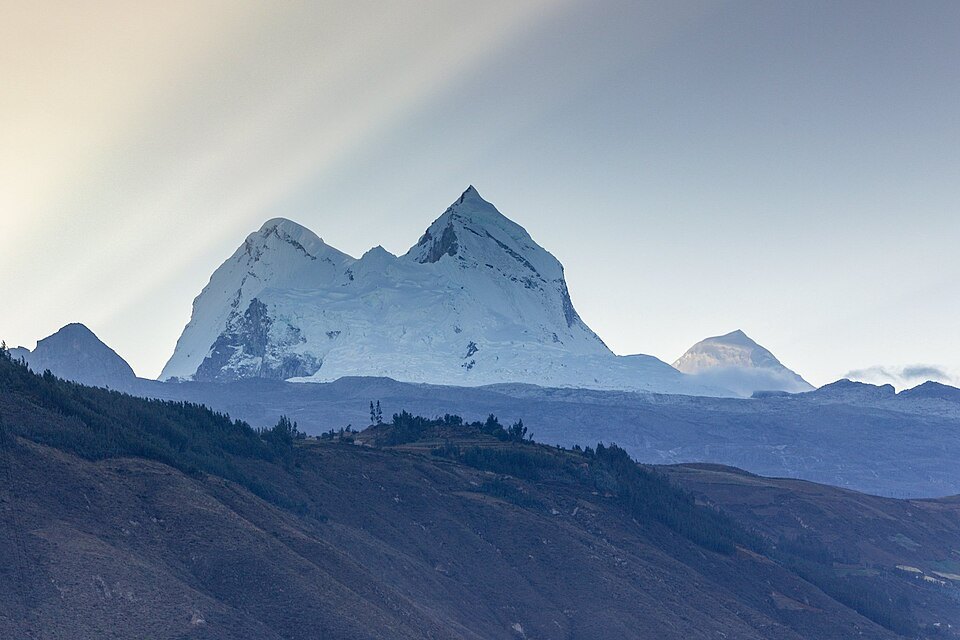
Morphology and Quechua Name
The Quechua name Tullpa Rahu, belonging to the Huailas dialect, precisely describes the arrangement of the four peaks of Huandoy: grouped like the stones of a traditional Andean hearth. This image, combining the geometry of the massif with a domestic reference from local culture, contrasts with the European geographical names that modern cartography has imposed on most summits of the Cordillera Blanca. The maximum elevation of 6,395 m a.s.l. corresponds to the north summit, the highest of the group.
Huandoy is the third highest mountain in the department of Áncash, a department that also contains Huascarán, the highest peak in Peru. This altitudinal hierarchy, within a region that concentrates the principal tropical summits on the planet, places Huandoy among the most significant high-altitude objectives in the Peruvian Andes.
First Ascent: German Expedition of 1932
The first ascent of Huandoy Norte was made on 12 September 1932 by German alpinists Erwin Schneider and Erwin Hein, members of an expedition of the German Alpine Club (Deutscher Alpenverein). The route followed ascended via the southern slopes of the north summit, which reaches 6,395 m a.s.l. This expedition was part of a broader campaign: the same members of the Austro-German group also made the first ascents, in that same season, of Huascarán Sur and Artesonraju.
The year 1932 thus represents an extraordinary milestone in the history of mountaineering in the Cordillera Blanca: in a single expedition, first ascents of several of the highest peaks in the tropical Andes were chained together. The achievement of Schneider and Hein on Huandoy Norte was part of that collective drive, which coincided with the period of most systematic alpine exploration of the range by European clubs.
Approach via the Llanganuco Valley
Huandoy is accessible via the Llanganuco valley, in the province of Yungay. This glacial valley, carved between Huascarán to the south and Huandoy itself to the north, is one of the best-known high-mountain corridors in the Cordillera Blanca. The Llanganuco valley acts as the geographic axis that organises access to several of the great nevados in the northern sector of Huascarán National Park, within which the Huandoy massif lies.