
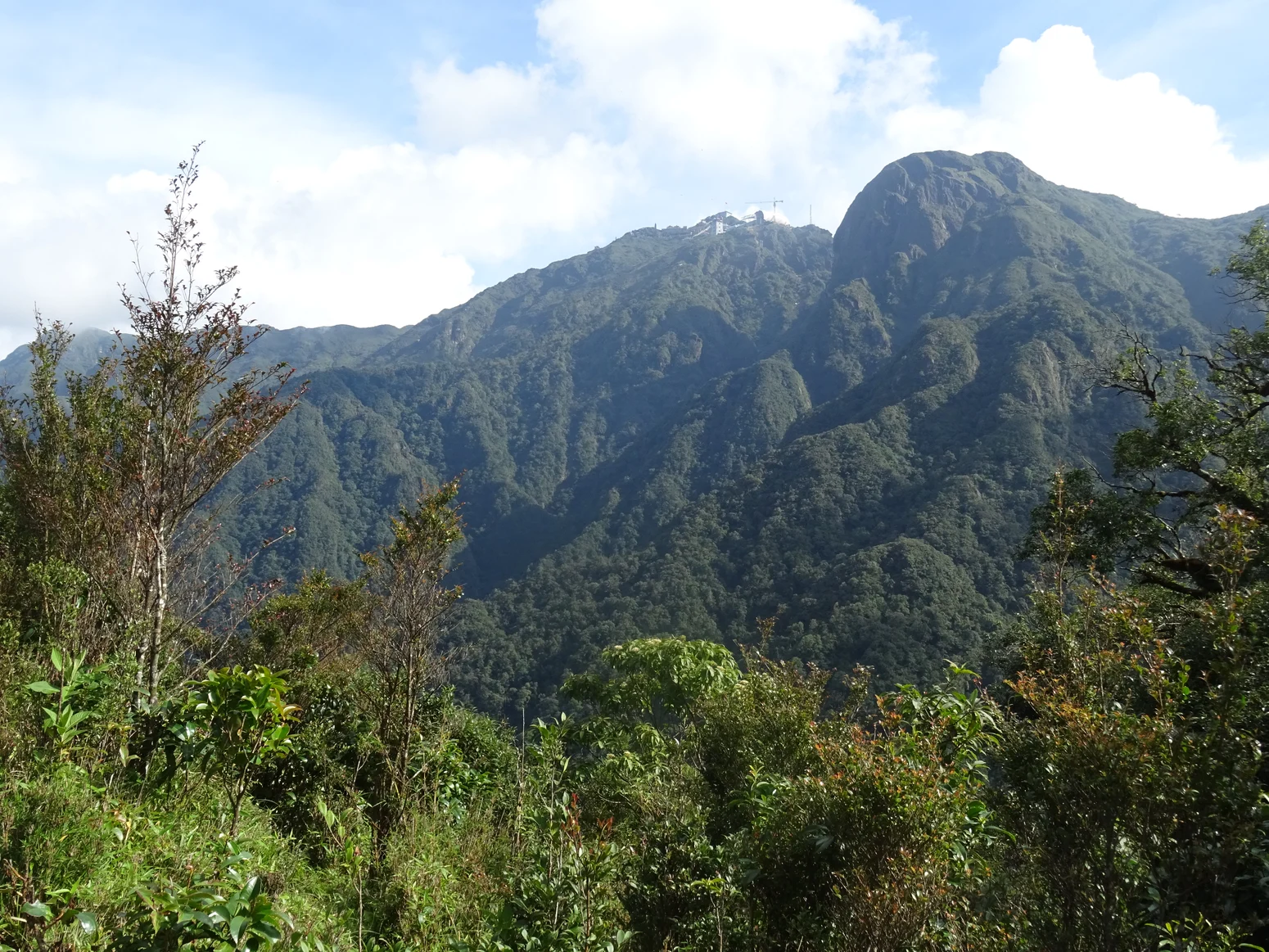
A Layered Forest Landscape
Hoang Lien Sa Pa National Park, which surrounds the massif, was designated an ASEAN Heritage Park on 18 December 2003. Its vegetation rises through distinct belts: submontane forest gives way to montane and then subalpine forest as altitude increases, producing a gradient of habitats that supports an unusually rich inventory of species. Among the conifers documented within the park is Fujian cypress (Fokienia hodginsii), a rare species native to southern China and northern Indochina, alongside other conifers found at these elevations.
The park's fauna carries clear Himalayan affinities. Gould's shortwing is among the birds recorded there — a species whose range connects these Vietnamese highlands to the broader montane zone extending westward across the region. These ecological relationships place Hoang Lien Sa Pa within a broader biogeographical story that reaches well beyond Vietnam's borders.
The Summit and Its Approaches
For much of the mountain's modern climbing history, reaching the top required a multi-day trek through the forest. That character of the ascent changed when a cable car system opened in 2016. The cable route extends roughly six kilometres and connects the lower slopes to the high terrain near the summit.
A separate system, the Muong Hoa mountain railway, departs from central Sa Pa and represents a distinct piece of infrastructure from the cable car. Near and below the actual summit platform, a complex of gardens and pagodas has been developed, through which visitors pass before completing the final leg to the top. The railway, the cable car, and the summit complex each occupy a different part of the experience rather than forming a single continuous route.
Sa Pa and the Regional Context
The town of Sa Pa serves as the principal base for Fansipan and lies within Lào Cai province in northern Vietnam. Its position in the Hoàng Liên Sơn range — a chain running roughly northwest to southeast near the border with China — situates it within the same upland arc that has historically connected the highland cultures and ecosystems of mainland Southeast Asia to those of the eastern Himalayan foothills. This geographic placement is part of what gives both the mountain and its national park their broader natural and cultural weight.