
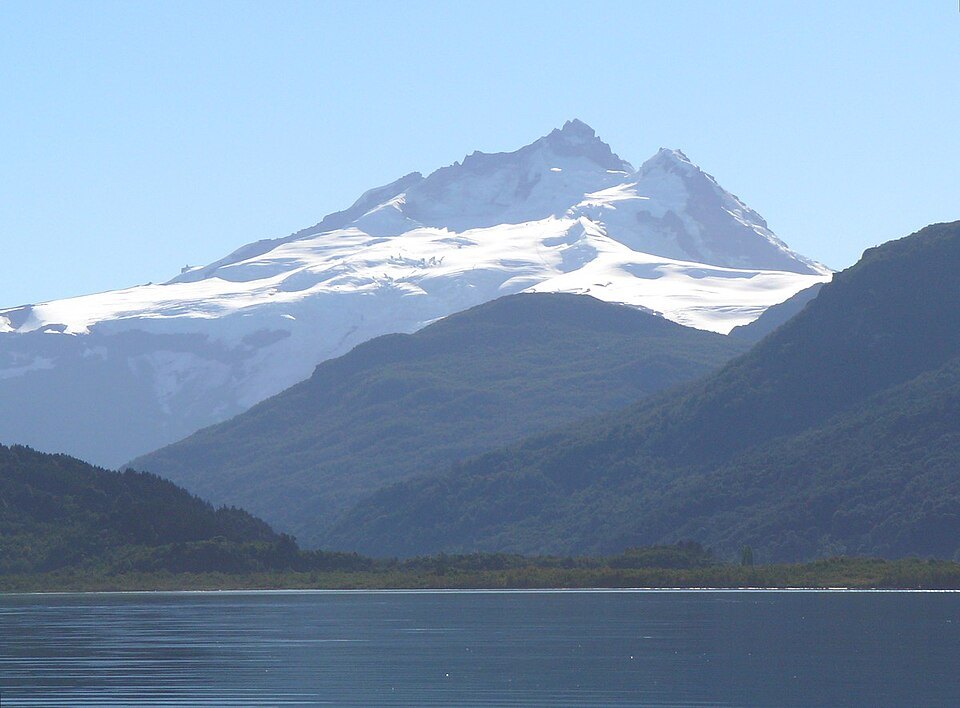
Pleistocene formation and volcanic origin
Tronador is a volcano whose activity belongs to a remote geological past. Its formation process, associated with the development of the Andes during the Pleistocene, extended over nearly one million years, between approximately 1.3 million and 340,000 years ago. This long eruptive history built the volcanic edifice seen today on the Patagonian border, although no recent volcanic activity has been recorded. Its classification as geologically inactive distinguishes it from other southern Andean volcanoes that retain fumarolic or eruptive activity.
Glacial action as a shaping agent
If volcanism built Tronador, glaciers have been patiently dismantling it on a geological timescale. The intense glacial erosion that has acted on its flanks over millennia has progressively steepened and reduced them, transforming what was once a compact volcanic edifice into a mountain of abrupt slopes and irregular morphology. The glaciers that persist on the peak today are simultaneously the testament to that process and its active agents: they continue to shape the underlying volcanic rock through abrasion, plucking, and the advance and retreat of their ice tongues.
This interplay between volcanic construction and glacial destruction is one of the most defining characteristics of Tronador as a subject of geomorphological study. The mountain visible today from Lago Mascardi is, strictly speaking, a reduced and sculpted version of the one that existed at the end of the Pleistocene.
A Patagonian border between two countries
Tronador's position on the border between Argentina and Chile near Bariloche gives it a geopolitical dimension in addition to its natural one. The mountain serves as a landmark in the southern Patagonian cordillera, a point where the international boundary overlaps with one of the most recognizable glacial landscapes in South America. Its surroundings, integrated within the context of Nahuel Huapi National Park on the Argentine side, form part of one of the oldest natural area protection systems in Argentina.