
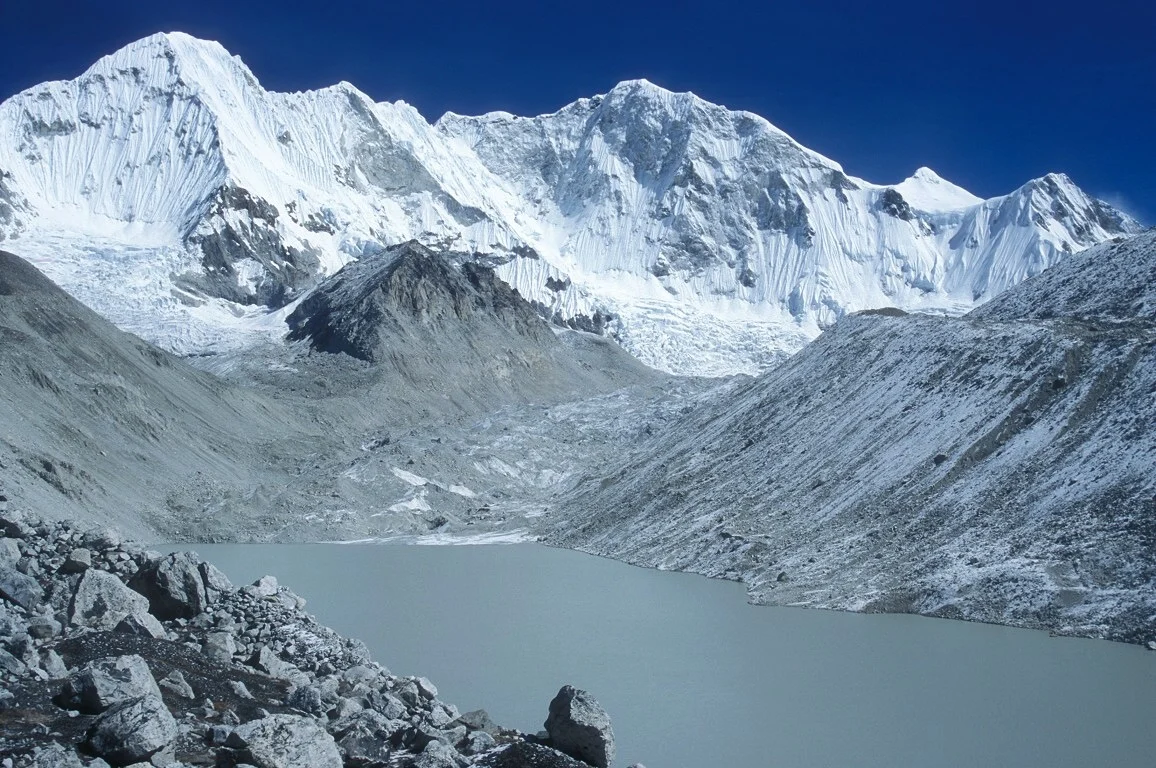
Valley Exploration and First Ascent
The first ascent of Baruntse came as a secondary achievement of a broad exploratory mission. Edmund Hillary led a 1954 New Zealand expedition that approached the Makalu area by way of the Arun River, then split into parties that explored and mapped terrain around the Chayang, Iswa, and Barun valleys. It was during this campaign that Colin Todd and Geoff Harrow reached the summit on 30 May 1954, making the first recorded ascent of the peak.
Two days later, on 1 June 1954, Bill Beaven and George Lowe repeated the summit by the same ridge line. Both ascents followed ridge terrain rather than a new technical route to a separate summit, a distinction that matters when reading the range of expedition accounts published in the years following. Lowe wrote accounts of the Barun expedition that appeared in both the American Alpine Journal and the Alpine Journal in 1955, providing the primary contemporary record of these climbs.
The West Face and Later History
Decades after the ridge-line first ascents, the peak attracted attention for its steeper faces. The American Alpine Journal published a firsthand account of a Russian team's 1995 ascent of the west face, a line that represented a markedly different technical challenge from the original ridge approaches. That account also cited earlier ascents of the main mountain as having followed ridge lines, offering a useful retrospective framing of Baruntse's climbing history from within the expedition literature itself.
Geography and Nomenclature
Nepal's Department of Tourism records the peak as Barun Tse. The New Zealand Alpine Club's Kiwi Pioneers bibliography situates the mountain on the watershed between the Imja, Barun, and Hongu valleys, a position that makes it a geographic hinge point among some of the most heavily glaciated terrain in the eastern Himalaya. Baruntse is a distinct summit, separate from both Baruntse North and the neighbouring giant Makalu, though all three share the broader Barun region as their geographic context.