
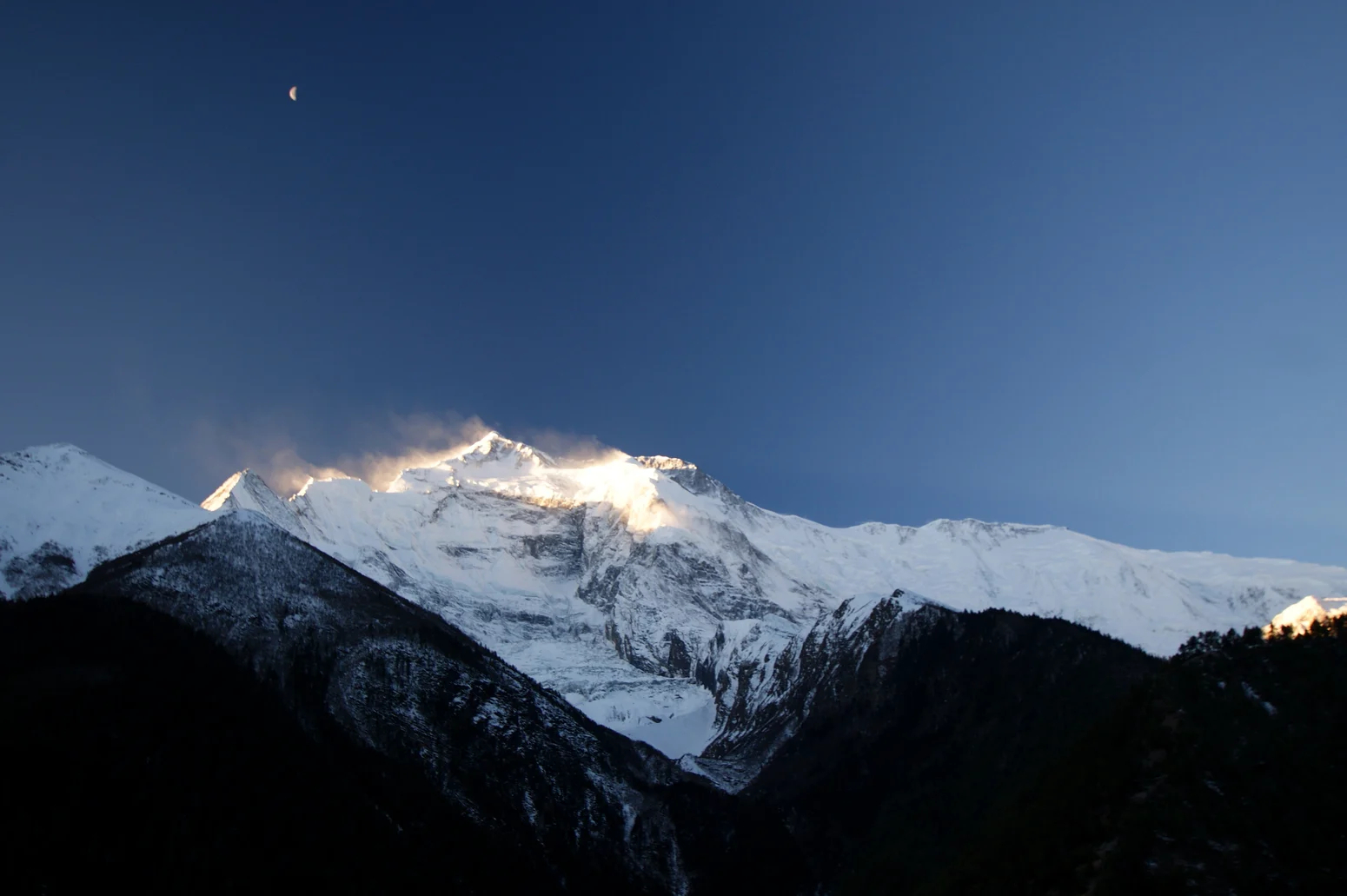
A Summit Defined by Its Ridge
When the 1960 British-Indian-Nepali expedition led by J. O. M. Roberts approached the mountain from the north, the team initially followed the same line that had already been used to reach Annapurna IV, before traversing west along the connecting ridge toward the higher summit. On summit day, Grant, Bonington, and Ang Nyima set out from Camp V while the team established Camp VI farther along and below; the shared approach and the exposed ridge traverse between the two peaks give Annapurna II a logistical character distinct from mountains that rise in greater isolation.
Roberts organised the expedition as a joint endeavour drawing on services from Britain, India, and Nepal. The team employed supplementary oxygen on the upper mountain. Two Sherpas carried equipment forward and established Camp VI while the summit trio climbed, illustrating how the high-ridge logistics relied on coordinated effort across multiple camps above the north approach.
The First Ascent, 17 May 1960
On 17 May 1960, Richard Grant, Chris Bonington, and Ang Nyima Sherpa reached the summit of Annapurna II at 4:30 p.m., completing the first ascent, and returned to Camp VI at nightfall. Roberts, writing in the American Alpine Journal, describes the final stages as a traverse along the high connecting ridge from the direction of Annapurna IV. The account places this ascent within a broader expedition that treated both Annapurna II and Annapurna IV as objectives within the same high massif.
Second Ascent and Continued Expeditions
The second ascent of Annapurna II was achieved on 22 October 1969, when two members of a Yugoslav expedition reached the summit via the northern approach. Other members of the same expedition also reached Annapurna IV during the same season, reinforcing the tendency of teams to treat the two summits as companion objectives linked by their shared approach terrain.
The first winter ascent of Annapurna II was completed on 4 February 2008, via the northwest face of Annapurna IV and then along the west ridge of Annapurna II, a line that illustrates how the two summits are linked in the practical history of Himalayan climbing on this part of the massif.
Standing in the Annapurna Himal
Annapurna II is catalogued in Nepal's government register among the regulated summits of the Annapurna Himal, and carries the identifier ANN2 in the Himalayan Database expedition archive. At 7,937 metres it is distinct from both Annapurna IV and Annapurna I, the 8,091-metre summit to its west.