
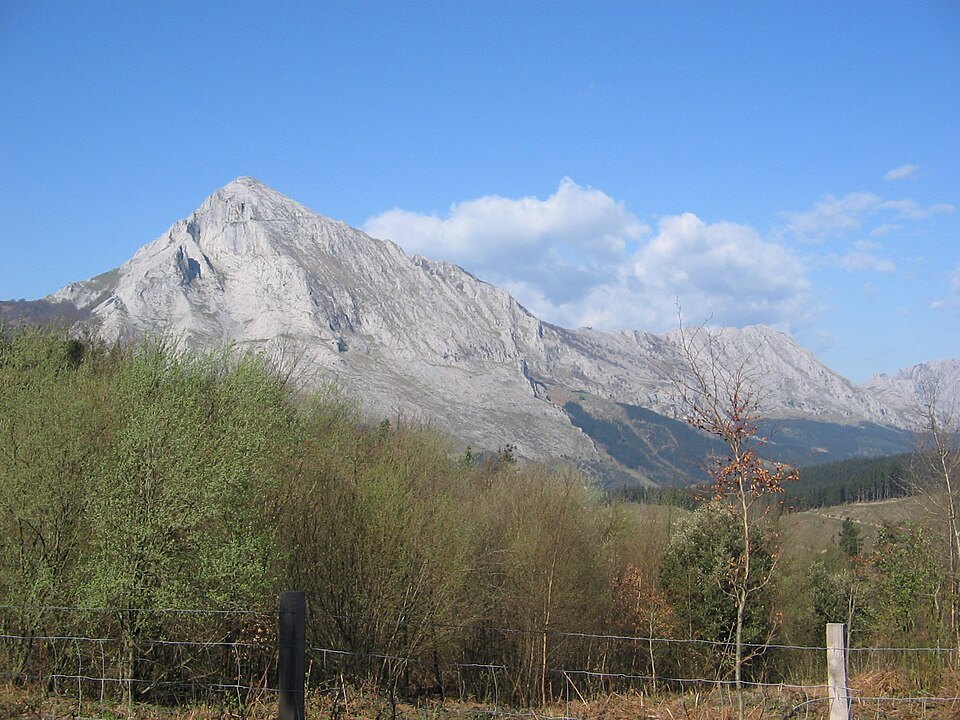
Position and relief: between Biscay and Álava
Anboto stands on the boundary between the provinces of Biscay and Álava, within the mountain group known as the Basque Mountains. At 1,331 metres, it is the most prominent summit of the Duranguesado mountains or Sierra de Amboto, a chain that visually dominates the Duranguesado comarca. Its position on the border between two provinces has historically reinforced its character as a shared territorial landmark.
Mari, the Lady of Amboto
Anboto is one of the best-known mountains in the Basque Mountains not for its height but for its central place in Basque mythology. Tradition identifies it as the principal dwelling of Mari, a female deity associated with the forces of nature. Because of this connection, Mari is given the epithet "the Lady of Amboto." This mythic presence has shaped, over centuries, the way communities in the surrounding area have named, inhabited and interpreted the mountain, endowing the summit with a symbolic dimension that goes far beyond its physical reality.
Names and designations
The mountain appears under several designations: Amboto in Spanish, Anboto in the standard Basque spelling, and also as Peña Anboto or Anboto haitza, the latter being the Basque term for "rock" or "crag." The coexistence of these forms reflects the linguistic and cartographic history of the Basque Country, where Spanish and Basque have recorded place names in parallel over time.