
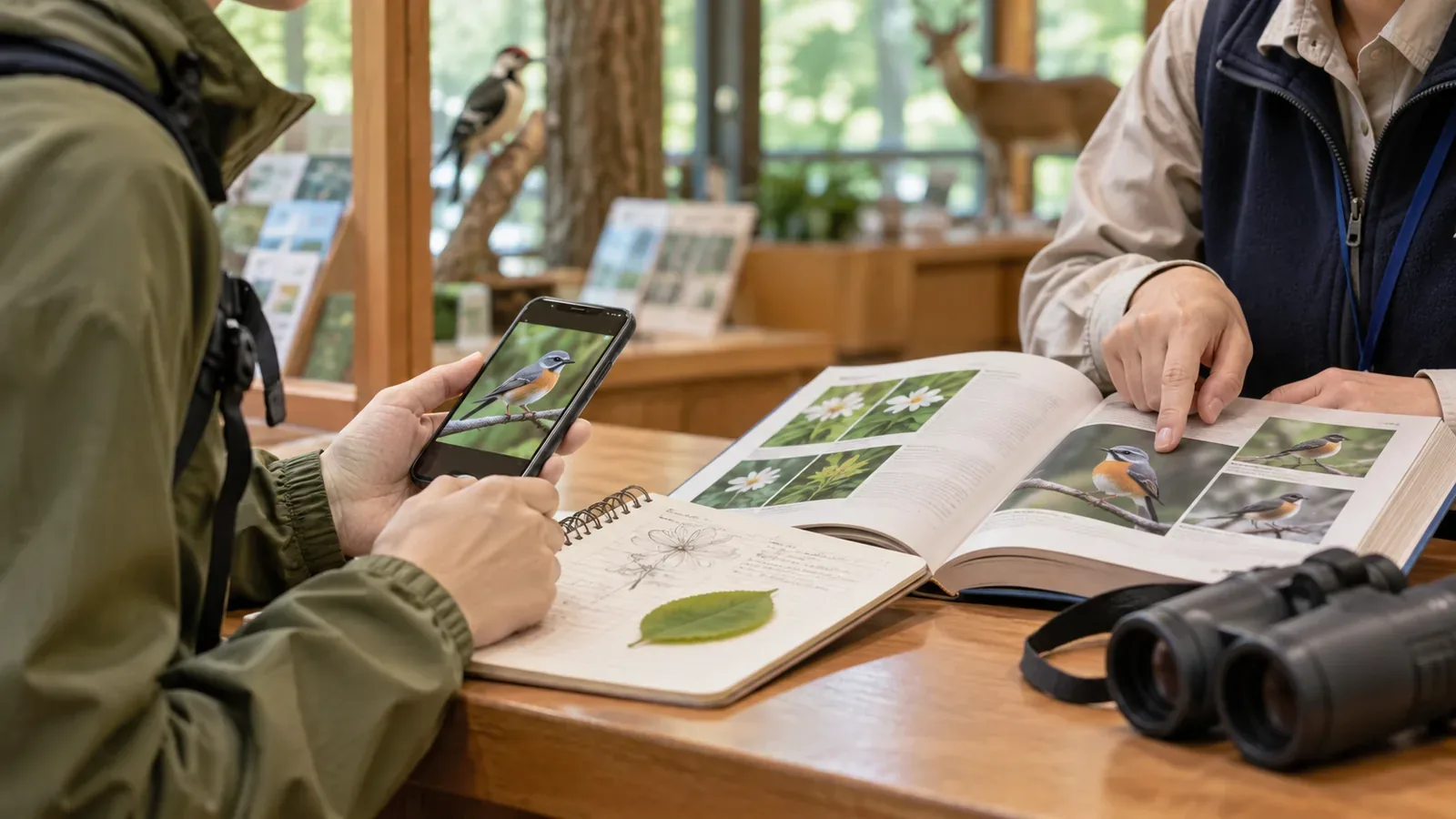
After a hike, write down where you were and what you noticed, then use the center's displays, lists, or newsletters to narrow down the possibilities. Official pages from Lake Shikotsu, Nasu Highland, Mitake, and Tanzawa as of November 4, 2026 show that the resources differ from one center to another. This guide covers what to record, how to fit a visit around closing time, where to look at each center, and what to ask staff. Check the resources for the mountain and facility you plan to visit.
Record what you saw and where you saw it
If you want to take a note or photo, stop where the footing is stable and you can stay out of other people's way. If there is nowhere suitable, wait. It is often easiest to make notes after you have finished the hike and reached a safe place at the parking lot or station, while the details are fresh.
Start with three things. First, record the location, including roughly how far you had walked from the trailhead and whether you were beside the trail, in the open, in the woods, or near water. Second, note observable features such as color, size, shape, what the leaves or feathers looked like, any sounds or calls, and how it moved. Third, record the date, approximate time of day, and weather.
If you have a guess at the name, write it in a separate “possible identification” field. Keeping your guess separate makes it easier to compare the observed features with other candidates later. The features and location also help staff match what you saw to displays or reference material.
Give the observation a broad category such as animal, flower or fruit, or something else. That helps you choose a source later. For example, Tanzawa's official site has separate lists for mammals, birds, reptiles, amphibians, and insects, and a separate section for flowers. A rough category is enough to get you started. Before your next hike, try writing three lines about something you remember from the last one. That will give you an idea of what to pay attention to on the trail.
Compare your descent time with closing time
Use your estimated finish time and the center's closing time to decide whether you can visit after the hike. Check the official page for that center's opening hours and closure days.
Lake Shikotsu is open from 9 a.m. to 5:30 p.m. from April through November and 9:30 a.m. to 4:30 p.m. from December through March. It closes on Tuesdays from December through March, or the following day if Tuesday is a public holiday, and over the New Year period. Nasu Highland lists 8:30 a.m. to 5:30 p.m. from April through November and 9 a.m. to 4:30 p.m. from December through March. Since April 2026, the center generally closes on Wednesdays, or the following day if Wednesday is a public holiday. It opens on Wednesdays during Golden Week, Obon, the autumn foliage period and the year-end holidays. Mitake is open from 9 a.m. to 4:30 p.m. and closes on Mondays, or the next day when Monday is a holiday or Tokyo Citizens' Day. It also closes from December 29 through January 3. In Tanzawa, Hadano lists 9 a.m. to 4:30 p.m. with a year-end closure. West Tanzawa lists 8:30 a.m. to 4:30 p.m., closing at 4 p.m. from December to March. It closes Mondays, or the next working day when Monday is a public holiday, and December 29 to January 3. Confirm the schedule for the center you plan to visit.
Lake Shikotsu and Nasu close an hour earlier from December. A schedule that worked in summer may leave too little time in winter. Start with the time you expect to finish descending, then add travel time from the trailhead to the center and the time you want to spend there. Compare the result with closing time. If there is no comfortable margin, plan to skip the visit.
Tanzawa's official site asks hikers to get down before sunset and carry a light. Descend at a safe pace even if it means missing the visitor center. If you will be too late, look up your observations later on the official website or center blog. Keep the option to turn back or descend early if conditions call for it.
Check parking as well. Nasu Highland's FAQ says parking is unavailable outside opening hours. If you leave your car there, compare your return time with closing time. Other facilities have their own parking rules. Check the appropriate official page.
Find the right reference for each visitor center
Centers provide different ways to look up a sighting, including exhibits, species lists, newsletters, and blogs. The official pages show where you can start.
Mitake has ground-floor exhibits on the plants and wildlife you can see at that time. It says interpreters prepare information on hiking trails and local nature. It also offers crafts using materials such as nuts or seeds and slideshows. You can compare your notes with exhibits from around the time of your visit.
The Tanzawa site has a wildlife list for mammals, birds, reptiles, amphibians, and insects and a flower calendar. Its individual center blogs provide seasonal nature information. Start with the relevant category and check the season and area described in the text or photo. Lake Shikotsu provides a PDF pocket guide and a newsletter published in the middle of each month. The October 2026 issue, Vol. 202, was listed on November 4. Open the actual document and check what it covers and when it came out.
Nasu Highland's FAQ says the center provides nature and visitor information for the Nasu-Kashi area. If you want advice, tell staff where you were and what you want to learn. A photo or a recollection may leave too few clues for an identification. You can also ask which field guides or local nature resources to consult next.
At Tanzawa, for example, the five wildlife categories are separate from the flower calendar, so use the section that fits what you saw. Seasonal information changes, so look for a newsletter issue or blog post close to the date of your sighting.
Record your findings in a three-column table with the features you observed, the date you saw them, and the source you checked. Resources vary by center, so the source column gives you a way to find the evidence again. Start with your notes, check the official newsletter or blog, and ask at the counter if you still have questions.
Share the features and location and record possible identifications
Show staff the notes you made. For example, “Around noon on this date, about an hour from the trailhead, I saw some reddish fruit. Is there anything like it in the exhibits or reference material?” Give the features and location first so staff can compare them with what is on display or in a guide.
Tanzawa's official site directs visitors to the centers for the latest information and advice on land leeches, which are active from around April through autumn. That shows that centers answer some questions about local nature. It gives no details on species identification requests, so ask whether staff can help with your kind of sighting.
Write down the answer and how confident the staff member was. If they offer a possibility, record it as “looks similar to” and ask what features or source support it. Leave the name open if the photograph or your memory lacks enough detail. A possible identification alone gives too little information to judge whether something is safe to touch or eat. Leave it alone.
Follow the facility's rules while you are there. Nasu Highland is free to enter and asks visitors to eat and drink only on the wooden deck. There are no trash cans, and the vending machine sells drinks only. Finish your food or drink before sitting down with your notes and plan to carry your trash out.
Summary
Record the location, features, and time. Visit if you can comfortably make it before closing, and write down how certain any identification is. Make notes from a safe place where you can stop, or after the hike. If the center will be closed, use official newsletters, blogs, or other resources you can consult later. Before your next hike, look up the hours, closure days, and available reference material for a center you often pass and put them in a simple table.
References and sources
- Lake Shikotsu Visitor Center
- Nasu Highland Visitor Center FAQ
- Mitake Visitor Center | Tokyo Metropolitan Government Bureau of Environment
- Tanzawa Visitor Centers | Kanagawa Park Association
- Nasu Highland Visitor Center, hours and closure rules from April 2026
- Hadano Visitor Center, hours and access
- West Tanzawa Visitor Center, hours and access