
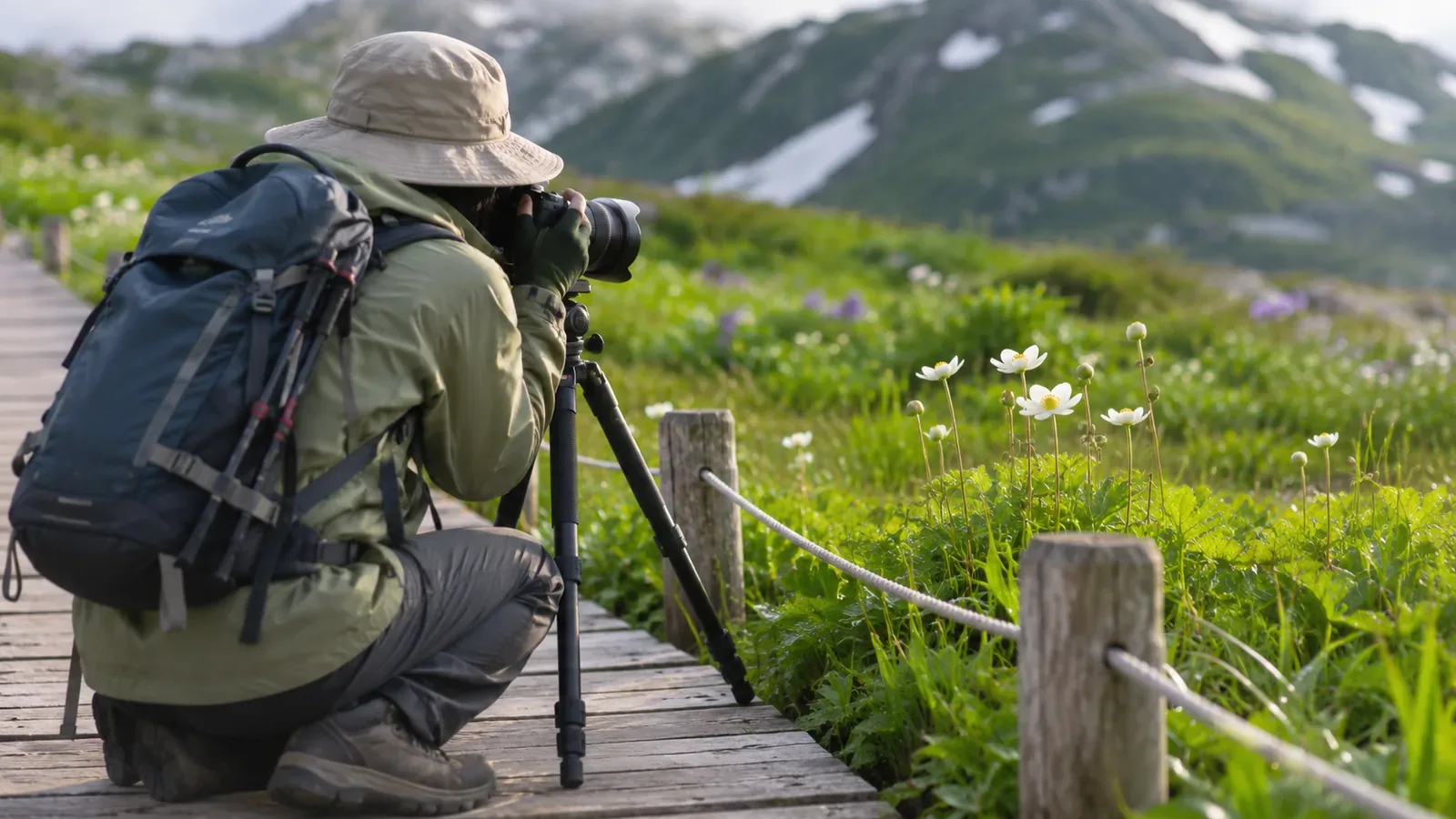
Choose a shot you can take from the trail when photographing flowers. If your lens can’t reach, skip the shot and stay off the vegetation. Guidance from the Oze Preservation Foundation, Fukushima Prefecture and Japan’s Ministry of the Environment shows what to look for in a photo spot, including where you and your gear will go. Check the latest rules from the manager of the place you’ll visit.
Keep feet and gear off the vegetation
The Oze Preservation Foundation asks visitors to keep tripods out of the wetland and avoid putting their feet in it while sitting on the boardwalk or at a rest area. Fukushima Prefecture also asks visitors to stay out of the wetland and keep trekking pole tips and tripods off it.
Keeping off vegetation includes the tripod feet, your feet when sitting and the tips of trekking poles. The foundation asks visitors to cap their pole tips and keep them on the trail. It explains that sharp tips damage plants and soil and wear out the boards faster. The same guidance asks visitors to leave animals, plants, insects, wild vegetables, fallen leaves and branches where they are.
The foundation says Oze’s boardwalks protect the wetland, and Fukushima Prefecture explains they were installed in response to damage. The boardwalk gives people a route through the wetland while protecting it. Our suggestion is to decide before the trip that any shot you can’t take from the trail can wait for another day. Then it’s easier to choose a spot when you arrive.
Choose where to photograph from the trail
Plan in three steps: find a section of trail, check your gear and choose a place to stop.
First, before the trip, look for stretches where flowers are visible from the trail. Use maps, official guidance and previous photos to find likely places. Plan for the view from the trail. If you have only a few suitable spots, take your time with those.
Second, choose a lens and a way to shoot from the distance you’ll have. Check the functions and controls on your own equipment before leaving. Try taking a picture from a pavement near home with your feet inside the edge. See how close you can get and what fits in the frame, then use that as a guide outdoors.
Third, choose where to stop before raising the camera. The Oze Preservation Foundation asks visitors to walk on the right and give way to uphill hikers. Choose somewhere people can pass safely in both directions. Look behind you before you stop.
Take care with tripods. Oze asks visitors not to set them up in the wetland. Check whether they’re allowed on the particular stretch of boardwalk. The foundation recommends talking to people at visitor centres, mountain huts and local guides. Check locally, and if you can’t confirm permission, take a handheld photo where it’s safe to stop or skip it.
Fukushima Prefecture warns that wet boards can be slippery. Stepping backwards for a shot or moving while looking through the viewfinder could send you into the wetland if you slip. Stop and check your footing before you raise the camera.
Watch wild birds quietly from a distance
In a May 2019 report, staff from the Ministry of the Environment’s Tateyama office described visitors getting too close to ptarmigans or stepping into vegetation to watch or photograph them. The report explains that the plants provide feeding and nesting areas and asks visitors to avoid following the birds or entering the vegetation.
The writer kept a distance and used a telephoto lens. The bird then approached on its own. Ptarmigans can be seen in pairs at that time of year, and the report asks visitors to watch quietly. It’s an example of how keeping your distance and waiting can give you a photo. The observation is from Tateyama Murodo in spring 2019. Check the latest guidance on distance for the bird and the place you visit.
Set a limit on how long you’ll wait. If the bird stays at a distance, finish with the pictures you can take from there. Stay on the trail and give the bird room to move. If it doesn’t come closer, move on when your allotted time is up.
Set a turnaround point even if you haven’t got the photo
Leave enough time to descend when you plan to wait for flowers or birds. Ibaraki Prefectural Police advises planning to finish before dark and carrying a headlamp or other light. Even at a suitable spot, stop if daylight, weather or a companion’s condition changes. Keep to the route and schedule when the shot you wanted doesn’t come together.
Try writing out your schedule the day before. Set aside a separate block for photography, in addition to walking and breaks. Work out when you’ll finish if you use the whole block, and check whether it’s well before the sunset time you looked up. If the margin is too small, reduce the time for photography or shorten the route.
Decide where and when to turn back even if you haven’t taken the picture. Include it in the plan you share with family or colleagues. Ibaraki Prefectural Police also recommends telling someone your route and expected return time. Make a note of flowers you missed for a future visit and leave on time. A brief note of the flowers or scenery you did see from the trail can help you plan the next trip.
Choose a picture you can take from the trail
Keep tripod feet, trekking poles and your own feet out of wetlands and vegetation. Watch birds at a distance and follow local guidance. Ask the site manager if equipment use on a boardwalk is unclear. Keep it packed if you can’t confirm permission. Before leaving, look for trail sections with a view of the flowers, decide what to bring and where to stop, and set a time to finish taking photos.