
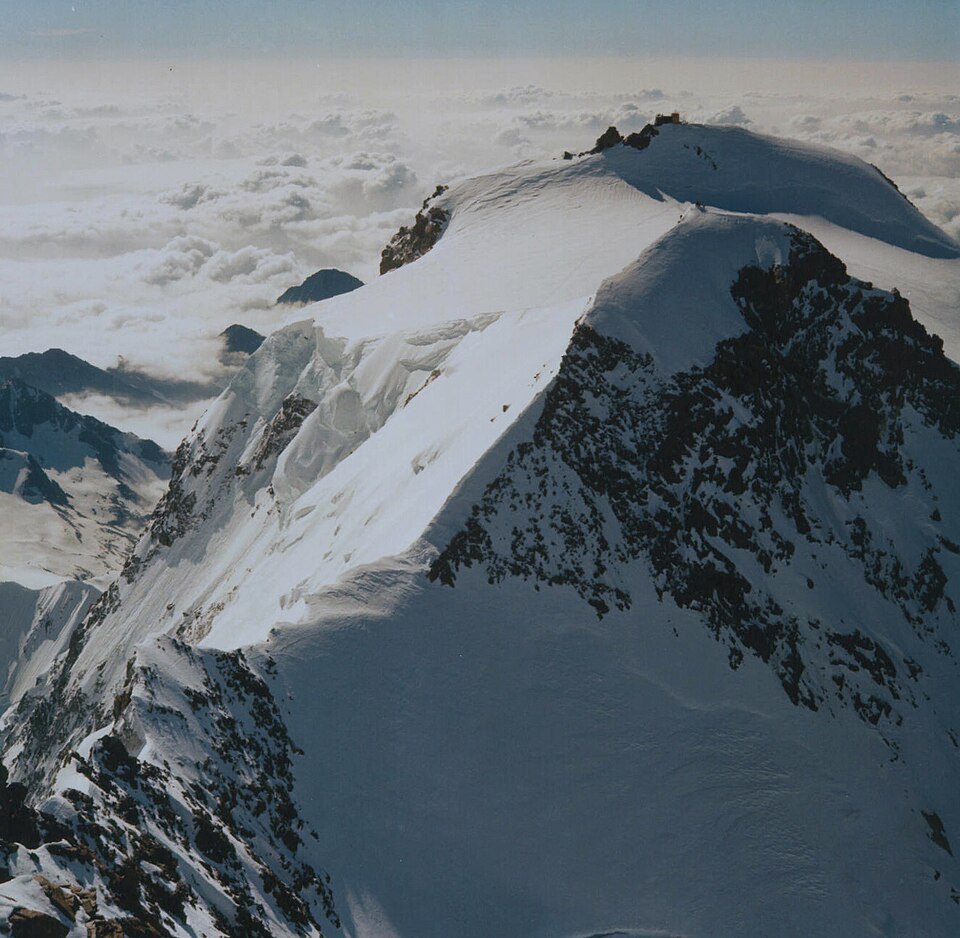
A position at the roof of Europe
Punta Zumstein lies within the Monte Rosa massif in the Pennine Alps, on the border between Italy and Switzerland. Its elevation places it third in the entire Alpine arc after Punta Dufour (4,634 m) and Punta Nordend (4,609 m), a circumstance that places it squarely among the major UIAA-recognised 4,000-metre summits of the Alps. This proximity to summits of absolute rank also defines the morphological context of the mountain: it forms part of a cluster of closely grouped peaks of the highest order that compose the unmistakable profile of Monte Rosa as seen from the Piedmontese valleys.
The east face: the highest in the Alps
The eastern flank of Punta Zumstein drops more than two thousand metres to the Monte Rosa glacier, in the upper Valle Anzasca. This face, oriented east-north-east, is classified as the highest in the Alps and the only one of Himalayan character in the entire Alpine arc — a distinction that underlines its exceptional scale by European standards. Routes of great alpinistic ambition were opened on it over the years; however, reporting notes that those routes are no longer climbable today owing to a massive ice collapse that occurred beneath the group of rocks to which local guides had given a specific name. The face thus remains a testament to the growing instability of the high Alpine environment, as well as to its grandeur.
The first ascent of 1820 and its participants
The first ascent of Punta Zumstein was made on 1 August 1820 by a party comprising Joseph and Johann Niklaus Vincent, Joseph Zumstein, Castel, Molinatti and others. It is worth noting that the participants, though bearing names that might suggest Swiss or French origins, were in fact natives of Gressoney, a locality that at the time formed part of the Kingdom of Sardinia: a clarification that roots this mountaineering achievement in the Walser identity of the valley and in the pre-unification political context of the region.
The mountain was named after Joseph Zumstein by the general and topographer Baron Ludwig von Welden, a key figure in the scientific surveying of the Monte Rosa massif in the early nineteenth century. The name thus constitutes a direct link between the history of Alpine exploration and that of European military cartography: von Welden chose to honour with the naming of the summit the expedition companion who had contributed decisively to knowledge of it.
One name, three languages
The summit is known as Punta Zumstein in Italian and as Zumsteinspitze in German, names that reflect the dual linguistic and geographical allegiance of the Monte Rosa massif, a border territory between Italian Alpine culture and the German-speaking Valais. This onomastic duality is common to the peaks of the group and reflects the historical layering of peoples, kingdoms and states that have succeeded one another on these mountains, each leaving its own trace in the place names.