
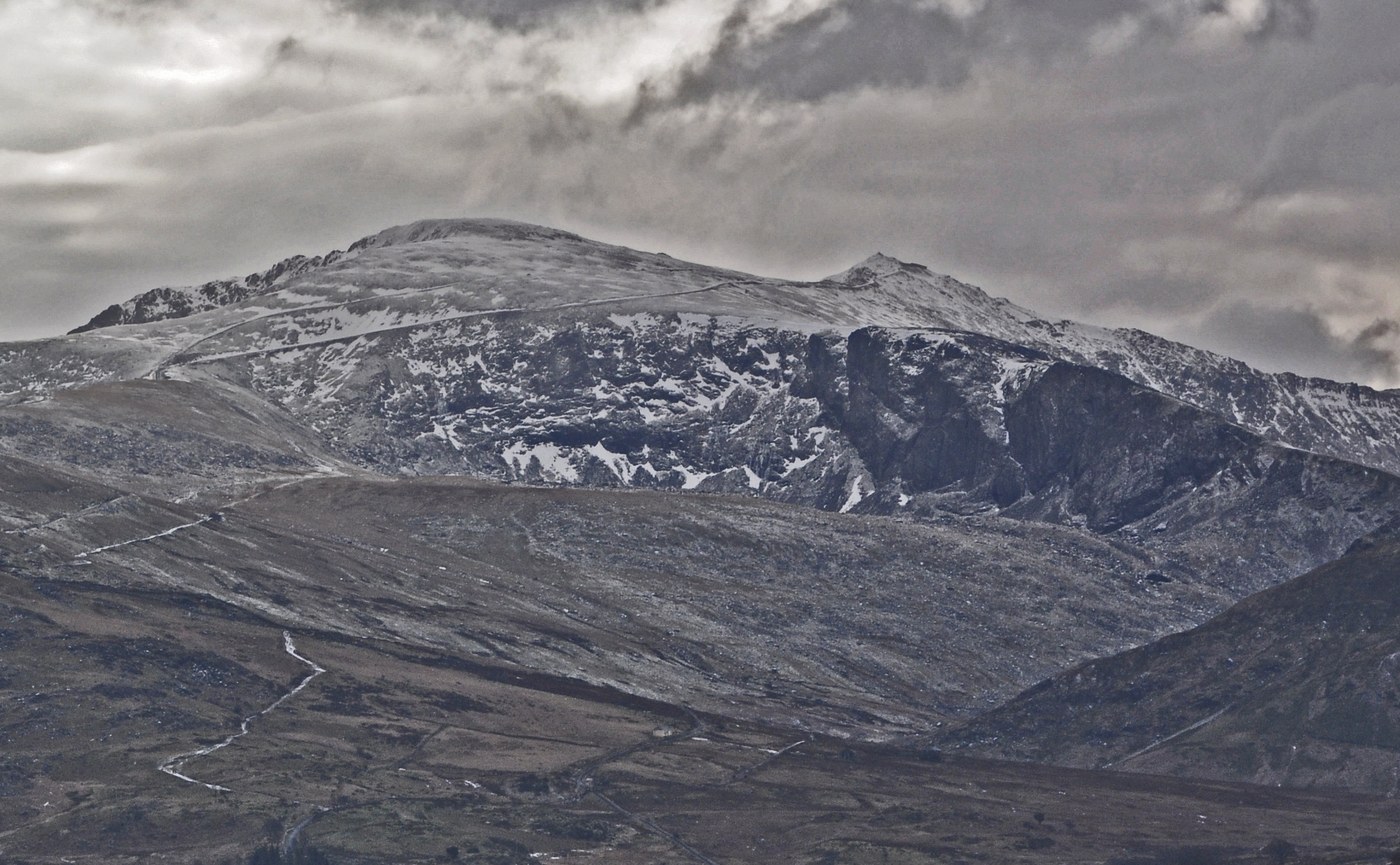
Rock and Ice
The mountain's fabric is a mixture of volcanic and sedimentary rocks, laid down long before any human presence and later reshaped by the sustained pressure of Pleistocene glaciation. Moving ice cut the corries and sharp ridges that give the summit its distinctive profile from every approach. The lakes Llyn Llydaw and Glaslyn occupy basins beneath the summit, occupying hollows scoured directly into the bedrock by glacial action — among the clearest visible evidence of that ancient ice across the whole massif.
The summit elevation of 1,085 m is the figure given in the Office for National Statistics listing of the highest mountains in the United Kingdom, confirming Yr Wyddfa's status as the highest point in Wales. The Welsh name, Yr Wyddfa, is the primary designation; Snowdon is the widely used English alternate name.
The Llanberis Rack Railway
Construction of the Snowdon Mountain Railway began in December 1894 and ran for fourteen months, concluding in February 1896 with the line opening to passengers that same year. The railway climbs from Llanberis on a rack-and-pinion system, a Swiss-influenced engineering solution suited to gradients that would defeat conventional adhesion railways. The original locomotives used on the line were of Swiss manufacture, reflecting the direct import of alpine railway technology to the Welsh hills.
The railway's construction timeline — just over a year to lay track on steep mountain terrain — represents a substantial feat for the period. Its opening in 1896 made the summit accessible to passengers who would not otherwise attempt the ascent on foot, fundamentally changing who could reach the top of the highest mountain in Wales, and establishing a relationship between the summit and the town of Llanberis that has continued for more than a century.
The Summit Landscape
Below the peak, the corrie lakes Llyn Llydaw and Glaslyn sit in their glacially formed bowls, fed by the high ground above and draining away from the summit massif. Their presence reflects the same ice-carved topography that shaped the ridges above — the corries, the headwalls, and the intervening arêtes that make Yr Wyddfa's upper mountain a textbook example of Pleistocene glacial landforms in the British uplands. The interplay of volcanic rock, sedimentary strata, and ice-sculpted relief gives the mountain a geological variety that the broader Eryri national park landscape shares but that the summit area concentrates.