
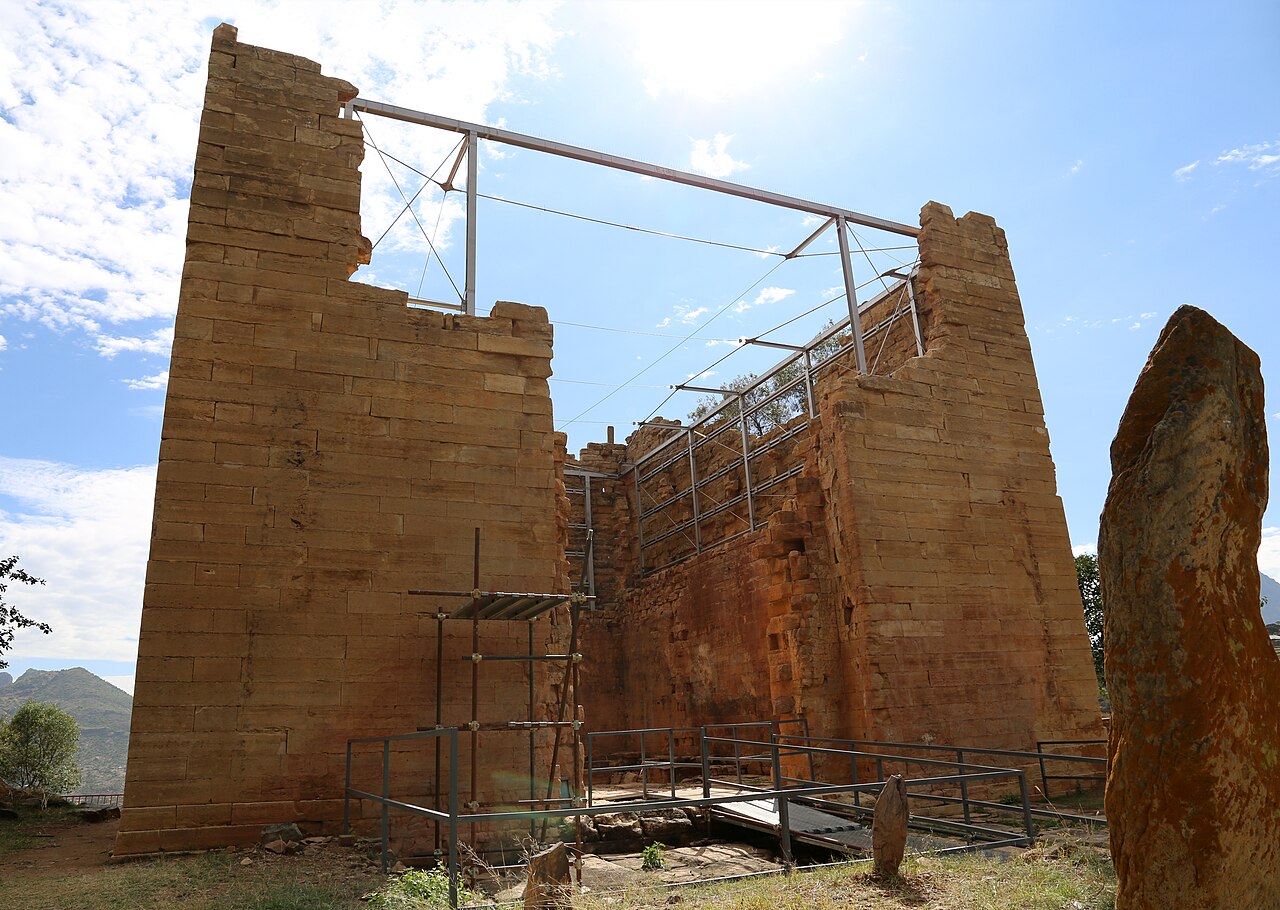
Great Temple of Almaqah on the Hilltop
The Great Temple, dedicated to the South Arabian moon deity Almaqah, was constructed from large dry dressed stone blocks laid without mortar, a technique that has allowed its walls to stand to considerable height. Dating to about the seventh century BCE, it represents one of the best-preserved pre-Aksumite religious structures known. An Ethiopian Orthodox church stands separately within the broader site and remains in active use as a sacred place of worship today.
Grat Beal Gebri and the Rock-Cut Tombs
Below the hilltop temple, the Grat Beal Gebri complex forms a distinct monumental building associated with the early to mid first millennium BCE. Rock-cut tombs cut into the surrounding terrain extend the archaeological footprint of the site and point to organised funerary activity across the same broad period, distinguishing the wider landscape from the hilltop sanctuary.
Church Forecourt Excavations, 2013–2018
An Ethiopian–German team led under the German Archaeological Institute's Yeha research project sampled stratified layers in the church forecourt between 2013 and 2018. The team concluded from the recovered sequence that continuous use of the area can be inferred from at least the late Aksumite period onward. Yeha appears on Ethiopia's UNESCO Tentative List of cultural heritage sites.