
Name, Survey Record, and Neighbouring Summit
On 13 August 2004, the Geographical Names Board corrected an error in its notice of 3 July 1970, which had assigned the name Yaouk Peak to this feature. The correction names it Yaouk Bill Peak. The parks service lists a separate historic survey station on each summit.
Granite Landscape and Reserve Setting
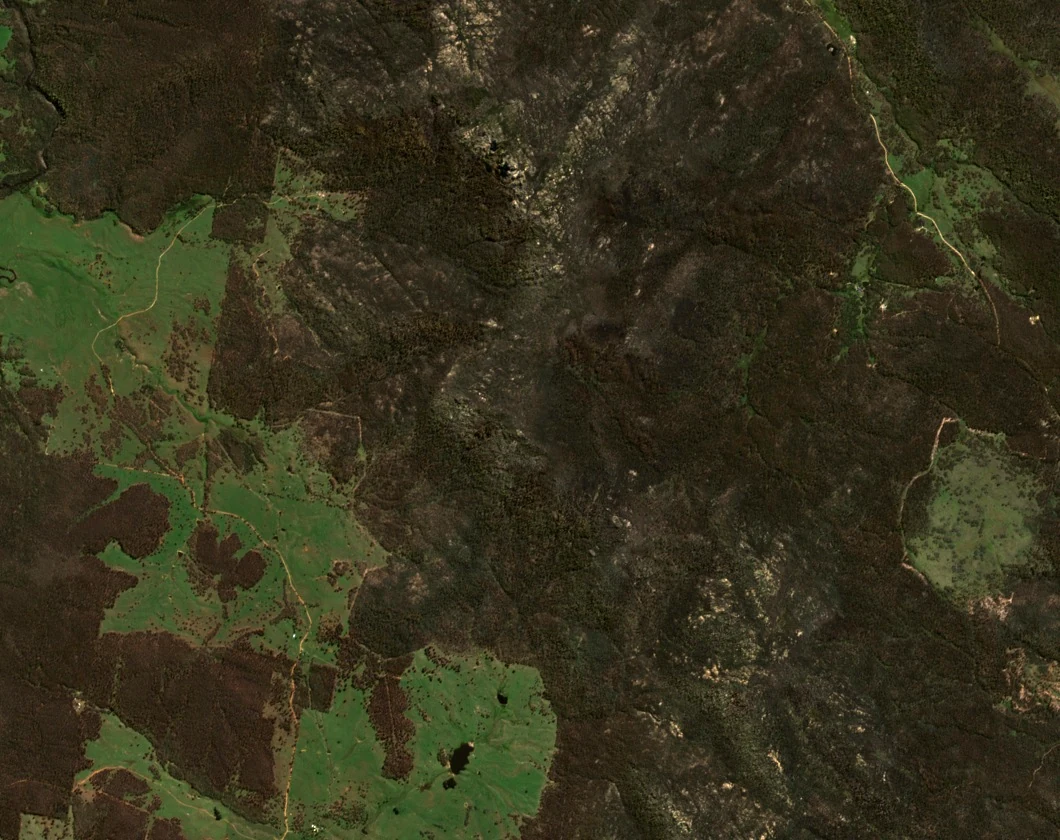
The reserve's underlying geology is the Yaouk leucogranite, a Silurian–Devonian unit that includes both fine and coarse leucogranite and aplite. The reserve management plan describes weathered rock fragments accumulating on exposed peaks, with shallow deposits forming further downslope. A Sentinel-2A true-colour image acquired on 31 March 2026 shows the ridge and the clearings distributed across the surrounding terrain.
Yaouk Nature Reserve was established in 2001. The management plan records historical trig stations on the high ground and traces of old boundary fencing within the reserve, details that reflect the area's documented land-use history.
Leptospermum namadgiensis at the Summit
The tea-tree Leptospermum namadgiensis was formally described by A. M. Lyne in a 1993 paper; the type specimen was collected on Mount Scabby in 1992. In subsequent work, Lyne reported the species at the summit of Yaouk Bill Peak, as well as at Mount Namadgi and Sentry Box Mountain. The paper characterises its typical habitat as rocky, exposed summits and ridges between approximately 1,500 m and 1,820 m, with shallow gravelly soils. Identifying features noted in the paper include silky leaves and small white flowers that are sometimes pink-tinged.