
Official Summit Heights of the Three Sacred Mountains
Chinese national government authorities reported revised heights for the three peaks in 2023, placing Yangmaiyong in the south at 6,033.0 m as the highest, Xiannairi in the north at 5,998.5 m, and Xianuo Duoji in the east at 5,951.3 m. A 2020 Daocheng County report had given Xiannairi as 6,032 m and each of the other two peaks as 5,958 m, a ranking that differs from the 2023 national survey figures.
Glacial Landforms and Alpine Lakes
Zhongli Liu of the reserve administration describes the three peaks as separated by less than 7 km in straight lines, with the valleys between them cut into broad U-shapes by glacier erosion. Cirques are bowl-shaped hollows carved by glaciers at the heads of former ice flows. Moraines are the ridges and other deposits of debris left behind as ice moved and retreated.
The county records Milk Lake, Five-Color Lake, and Pearl Lake as separate lake features of the valley, with Luorong serving as a pasture. The Chinese Academy of Sciences describes ancient glacial formations standing alongside today's glaciers, with mountain meadows, alpine lakes, and old-growth forests occupying the landscape.
Tibetan Buddhist Pilgrimage Tradition
In Tibetan Buddhist tradition the three peaks are associated respectively with Avalokiteshvara, the bodhisattva of compassion, in the north, Manjushri, the bodhisattva of wisdom, in the south, and Vajrapani, the bodhisattva of spiritual power, in the east. Local Buddhist texts credit the eighth-century figure Padmasambhava with consecrating the site, according to Zhongli Liu. Chonggu Monastery is a starting point for kora, the ritual of walking around sacred mountains, according to Daocheng County.
Joseph Rock's 1928 Visits to the Three Sacred Mountains
The Smithsonian's ornithological report documents that Joseph F. Rock made two trips to the range for the National Geographic Society in June and August 1928. The team collected bird specimens at around 14,000 to 17,000 feet during those journeys. The Royal Botanic Garden Edinburgh catalogues his 1928 field diary for the Konkaling journey from Muli. His account with photographs appeared in the July 1931 issue of National Geographic under the title Konka Risumgongba, Holy Mountain of the Outlaws.
Reserve Designation
China established Yading National Nature Reserve in 2001, as recorded by Liu. UNESCO designated Yading a biosphere reserve in 2003 under its Man and the Biosphere Programme.
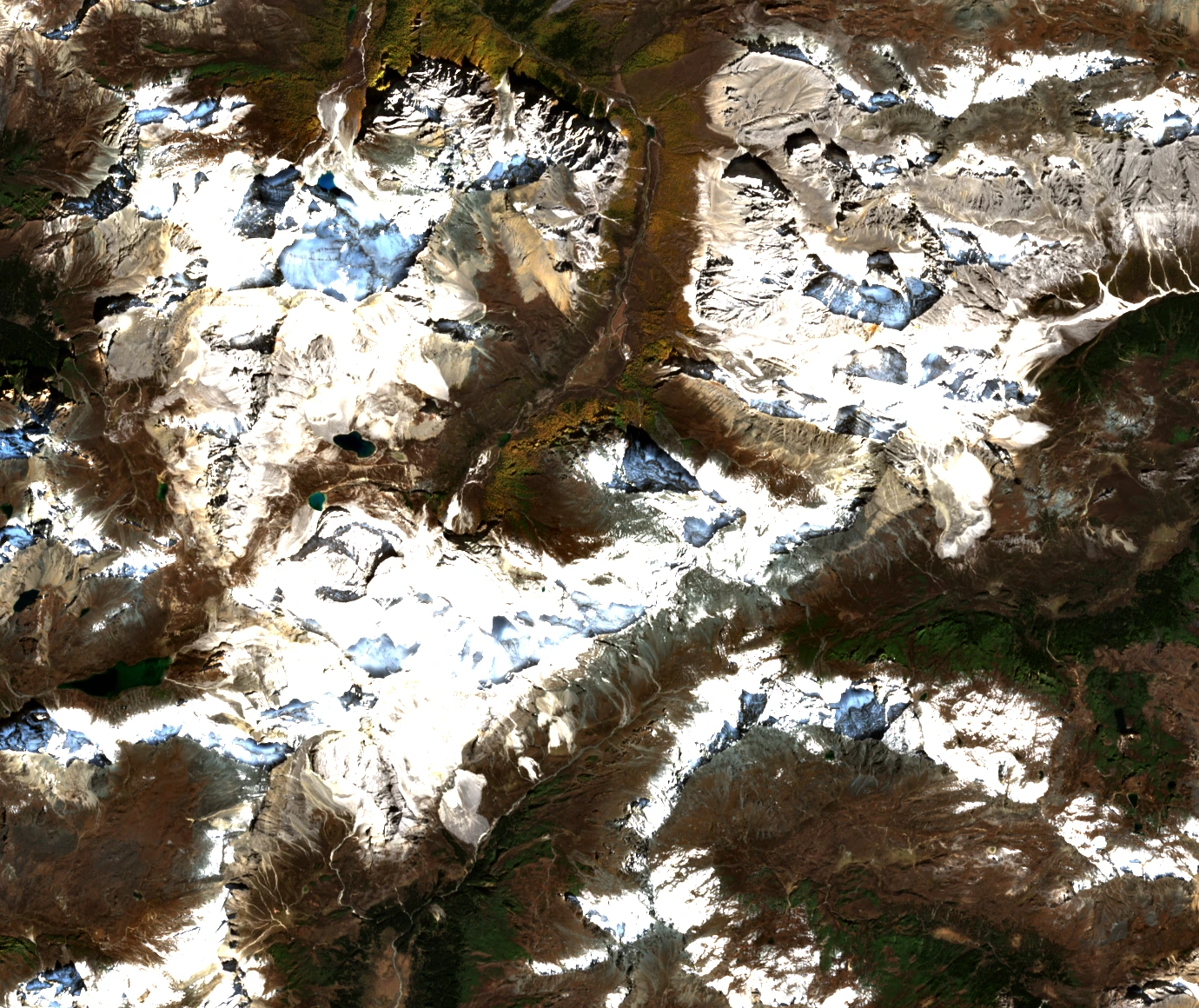
Sentinel-2 View of the Three Sacred Mountains
This true-colour Sentinel-2 image was taken on 23 October 2026 with north at the top. Xiannairi occupies the upper left, Yangmaiyong the lower left, and Xianuo Duoji the right portion of the frame.