
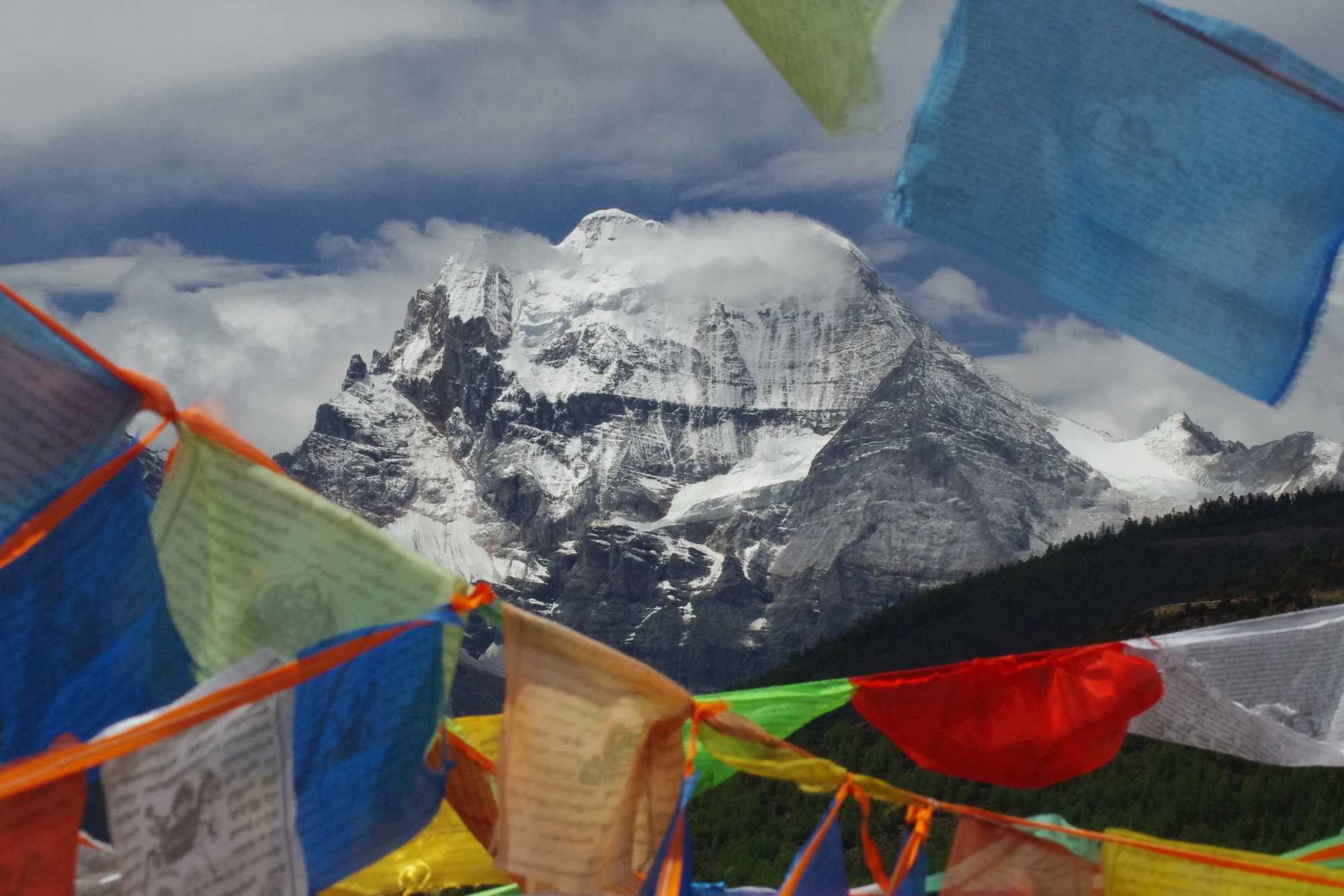
Glaciated Landscape Below the Summit
In a 2018 study, reserve researcher Zhongli Liu describes U-shaped glacial valleys between the three summits, which lie less than 7 km apart. Cirques, sharp peaks and moraines preserve evidence of the reserve’s glacial history. The Chinese Academy of Sciences documents both these traces and the glaciers that still occupy parts of the protected area. The photograph of Xiannairi from 18 June 2012 shows prayer flags in front of the mountain.
Sacred Tradition and Pilgrimage Practice
Tibetan Buddhists revere Xiannairi as Avalokitesvara, the bodhisattva of compassion. Jambeyang embodies Manjusri, and Chanadorje embodies Vajrapani. Daocheng County records a tradition in which Padmasambhava consecrated the three mountains in the eighth century. Chonggu Monastery stands at the foot of Xiannairi and is a customary starting point for kora, a pilgrimage that follows a circuit around a sacred place.
Exploration and Protection
Botanist and explorer Joseph Rock visited the three peaks in 1928. The Royal Botanic Garden Edinburgh holds his field diary, and National Geographic published his account in July 1931 under the name Konka Risumgongba. Tamotsu Nakamura records a Japanese team’s unsuccessful 1989 ascent attempt on Xiannairi. Writing in 2012, he reported that Daocheng County restricted ascents of the three sacred peaks. Yading became a Chinese national nature reserve in 2001 and joined UNESCO’s Man and the Biosphere Programme network in 2003.