
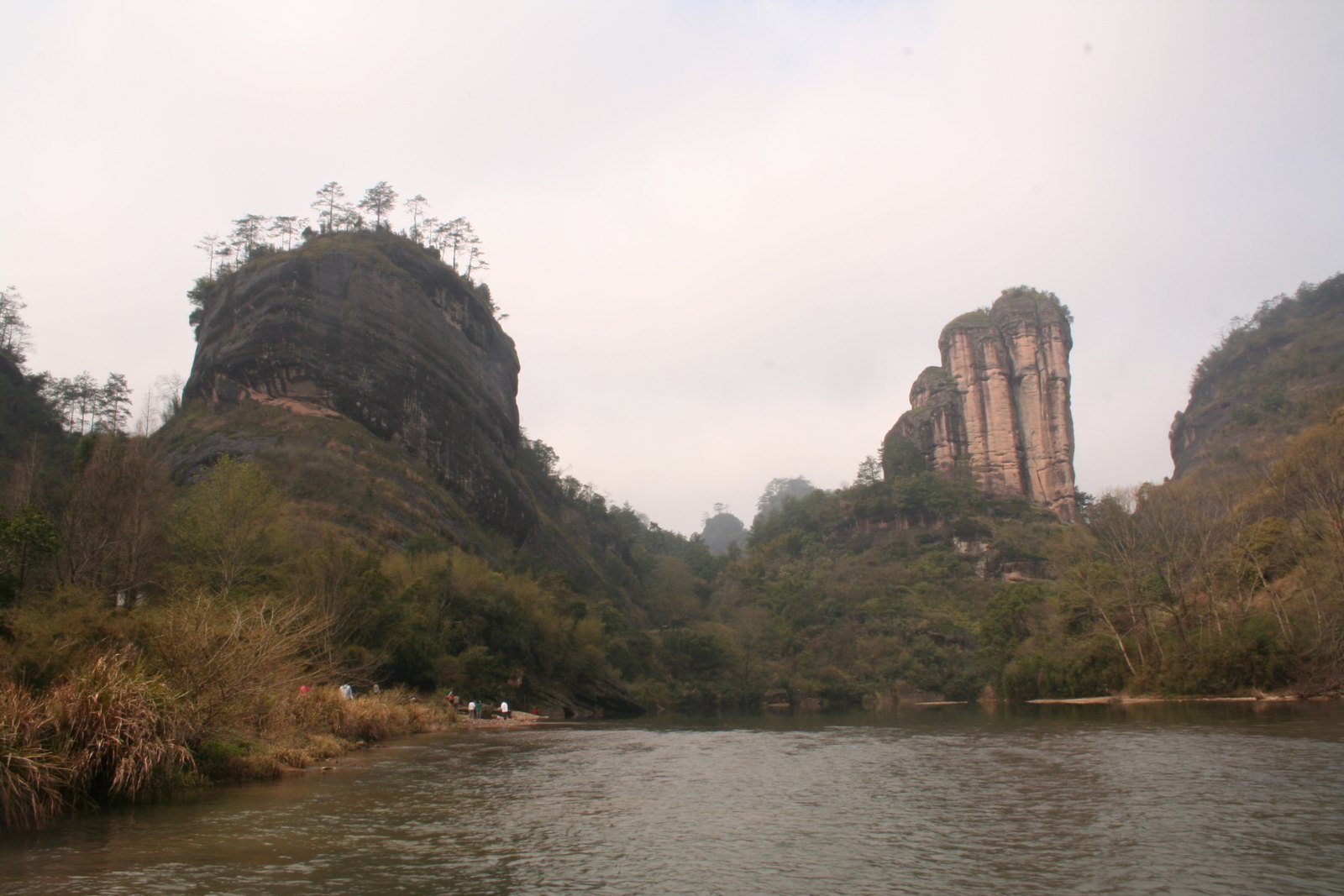
Terrain: Danxia Dissection and the Nine-Bend Stream
The eastern section of Mount Wuyi is defined by a landscape shaped by the long-term erosional dissection of red sandstone and conglomerate — a classic Danxia landform. The Nine-Bend Stream (Jiuqu Xi) winds through this red-rock terrain, renowned for its sinuous, meandering course. Stream, cliff faces, and rock peaks together form the most recognisable scenic thread through the eastern section of the heritage area. The depth of the valley incision and the layered tones of the cliff walls are direct evidence of the mature development of Danxia landforms in this area.
The topographic structure of Mount Wuyi shows a marked east–west differentiation: to the west lies a mid-altitude mountain zone along the Fujian–Jiangxi border, represented by Huanggang Mountain, with high terrain and continuous forest cover; to the east is the lower-altitude Danxia zone traversed by the Nine-Bend Stream. The two differ significantly in landscape type and ecological conditions. The highland containing Huanggang Mountain and the scenic zone of the Nine-Bend Stream are geographically separate and should not be conflated.
Natural Ecology: Intact Subtropical Forest Preservation
Mount Wuyi contains one of the largest and most intact surviving subtropical primary forests in southeastern China. In its heritage assessment, UNESCO specifically noted that the vertical vegetation zones are complete, with continuous distribution from lowland evergreen broadleaf forest up through mid- to high-altitude mixed conifer-broadleaf forest, providing habitat for a large number of plant and animal species. This ecological integrity is the core basis for Mount Wuyi's natural heritage designation.
Neo-Confucian Culture: Zhu Xi and Academy Remains
Mount Wuyi holds a singular place in Chinese intellectual history. The Song dynasty Neo-Confucian synthesiser Zhu Xi spent extended periods here lecturing and writing, leaving behind academy remains associated with his scholarly activities. UNESCO's heritage documentation incorporates this cultural dimension within the mixed heritage framework, treating it as an essential component of Mount Wuyi's humanistic value. The transmission and development of Neo-Confucianism here elevates Mount Wuyi beyond the status of a purely natural landscape, making it an important node in the scholarly geography of Confucian learning.
The choice of Mount Wuyi as a place of retreat and teaching by Zhu Xi and other Neo-Confucian thinkers was closely connected to the seclusion afforded by the region's topography and to its cultural traditions. The surviving academy remains are distributed across the heritage area, and together with the surrounding natural environment form what the World Heritage Committee recognised as the "outstanding universal value of the intertwining of culture and nature." This humanistic dimension is an indispensable thread for understanding the full significance of Mount Wuyi.