
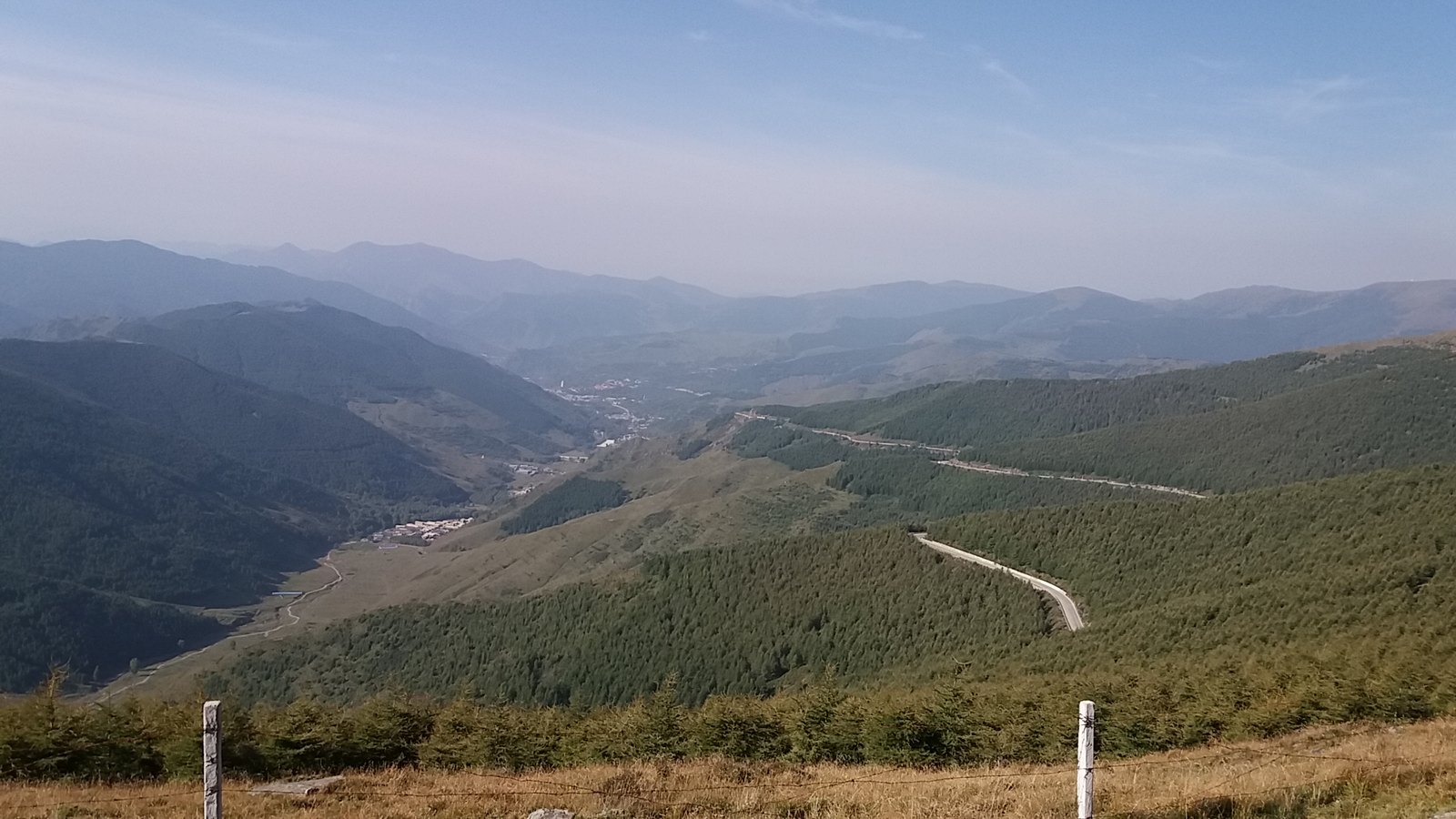
Landform: Five Terraces and an Alpine Environment
The defining topographic feature of Mount Wutai is its five summits, each with a broad, relatively flat top — a form rare among the mountains of North China. The North Terrace, Yedou Peak, is the highest of the five. Its elevation of 3,061.1 metres was officially announced by the National Administration of Surveying, Mapping and Geoinformation and the Ministry of Construction in 2007. Subalpine meadows and high-altitude vegetation have developed across the terraces; the mountain as a whole falls within the alpine environment category recorded by the Shanxi Provincial Forestry and Grassland Bureau.
The five terraces are not five separate peaks but rather five summit extensions of a single massif, radiating in five directions and connected by a plateau surface and ridgelines. This topographic configuration gives Mount Wutai its distinctive spatial scale, allowing the Taihuai basin to form a relatively habitable interior valley enclosed by high peaks — a setting that historically made it a concentrated zone for monastery construction.
Buddhist Heritage: The Mañjuśrī Cult and Tang Dynasty Timber Architecture
Mount Wutai is traditionally regarded as the foremost of China's four sacred Buddhist mountains. In traditional belief it is considered the bodhimaṇḍa of Mañjuśrī, an association traceable to the early spread of Chinese Buddhism. The area around Taihuai Town contains monasteries built across successive historical periods, forming a dense religious architectural complex where monks continue to practise and reside today.
Among the surviving structures, the East Main Hall of Foguang Temple holds particular historical importance. According to UNESCO heritage records, the hall was built in 857 CE and is one of the most significant surviving Tang dynasty timber buildings in China; its bracket-set configuration and roof-frame structure preserve the defining characteristics of Tang official construction methods. This standing monument means that Mount Wutai carries significance for architectural history research well beyond its status as a religious site.
World Heritage: Cultural Heritage Inscription in 2009
Mount Wutai was inscribed on the World Heritage List in 2009 as a cultural heritage site, under reference number 1279. UNESCO's statement of outstanding universal value covers its role as the principal centre of Mañjuśrī veneration and the cumulative monastic architectural complex around Taihuai that grew through continuous construction from the Northern and Southern Dynasties through to the Qing dynasty. The core zone of the heritage property radiates outward from Taihuai Town and encompasses dozens of historic monasteries in varying states of preservation.
The heritage value of Mount Wutai rests on the long-term interplay between its mountain environment and religious culture, rather than on any single monastery or period. This continuity gives it strong representativeness among comparable cultural landscape heritage properties, and makes it an important field site for scholarly research into the history of Chinese Buddhist architecture and pilgrimage geography.