
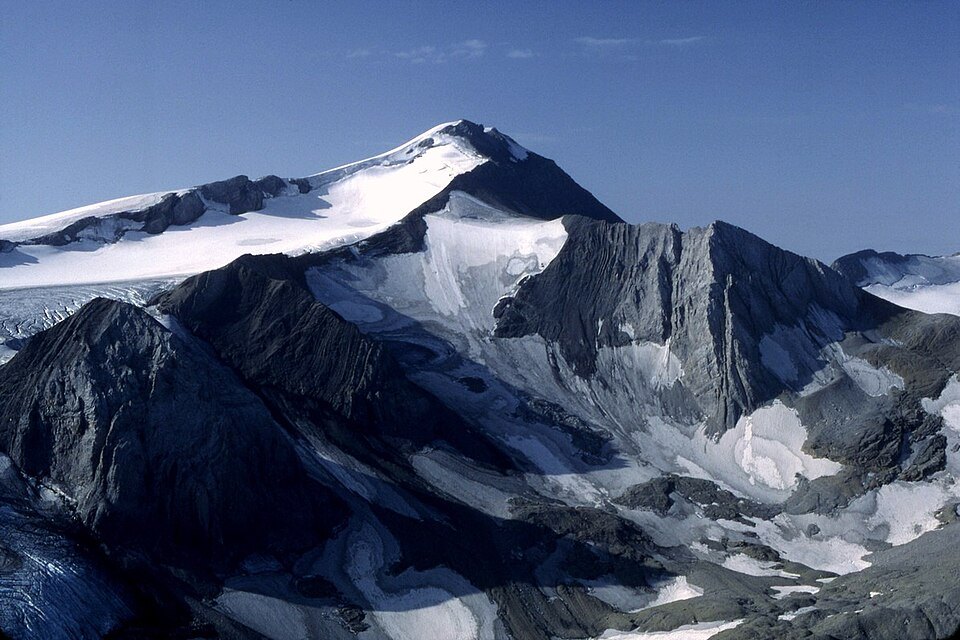
Two summits of near-equal height
The Wildhorn consists of two distinct summits. The western summit, the higher of the two according to the Swiss Alpine Club, reaches 3,250 m, while the eastern summit — recognisable by the cross that crowns it — rises to about two metres below. This near-equality of altitude gives the whole the appearance of a split ridge, with no obvious dominant peak to the untrained eye. The highest point between the Sanetsch and Gemmi passes, the massif marks the border between the cantons of Berne and Valais. The federal map swissNAMES3D records the official name Wildhorn with coordinates established at 46.355° N and 7.361° E.
Chilchligletscher and Glacier du Téné
The approach from the north-east runs successively along the Chilchligletscher, crosses rocky terrain, and then reaches the Glacier du Téné. At the foot of the Chilchligletscher, a glacial lake has formed, bearing witness to the recent evolution of this glacier. These two distinct glacial bodies surround the massif and give it its high-mountain character. The Wildhornhütte, a Swiss Alpine Club hut, is the main base associated with this sector in the SAC sources.
The first ascent on 10 September 1843
The history of mountaineering on the Wildhorn is precisely dated. On 10 September 1843, Gottlieb Studer and M. Schäppi reached the summit in the company of a cowherd from Iffigen, whose name has not been preserved in the available sources. This founding ascent brought together two worlds: that of nineteenth-century mountaineers who systematically traversed the summits of the Bernese Alps, and that of the alp-farming communities whose intimate knowledge of the terrain made these first explorations possible. The mention of the Iffigen cowherd in the annals of the Swiss Alpine Club is a reminder of the central role played by local pastoral communities in this history.