
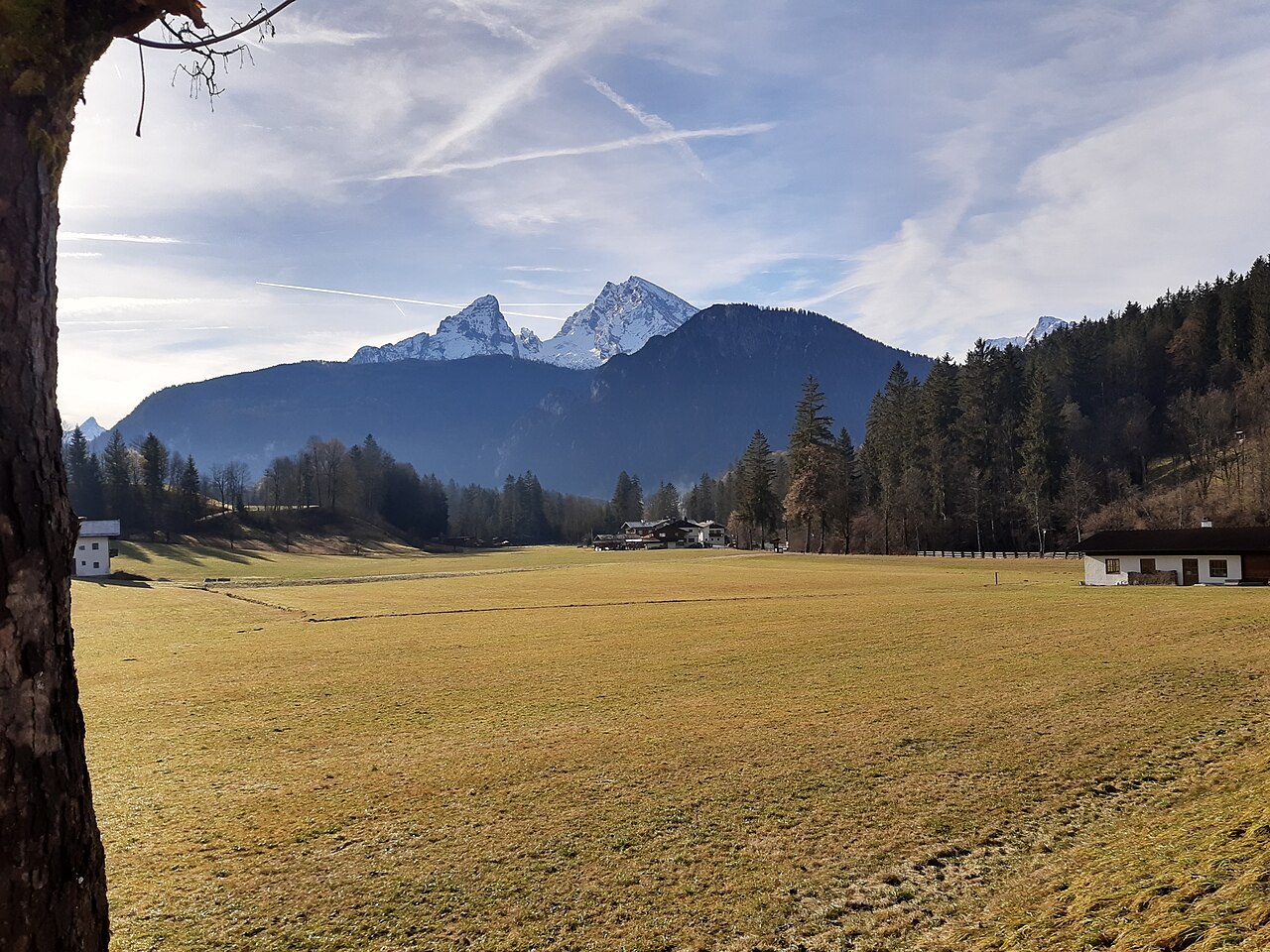
Three summits and a long ridge
The Hocheck stands 2,651 metres high. Further south lie the Mittelspitze at 2,713 metres and the Südspitze, only one metre lower. Their proximity explains why the Watzmann appears as a single summit in many photographs, even though the traverse follows a long ridge between them.
The joint brochure published by the Alpine Club, Mountain Rescue, and the National Park dates the first ascents of the Hocheck and Mittelspitze to 1800 and that of the Südspitze to 1832. The traverse links the summits along the ridge. A separate climbing history developed on the east face. One of the classic lines bears the name "Kederbacherweg," after the mountain guide Johann Grill, known as Kederbacher.
Rock from a Triassic sea
In the lower part of the massif, dolomite weathers into angular scree. Above it lie the massive, partly fossil-rich beds of Dachstein limestone that are visible in the east face. The Bavarian State Office for the Environment traces the origin of the older rocks to a shallow sea of the late Triassic, approximately 220 million years ago.
Weathering continues all the way down to the lake shore. On the eastern side, debris from the massif moves toward the Königssee and has built up the alluvial fan on which St. Bartholomä stands.
Why the Eiskapelle forms at the foot of the wall
Avalanches carry snow out of the east face and into the Eisbach valley throughout winter and spring. This continual supply maintains the firn field well below the summer snowline. As water and air circulate through the ice, cavities and passages form whose shape changes with the seasons. The name Eiskapelle refers to a part of this firn field.