
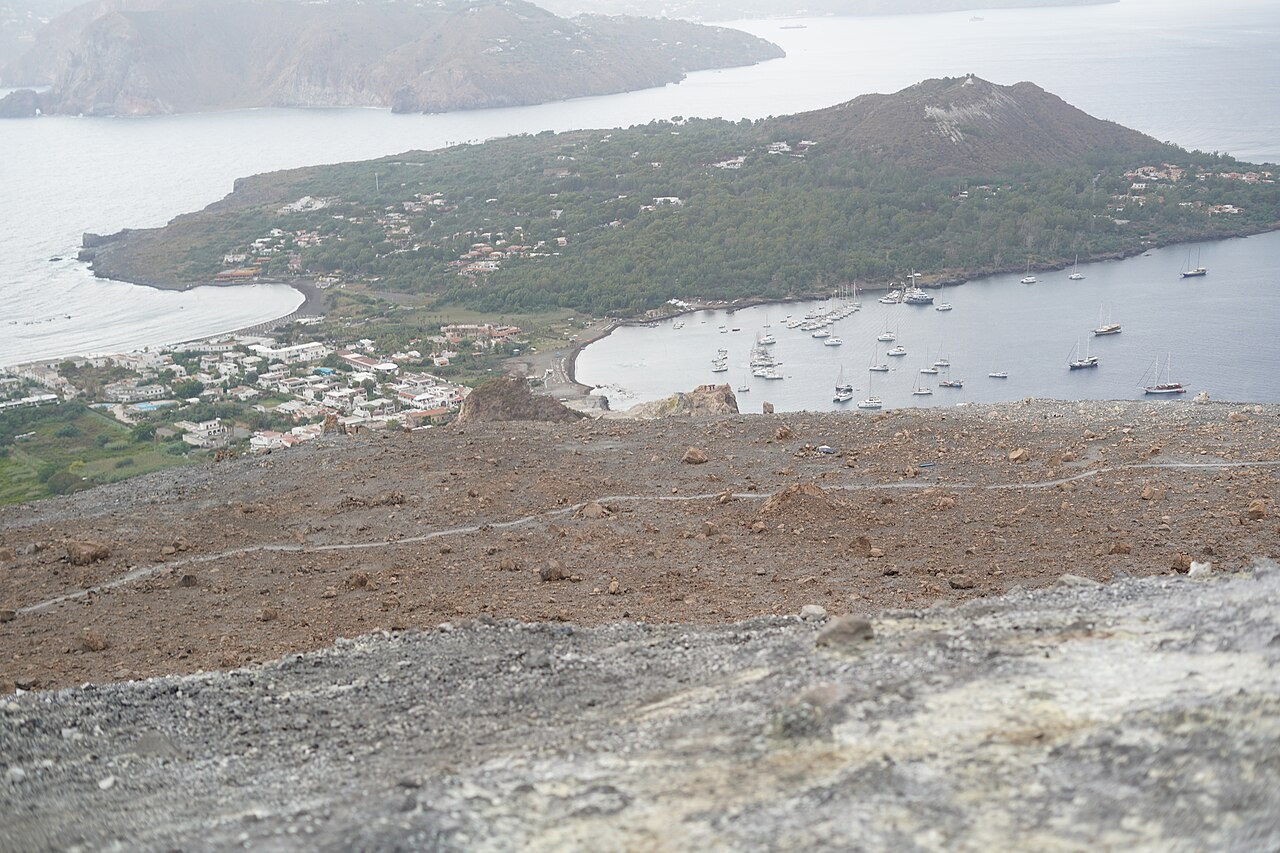
Morphology and volcanic context
The headland forms part of a volcanic complex that also includes the La Fossa cone, a distinct and still-active structure with which Vulcanello shares the underlying geological apparatus. The multiple cones that make up the headland attest to an articulated eruptive history that cannot be reduced to a single formative episode. The variety of internal forms reflects separate phases of activity that overlapped over time.
Chronology and review of historical sources
Stratigraphic studies reconstruct eruptive activity assignable to the medieval period and the early modern era, without it being possible to attribute a precise founding date to Vulcanello. The traditional attribution of its formation to the Roman period — long repeated in popular literature — finds no confirmation in the critical analysis of ancient sources, according to the most recent research published in Earth-Science Reviews. Preserving this distinction between tradition and scientific reconstruction is essential for a correct understanding of the headland's history.
The isthmus and its consolidation
Vulcanello is connected to the rest of the island of Vulcano by an isthmus whose formation has been the subject of historiographical and geological revision. According to scientific reconstructions, the isthmus consolidated progressively through the accumulation of eruptive material originating not only from the headland's own activity but also from the products of La Fossa. This interpretation, derived from stratigraphic and volcanological studies, attributes to the isthmus a composite origin involving the entire volcanic system of the northern part of the island.