
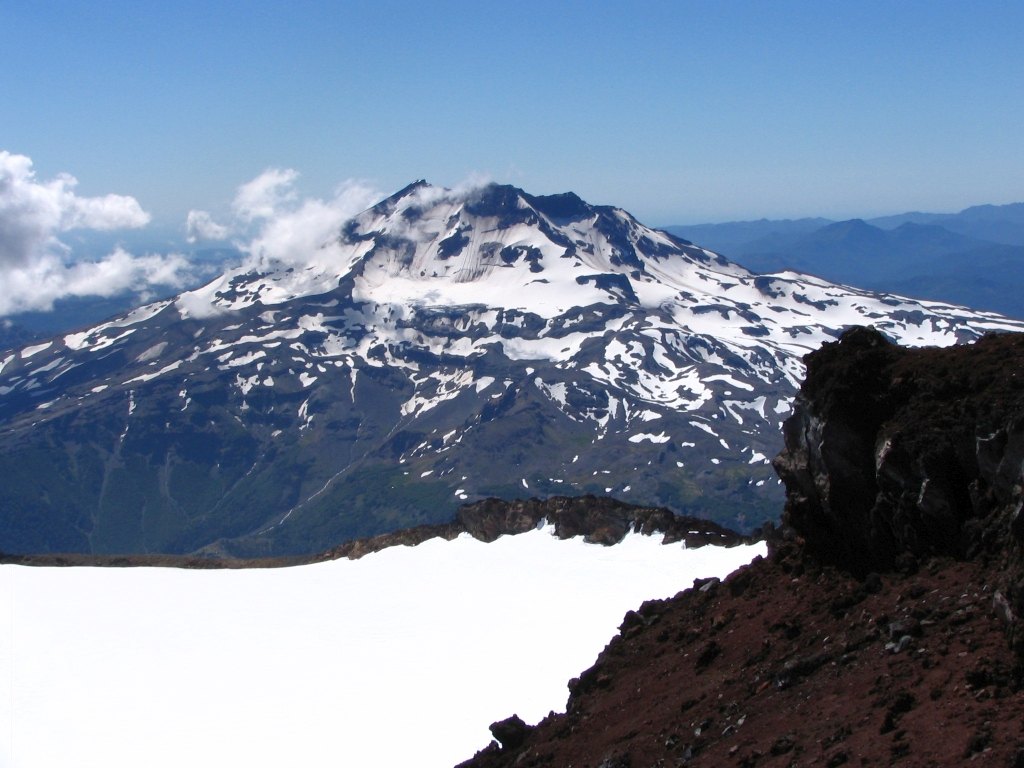
Morphology and eruptive record
The summit of Tolhuaca features a chain of craters oriented northwest–southeast, and its flanks show secondary emission centers that formed after glacial retreat. Some studies identify deposits from explosive eruptions in the early Holocene as well as lava flows that covered the northwest flank in later stages. The Global Volcanism Program records historical reports of activity in 1876 and 1933, though neither account has been confirmed.
Geothermal system
Fumaroles and hot springs emerge on the northwest flank, expressing a geothermal system that has been studied using the magnetotelluric technique. This method observes variations in the electrical resistivity of the subsurface to estimate internal structures at depth. The hydrothermal manifestations and the eruptive record represent distinct aspects of the volcano's geological history.
Regional context
Tolhuaca forms part of a segment of the southern Andes where Quaternary magmatic activity has interacted with glacial cycles. The Holocene pyroclastic deposits and flank emission centers documented by the Global Volcanism Program reflect different stages of that volcanic history, which glacial retreat helped to shape morphologically.