
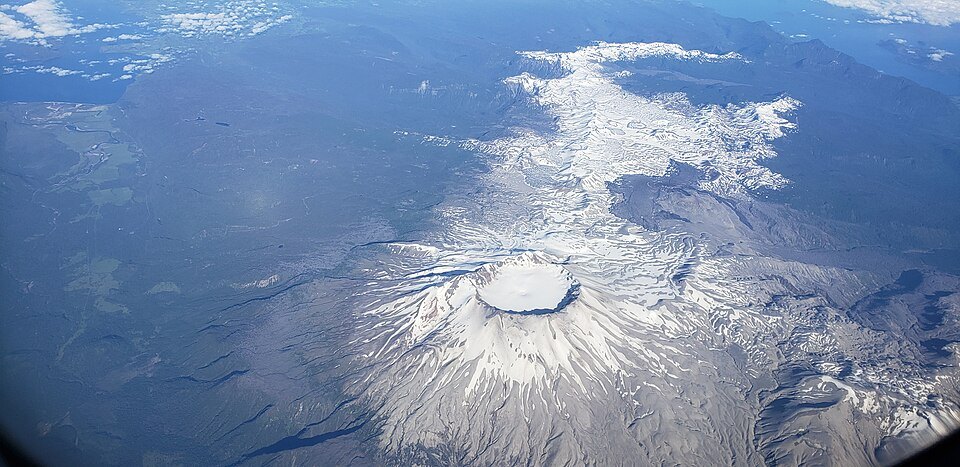
Structure of the volcanic complex
The Puyehue–Cordón Caulle complex comprises three distinct elements: the stratovolcano edifice with its summit caldera, the intermediate fissure system of Cordón Caulle, and the Cordillera Nevada. The caldera belongs to the Puyehue edifice. Cordón Caulle is a fissure system located between the two structures.
Historical eruptions of Cordón Caulle
The well-documented eruptions of 1921–22, 1960, and 2011 were centred on Cordón Caulle. In each case the activity originated in the fissure system, whose vent is physically distinct from the summit caldera of Puyehue.
Ash and lava in the 2011 episode
On 4 June 2011 Cordón Caulle began an eruption whose ash column reached Argentine Patagonia, where the Instituto Geográfico Nacional studied the deposits and their redistribution. That episode also generated a silica-rich lava flow that advanced from the fissure centre, and NASA imagery showed the emission vent separated from the snow-covered caldera of Puyehue.