
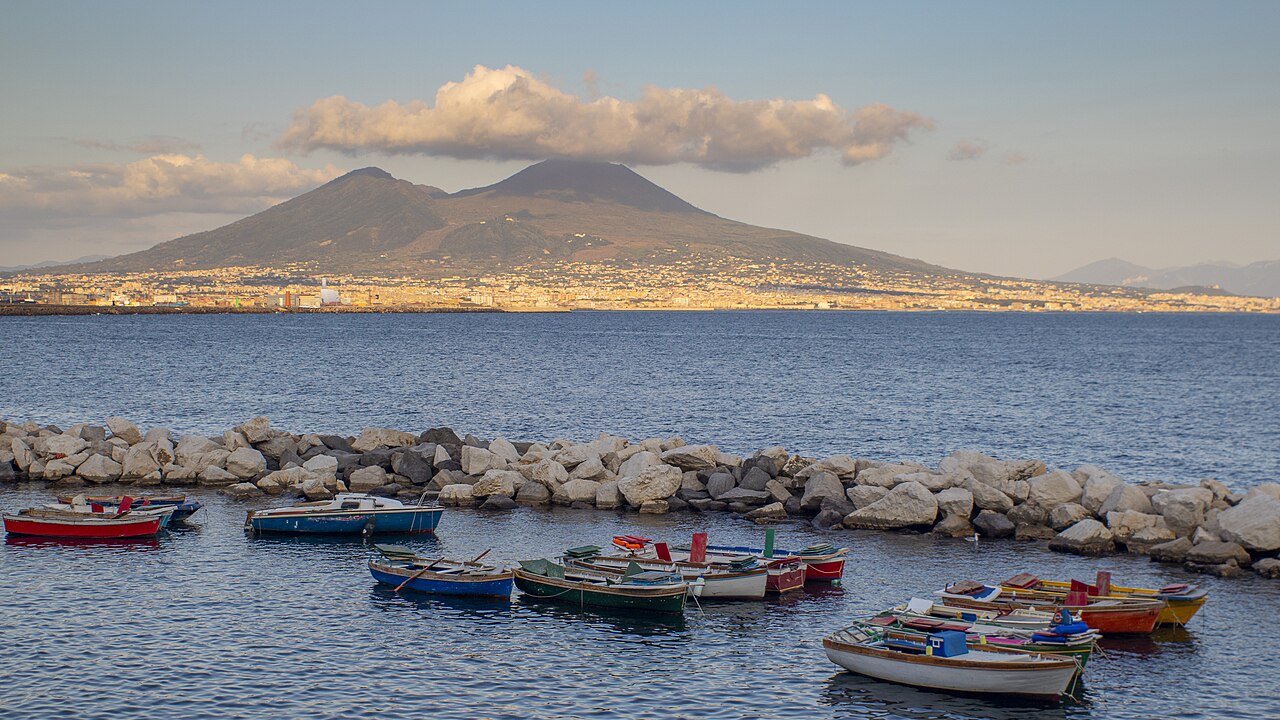
A volcanic system with a double structure
The INGV describes the Somma-Vesuvius complex as two distinct but genetically connected edifices. Monte Somma is the older structure: its caldera was not formed in a single catastrophic event but through multiple phases of collapse and reconstruction accumulated over geological time. Within this depression the Gran Cono of Vesuvius then developed — the volcanic body visible today from Naples and the Campanian coast. According to the Vesuvius National Park, the cone in its current form would have begun to build up after the great eruption of AD 79, which makes every lava layer of the Gran Cono a legible record of historical and prehistoric eruptions.
The morphological distinction between the two edifices is still perceptible through direct observation: the rim of Somma forms a crescent of ridges to the north of the Gran Cono, separated from it by the depression known as the Valle dell'Inferno. This valley is not merely a landscape feature but a geological boundary — the place where material erupted by the younger cone has accumulated against the walls of the old summit edifice.
AD 79 and the construction of a collective memory
The eruption that in AD 79 struck Pompeii, Herculaneum, Stabiae and Oplontis remains the most documented event in the volcano's history and one of the best known of antiquity. The four buried cities form a geographical arc around Vesuvius that testifies to the extent of the eruptive phenomena — pyroclastic flows, streams of incandescent material and pumice falls — in various directions from the eruptive centre. The Vesuvius National Park links the beginning of the construction of the Gran Cono in its current form precisely to the eruption of AD 79, suggesting that the edifice observed today is largely a post-classical creation, formed in the centuries following that catastrophe.
The 1944 eruption and the accounts of Giuseppe Imbò
March 1944 marks the last documented eruption of Vesuvius. The lava flows partially invaded the inhabited centres of Massa di Somma and San Sebastiano al Vesuvio, leaving physical traces still identifiable in the landscape today. The event was systematically observed and recorded by Giuseppe Imbò, then director of the Vesuvian Observatory, who followed the eruption from the historic headquarters of the institute and articulated his description in four distinct phases. His direct testimony represents a primary source of extraordinary scientific and historical value: an account from within, produced while the phenomenon was unfolding.
The Vesuvius National Park identifies outcrops of the 1944 lavas along a path running from the Valle dell'Inferno to San Sebastiano al Vesuvio. By reading the present-day landscape it is possible to distinguish, even without technical instruments, the products of different eruptive processes: effusive flows, which advance slowly like rivers of molten rock, and pyroclastic currents, high-velocity mixtures of gas and solid material capable of covering great distances in a very short time. These 1944 lavas are not merely geological relics: they are the tangible residue of the last eruptive chapter of a volcano that the INGV still considers active and monitors continuously.
Monitoring and scientific identity
The Vesuvian Observatory, now part of the INGV network, is one of the oldest volcanological institutions in the world and has built its scientific identity around this volcano. The eruptive history of Vesuvius is reconstructed by the Observatory as a sequence of events extending from antiquity to 1944, making Vesuvius one of the volcanoes with the longest and most detailed historical documentation in the world. This continuity of observation — passing through figures such as Giuseppe Imbò and through decades of seismic and geochemical records — confers on the Somma-Vesuvius system a significance that transcends its geomorphological relevance: it is a natural laboratory and a living archive of the relationship between Mediterranean volcanism and human settlement.