
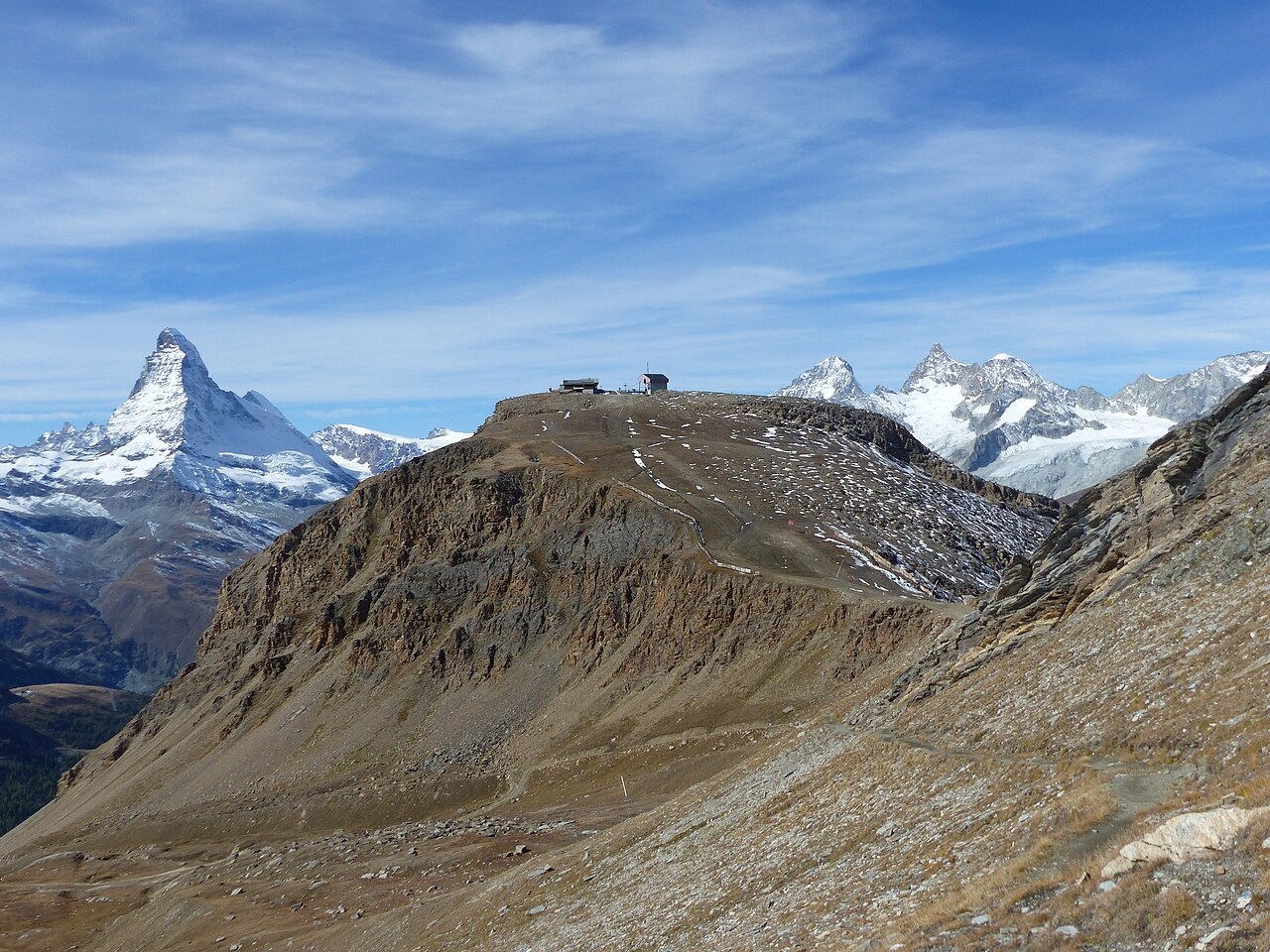
A Ridge in the Matter Valley
The Unterrothorn sits on the eastern flank of Zermatt at the top of a two-stage lift line that climbs from Sunnegga through the intermediate station at Blauherd. From the ridge, the freestanding pyramid of the Matterhorn appears directly across the valley without intervening summits breaking the sightline, while Dent Blanche and the arc of four-thousand-metre peaks that ring the upper valley fill the surrounding horizon. The relationship between Blauherd and the Unterrothorn summit defines the upper section of the ridge, with the Oberrothorn continuing higher along the same crest.
The Unterrothorn summit reaches 3,103 metres. A photograph taken during the ascent of the neighbouring Oberrothorn shows the broad Unterrothorn ridge in the foreground, with the Matterhorn and Dent Blanche visible behind as the route continues toward the higher summit.
The Rothornbahn Project
According to the company's 1988 historical account, an external proposal in 1961 led Zermatt mountain guides, hoteliers and ski instructors to pursue an independent project. They founded Zermatter Rothornbahn AG on 9 October 1964 and received federal consent on 26 February 1965. The lower Sunnegga–Blauherd gondola opened on 24 March 1967, and the upper Blauherd–Unterrothorn cabin cableway followed on 16 July 1967.
The operator's initial proposal included a circulating gondola for the upper section. Federal officials required a reversible cabin tramway for that section, citing avalanche conditions and rescue considerations. The upper installation was replaced in 1996 with cabins carrying 150 persons, rising 514 metres to an upper terminal at 3,100 metres, below the 3,103-metre summit.
The Peak Collection at the Summit
At the Unterrothorn summit, mountain guide Willy Taugwalder assembled an open-air installation that Zermatt's official description calls the Peak Collection. Local guides collected stones from the summits represented in the exhibition and wrote signed personal accounts. Taugwalder brought these stones, accounts and images together as the components of an exhibition comprising 18 metal sculptures, each devoted to one or two mountains of the surrounding region.
The panels accompanying each sculpture record the names of first ascenders, dates of those ascents and summit elevations, alongside guides' signed first-person accounts of the mountains. Written materials appear in German, French, English and Japanese. The sculptures are arranged in a circle of approximately 100 metres around the summit restaurant.