
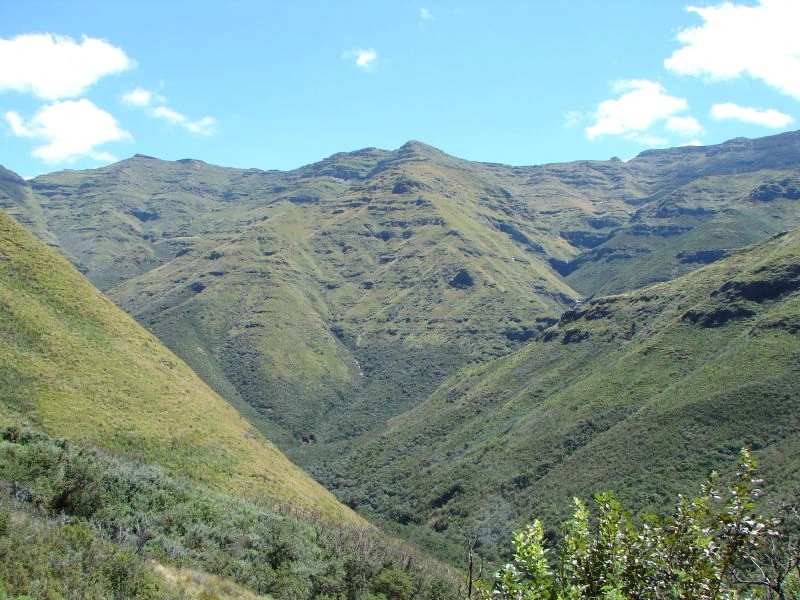
The rivers below Holomo Pass
The park protects about 5,600 hectares around the two rivers near the foot of Holomo Pass. Parts of the Tšehlanyane watershed also serve as local administrative boundaries, as recorded in Lesotho’s government gazette of 22 November 2004. In the 2006 photograph, grassy ridges descend into a wooded valley.
The bamboo that gave the river its name
Along waterways, field surveys have recorded stands of oldwood (Leucosidea sericea) and Drakensberg bamboo (Thamnocalamus tessellatus). Tšehlanyane is the Sesotho name for the bamboo, a name shared by the river and the park. The bamboo provides habitat for the threatened bamboo sylph butterfly (Metisella syrinx).
Plants in everyday life
From December 1999 to March 2000, Taelo Letšela and colleagues interviewed 149 households in Tšehlanyane and Bokong. Their 2003 study documented the use of 147 plant species across the two areas, including plants gathered as food or firewood and used to make household goods.
From a tunnel road to a biosphere reserve
The Lesotho Highlands Development Authority traces the park’s origins to the road built to access the Hlotse tunnel. The park was officially inaugurated in 2002. In 2021, Tšehlanyane and Bokong became the core protected areas of Matšeng, Lesotho’s first UNESCO biosphere reserve.