
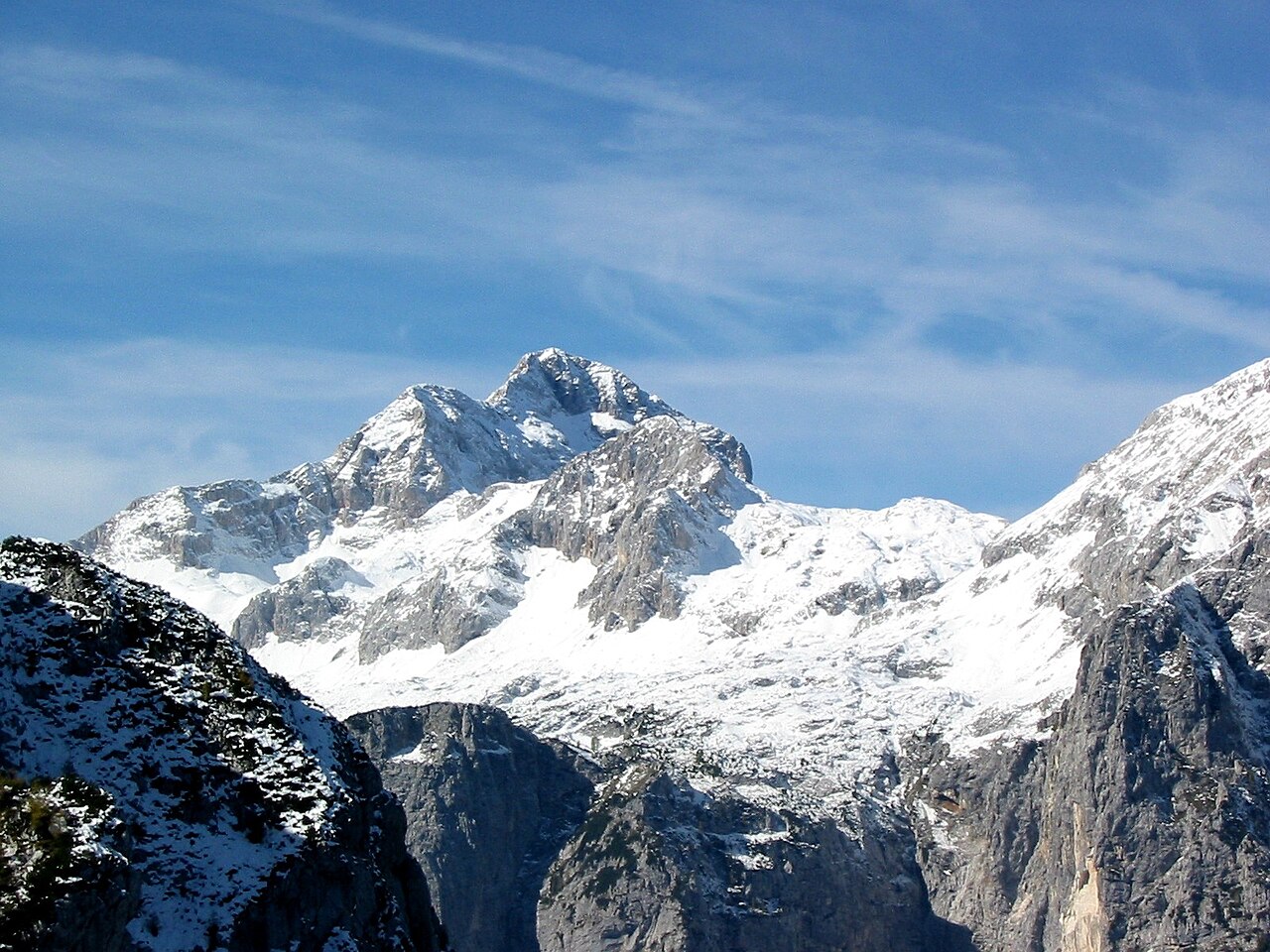
A Landscape Built from the Sea
The bedrock beneath Triglav National Park originated as marine sediment deposited over geological time. Tectonic uplift brought that material to alpine elevations. Glacial erosion then sculpted the landforms now visible across the massif, while limestone dissolution produced the high karst terrain that characterises the park: bare ridgelines, sinkholes, and high plateaus drained through porous rock rather than surface streams.
The First Recorded Ascent
The earliest ascent for which a written record survives took place in 1778, when four men from Bohinj reached the summit together: Luka Korošec, Matevž Kos, Štefan Rožič, and Lovrenc Willomitzer. The Slovenian Alpine Museum treats this as the founding event in Triglav's mountaineering history, an ascent undertaken by people from the valleys immediately below the peak that established the mountain in the written record and in the consciousness of lowland communities.
The 1778 climb preceded the formation of Alpine clubs by decades. The Alpine Museum places the local character of that party at the centre of its interpretation of Slovenian climbing culture, tracing from it a continuous relationship between the mountain and the communities that surround it.
The Aljaž Tower
The most recognisable object on Triglav's summit is a small cylindrical metal structure erected in 1895 and known as the Aljaž Tower. Its construction followed an initiative by Jakob Aljaž, the parish priest of Dovje, who purchased the summit plot from the local municipality and thereby created the legal basis for placing a permanent shelter at the highest point in Slovenia.
By the close of the nineteenth century the tower had become inseparable from the image of the mountain, appearing in visual representations of Triglav across many media. The structure reinforced the mountain's role as a focal point of Slovenian cultural identity well beyond its function as a shelter for climbers.
Triglav and National Identity
The Slovenian flag bears the country's coat of arms, in which the shield displays a stylised image of Triglav. This connection between the mountain and the state is reflected in the Slovenian Alpine Museum's framing of the summit's history, which treats each generation's engagement with Triglav as a continuation of a relationship between a people and their highest point.
The museum's collection spans equipment, photographs, and written accounts documenting climbs across two and a half centuries. Its exhibition, titled in translation "I Have Climbed to the Top of the Mountain," presents this continuity as evidence of the mountain's persistent place in Slovenian life from the Enlightenment era to the present.