
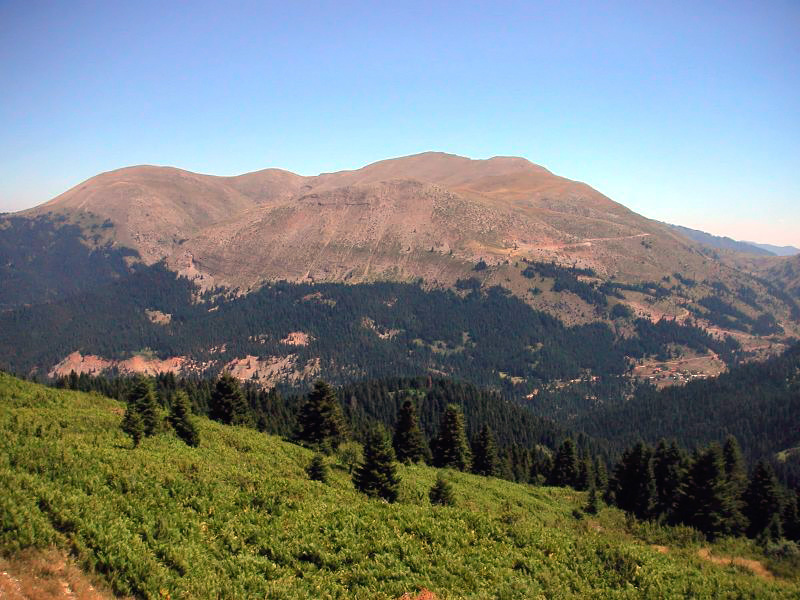
Summit Relief and Pastures
The Gkolemi saddle separates the Triggia massif from the neighboring peak of Neraida. Area plans document fir mixed with black pine covering the high slopes up to roughly 1,700 to 1,800 metres, above which the forest gives way to open, treeless meadows. Shepherds drove their flocks to those upland pastures each summer for centuries.
The Violet Type Collection
On 6 June 1971, B. Aldén collected a violet specimen on southeast-facing limestone scree north of Palaeochorion at an altitude of 1,950 to 2,100 metres. In 1985 Matthias Erben used that collected material to formally describe the subspecies Viola eximia subsp. tringiana. The preserved herbarium sheet is the type specimen on which that published name rests, and the Royal Botanic Gardens, Kew, accepts the name in its taxonomic records.
Krania Below the Slopes
The village of Krania, known in Vlach as La Kornu, appears in the archives of a Meteora monastery with a first recorded mention dated to 1520. The Church of the Holy Cross, standing between Krania and Doliana, is the surviving church of a local monastery and is recognized for its thirteen domes. The original structure is traditionally dated to the late eighteenth century. Triggia falls within the Meteora–Pyli UNESCO Global Geopark, designated in 2024.