
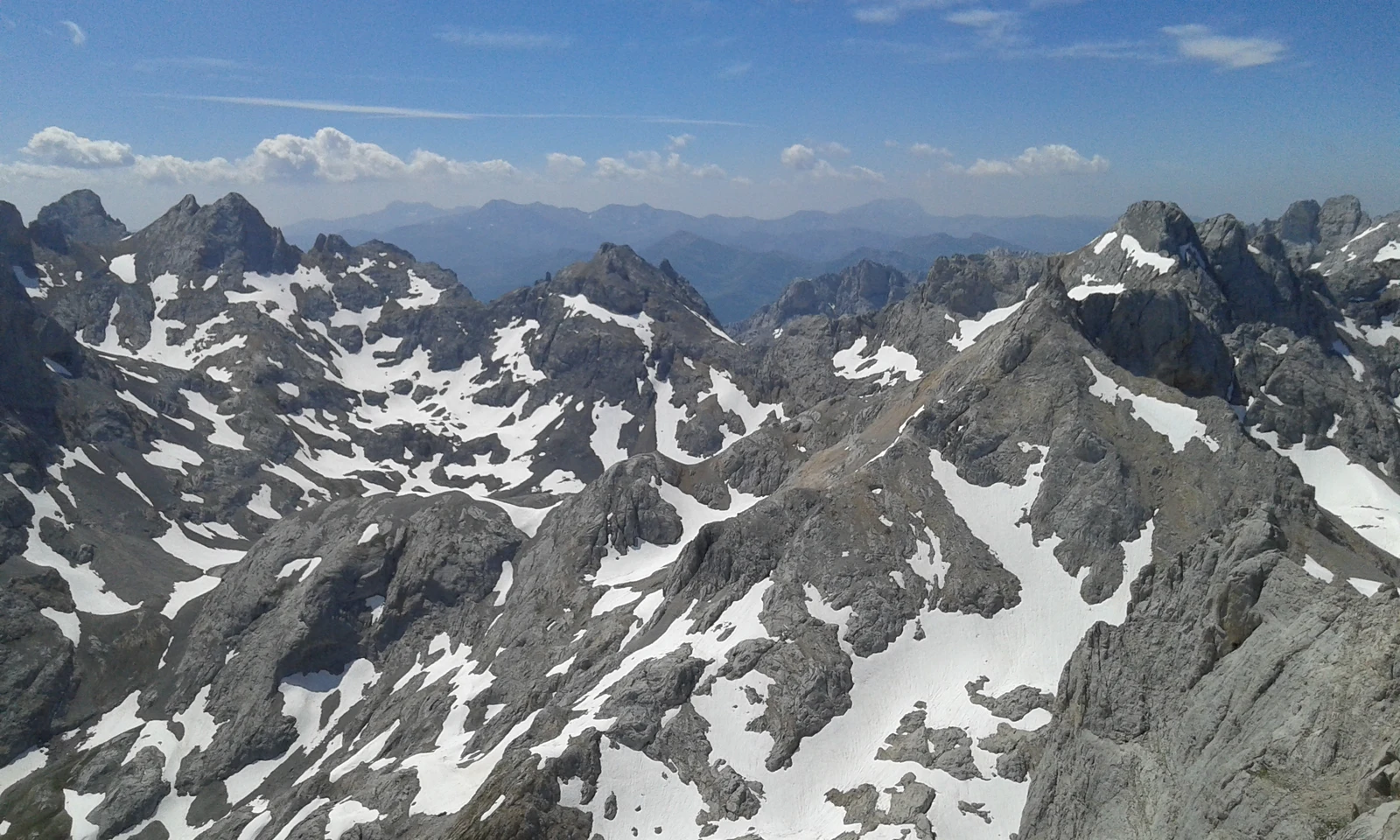
The jous in the Carboniferous limestone
The rock that makes up the Urrieles massif is a limestone accumulated on a shallow marine platform during the Carboniferous. Glacial erosion and dissolution of the limestone shaped this substrate. The result is a relief of closed depressions surrounded by vertical walls, known in the Picos de Europa as jous. Torre de la Párdida overlooks several of these jous: the Jou de Cerredo to the west and the northeast-facing cirque enclosed between Neverón de Urriellu, Párdida itself and Torre del Pomelo.
In his 2006 doctoral thesis, Juan José González Trueba documented a scree slope on the western flank of Torre de la Párdida descending towards the Jou de Cerredo. The section exposed on that slope makes it possible to observe the stratigraphy of the accumulated fragments. In the northeast cirque, González Trueba recorded stripes in the patterned ground at 2,255 m altitude on the fine material of a late-glacial moraine. A moraine is the deposit of sediments of varying sizes that a glacier carries and deposits along its margins or at its snout when it halts or retreats.
Ice signatures and a hypothesis for the Little Ice Age
The geological guide of the Instituto Geológico y Minero de España distinguishes that broader glacial record from a more recent interpretation: it considers it probable that the cirque situated to the east of Torre de la Párdida, enclosed by a moraine, harboured a small glacier during the Little Ice Age. Jou Negro, at the foot of Cerredo, Labrouche and Pico de los Cabrones, is another depression in the same massif where the guide describes evidence of glacial ice.
Botanical records from the National Park
The floristic catalogue of the Picos de Europa National Park, published in 2011, brings together records of herbarium specimens collected at Torre de la Párdida. Among them are Arabis alpina in the broad sense, with collection number FCO 12401, and Arenaria purpurascens, FCO 12078. Each number identifies a physical sample. Together, the place name and the preserved specimen make it possible to verify the botanical identification afresh.
High Route of the Urrieles on skis
In issue 279 of the journal Pyrenaica, published in 2020, David Atela recounted the second day of his Alta Ruta de los Urrieles. He set out from the Vega de Urriellu refuge, climbed via the Brecha de los Cazadores and the Horcada Arenera, and reached the summit of Torre de la Párdida on skis in the snow conditions described in the account. From the summit he descended to the eastern sector of the Jou de Cerredo before reaching the Jou de los Cabrones refuge at the end of the day.