
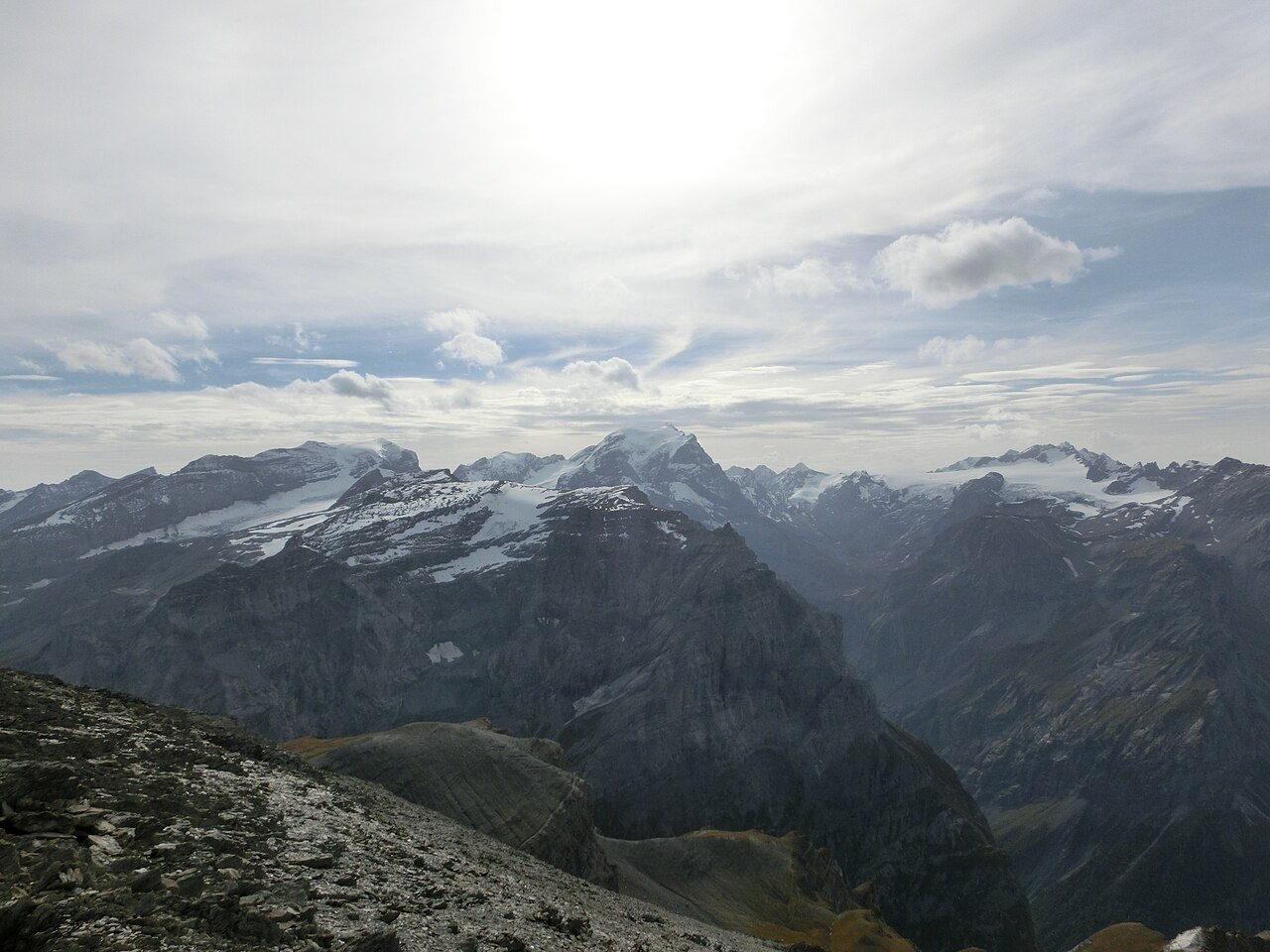
A Massif of Multiple Summits
Tödi is not a single peak but a group, and the distinction between its components matters for anyone approaching the mountain's history or geography. The massif includes Piz Russein, the Glarner Tödi, and the Sandgipfel, among other high points. Piz Russein is the apex of the group, with swisstopo survey data placing it at around 3,614 metres — a figure that reflects current measurement conventions, and one that should not be treated as identical to elevations recorded by earlier surveys using different instruments and datums. The Historical Dictionary of Switzerland describes the massif's underlying structure as a crystalline base overlain by sedimentary rocks, most notably limestone, a configuration typical of the thrust-sheet geology characteristic of the central Swiss Alps.
The 1824 Ascent and Its Historiography
The first historically credited ascent of Piz Russein is conventionally attributed to Placi Curschellas and Augustin Bisquolm in 1824, an attribution recorded in historical Alpine sources. This designation should be understood as the product of documentary evidence and later assessment rather than certainty about the full record of human movement in the area; Swiss Alpine Club historical writing acknowledges that early ascent claims can carry uncertainty and later debate. What the 1824 record does establish is a moment from which the mountain's documented climbing history proceeds, placing Tödi among the peaks with relatively well-sourced early ascents in the pre-club era of Swiss alpinism.
The Swiss Alpine Club's Foundational Connection
The Tödi massif holds an unusually direct connection to the founding of the Swiss Alpine Club. Rudolf Theodor Simler's ascent in 1861 contributed to the momentum that led to the club's establishment in 1863, and in that same year the massif was designated among the organisation's first official excursion areas. The Grünhornhütte was constructed in 1863 as part of this early institutional engagement with the mountain — making it one of the original fixed points in what would become the SAC's extensive hut network. The massif thus figures not only in the geology and topography of the Glarus Alps but in the administrative and cultural origins of organised Swiss alpinism.