
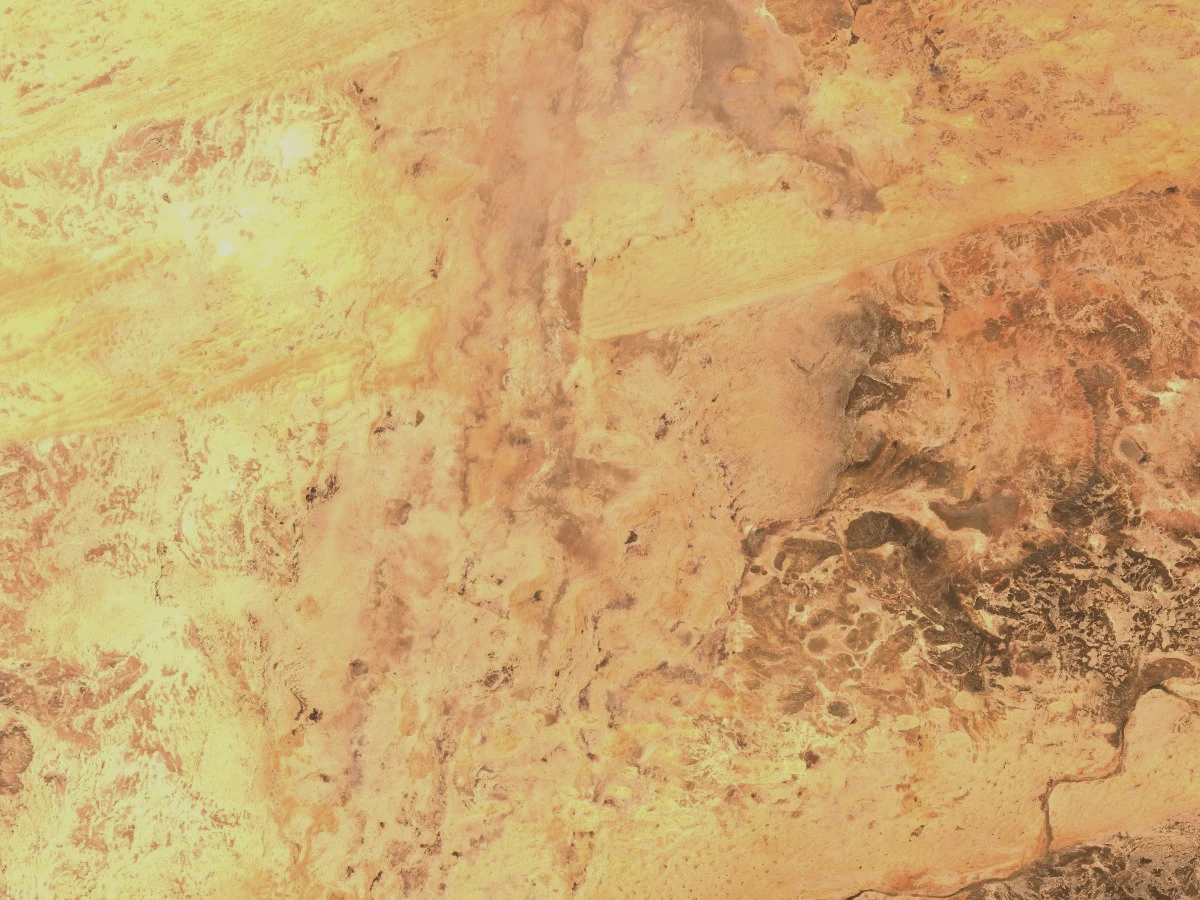
Traces of an ancient watercourse
The Sentinel-2C image of 31 December 2025 shows the arid terrain of the lower valley. This network of ancient channels drained toward the Niger at Gao. Archaeological surveys conducted around this network bear witness to a denser occupation at a time when the climate was more humid.
Today, the dried-out channels provide reference points for situating archaeological sites within their landscape.
Surveys and lithic evidence
In the summer of 2002, a survey recorded 70 sites in the Gao region and along the Tilemsi and Anchaouadj valleys. Previously, Andrew B. Smith had excavated Karkarichinkat Nord and Karkarichinkat Sud in 1972. The Lower Tilemsi Valley Project resumed research in 2005.
Michel Gaussen had described as early as 1960 stone projectile points collected in the lower valley, near the ancient watercourse.
Pottery, charred grains, and dating methods
Katie Manning and her colleagues studied charred grains and pearl millet impressions in pottery sherds and sediments from the lower valley. The two materials are not equivalent in chronological terms: a grain can be dated directly by radiocarbon, whereas for a sherd the dating applies to the organic matter contained in the temper, which may derive from carbon older than the firing itself.
At Karkarichinkat Nord, radiocarbon places a grain within a range of 2621 to 2464 BCE. Its morphology leaves open the question of its domestic status. At Er Negf, the temper of a sherd bears traces of domestic millet and yielded a date of 2579 to 2369 BCE. A 2025 study notes that older carbon present in this mixture can skew the date of the pottery.