
Geography and integration into the Parc Natural de Collserola
The Serra de Collserola forms an elongated orographic barrier to the northwest of Barcelona, and Tibidabo occupies its highest point at 512 metres above sea level. From the summit, the view encompasses both the urban fabric of Barcelona and the blue expanse of the Mediterranean, a geographical duality that distinguishes this site within the eponymous natural park. It is worth noting that the massif and the park that protects it are distinct entities: the 512 m mark corresponds strictly to the Tibidabo summit, while the Parc Natural de Collserola extends across a much wider territory around it.
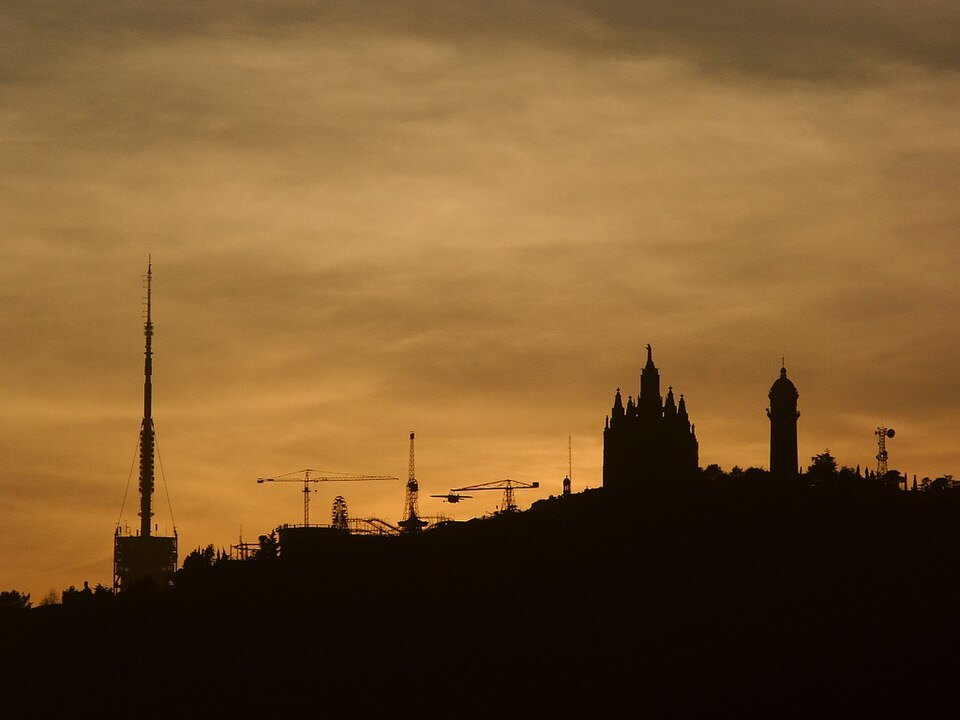
Near the summit stands the Turó de la Vilana, a hill separate from Tibidabo itself. It was on that neighbouring promontory — not on the Tibidabo summit — that the Torre de Collserola was built, designed by Norman Foster in collaboration with Ove Arup. The topographical distinction between the two elevations is relevant to understanding the arrangement of the infrastructure that characterises the massif as a whole.
Salvador Andreu's project and the opening to the public
In the late nineteenth century, the pharmacist Salvador Andreu drove an ambitious plan to turn Tibidabo into an urban leisure destination. Construction of the access works began in 1900 and culminated on 29 October 1901 with the official inauguration of the access avenue, the tram and the funicular railway. The funicular was not simply a means of transport: it was conceived and experienced from the outset as the first attraction of the place, before other entertainment offerings were added.
The function as a viewpoint was given physical form in 1921 with the opening of the Talaia, a 50-metre observation structure installed on the summit. This construction consolidated Tibidabo as a panoramic vantage point, a role already inherent to its geographical position but from that point forward endowed with its own infrastructure.
The Torre de Collserola and the 1992 Olympic Games
The Torre de Collserola, situated on the adjacent Turó de la Vilana, arose from a specific functional need: to unify the regional broadcasting infrastructure scattered across the massif and to meet the telecommunications demands of the Barcelona 1992 Olympic Games. Norman Foster, in collaboration with the engineering firm Ove Arup, was responsible for its design. The tower was inaugurated on 26 June 1992 and entered service the following day, 27 June, on the eve of the Games.
The year after its inauguration, in 1993, the tower opened an observation facility to the public, adding a new layer of civic use to a structure originally conceived for technical purposes. The tower went from being a piece of Olympic infrastructure to becoming a viewing platform that complements, from the Turó de la Vilana, the views that Tibidabo itself has offered from its summit throughout more than a century.
A summit of singular urban character
Tibidabo is not a remote peak or a high-mountain destination: it is the apex of a natural park that serves as the green lung of a metropolis. From its summit, Barcelona and the Mediterranean are laid out before the eye, a panorama that the infrastructure inaugurated in 1901 — tram and funicular — brought within the city's reach.