
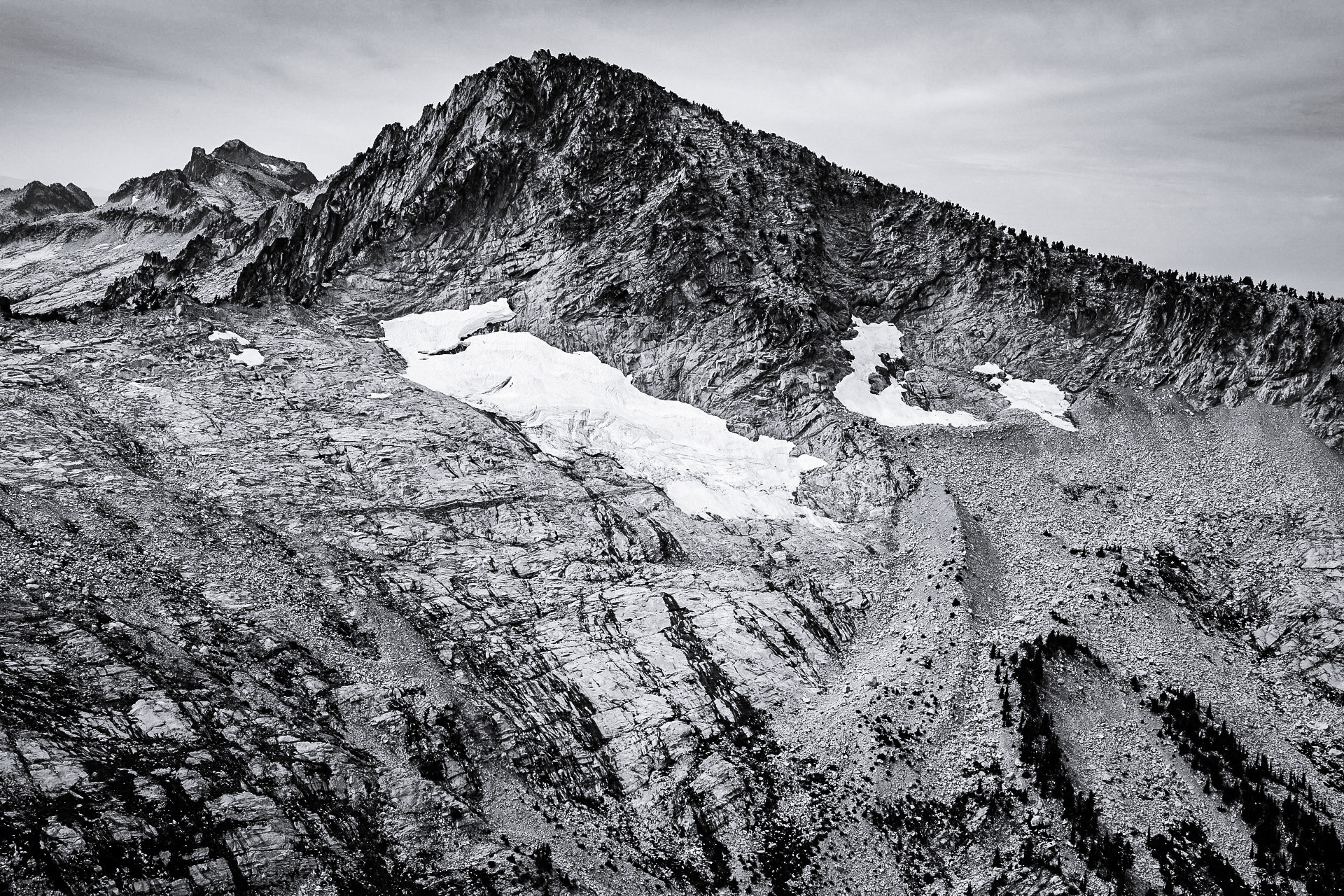
Rock shaped by glaciers
Early Cretaceous intrusions formed the pale granitic rock. A photograph published by the U.S. Geological Survey in 1972 shows the basin at the head of Grizzly Creek with Grizzly Glacier beneath the summit. Beside the ice sits a moraine, a low ridge of debris left by the glacier. A 2026 study used the ages of exposed boulders and tree rings to trace several earlier advances.
The last ice in the Klamath Mountains
Congress designated the Trinity Alps Wilderness in 1984. Following decades of decline, Grizzly Glacier broke into smaller patches. The glacier ice in the 2020 photograph was gone by 2022. Grizzly was the last glacier in the Klamath Mountains.
Plants on newly exposed ground
In 2014, field botanists mapped plants along the lower edge of the remaining ice. Some grew on ground still covered by the glacier in 1955. Club-fruited willowherb (Epilobium clavatum) and Tolmie’s saxifrage (Micranthes tolmiei) were among the species found closest to the edge, where new ground had opened as the ice receded.