
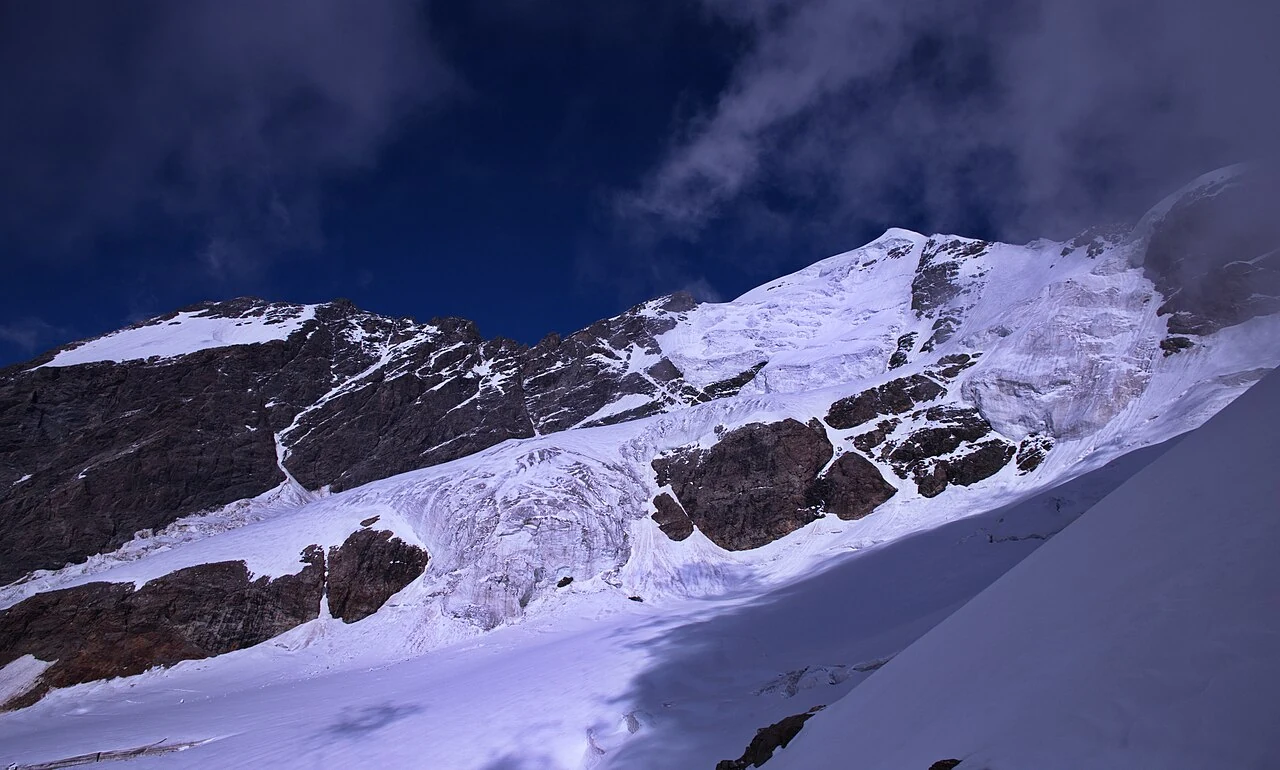
Terrain and the White Bride
Tetnuldi rises above Upper Svaneti, its ice-covered faces descending toward the glaciated basins below. A photograph taken from Nageb Pass at 3800 m in 2020 captures the peak rising above the glacier, illustrating the vertical scale between the ice basin and the summit snowfields. In Svan oral tradition, Tetnuldi features alongside Ushba in a legend built around imagery of a white dress, and the peak carries the local designation White Bride. The Tetnuldi ski resort opened in 2016.
Climbing History
The Alpine Journal's 1987 retrospective clarifies that a British expedition in 1886 climbed the neighboring summit Gestola under a mistaken application of the name Tetnuld. The peak now known as Tetnuldi was first reached on 6 August 1887 by Douglas Freshfield with guides François and Michel Dévouassoud and Joseph Desailloud. Freshfield narrated the climb in volume I of The Exploration of the Caucasus. The Georgian National Tourism Administration records an ascent in 1930 led by Aleksandra Japaridze.
Sella's Photographic Record
Vittorio Sella made three expeditions to the Caucasus, and photographs of Tetnuldi from those journeys are held by the National Archives of Georgia, which has made the collection publicly accessible online. Sella's Caucasus images form a significant visual record of the mountain's glacial terrain as it appeared in the late nineteenth century, valued for their mountaineering context and their topographic documentation of the high Caucasus at the close of that era.