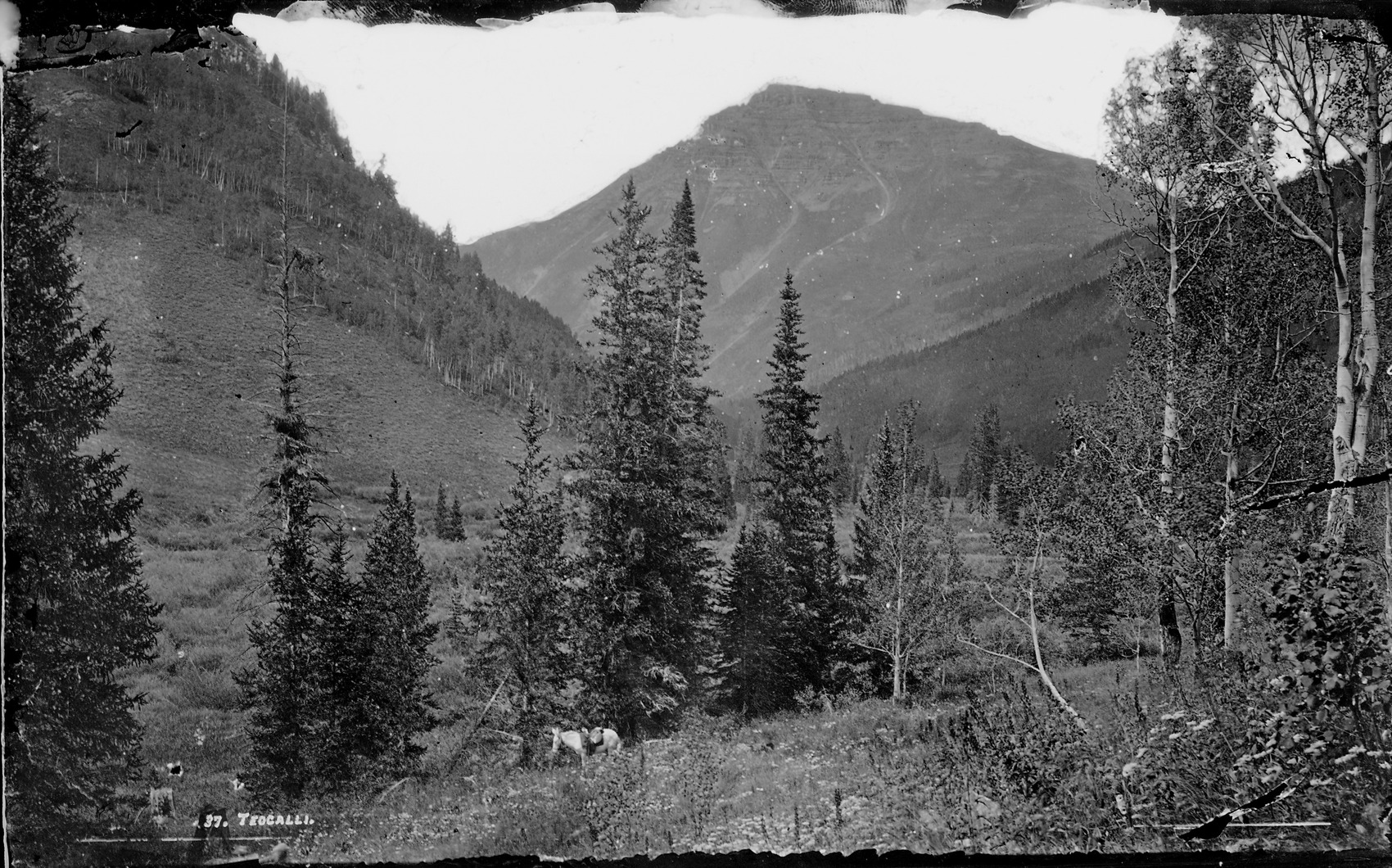
Teocalli Mountain rises above the valleys east of Crested Butte, Colorado, in the Elk Mountains. Its stepped upper slopes stand out in William Henry Jackson’s 1873 photograph, and the U.S. Geological Survey marks the peak on both its 1894 Crested Butte sheet and the modern Gothic quadrangle.
Photograph No. 37
William Henry Jackson photographed the mountain from the Red Rock Creek valley in 1873 during the Hayden Survey. The print at the National Archives carries the number 37 and the name Teocalli along its lower edge. The survey’s catalogue records the resemblance that gave the summit its name. Teocalli referred to an Aztec temple, and the survey likened the mountain’s profile to a temple pyramid.
Sandstone and Conglomerate
The 1894 U.S. Geological Survey folio describes thick beds of conglomerate and sandstone in the upper part of what it called the Maroon conglomerate, now the Maroon Formation. Shale and occasional limestone interrupt the red to chocolate-brown strata. The 1873 photograph records the steps and ledges of those upper slopes in black and white.
Where Magma Met Sedimentary Rock
In 1927, Whitman Cross and Earl V. Shannon published results from geological work in the Crested Butte area. They identified Teocalli Mountain as a striking example of sedimentary beds that changed color where they met an igneous intrusion. The heat of intruding magma can alter the minerals in neighboring rock and leave a band of changed color. In the wider study area, the researchers also found that some limestone pebbles in the conglomerate had recrystallized into white marble.