
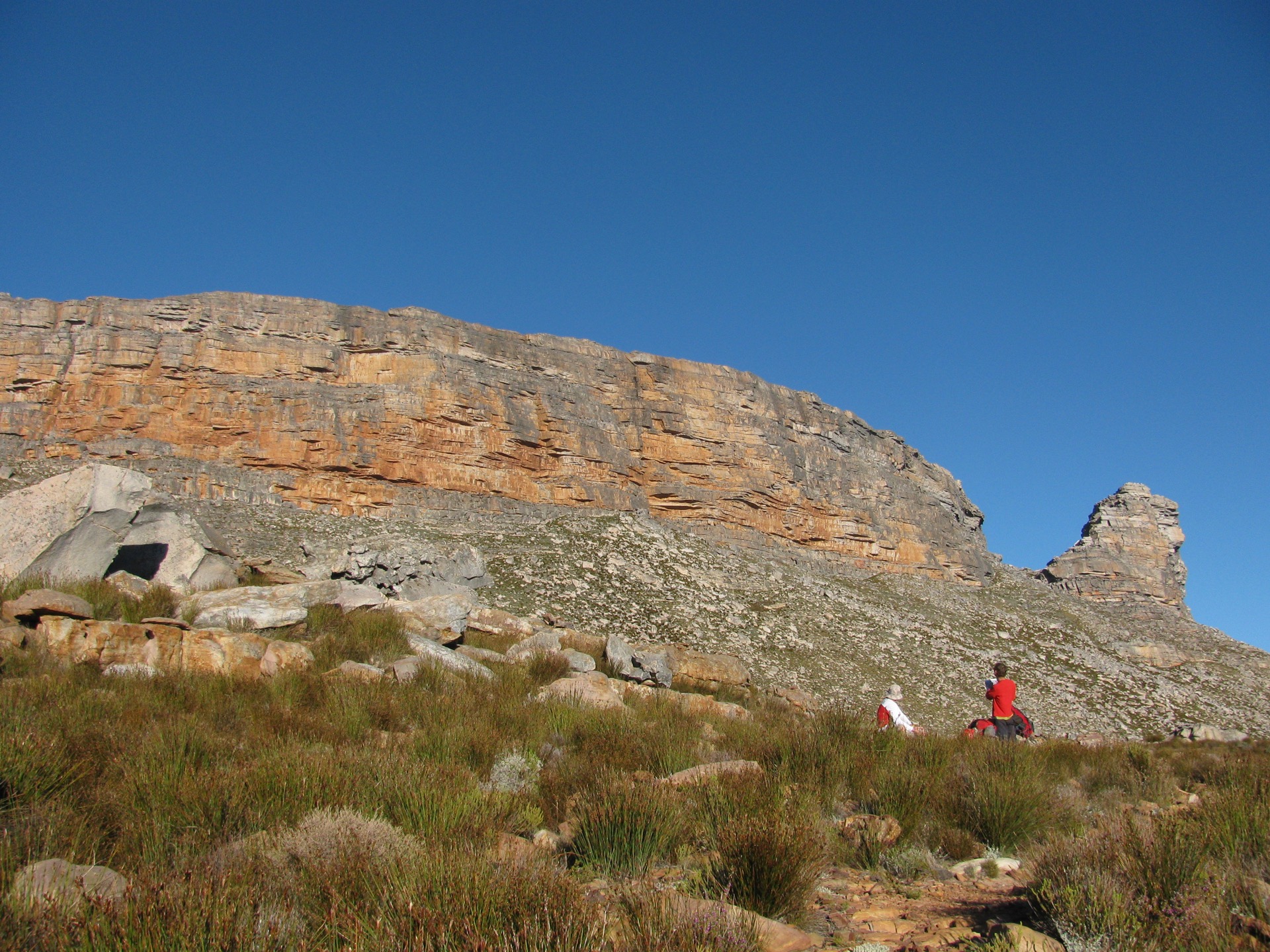
Sandstone Escarpment and the Spout
The near-horizontal ledges visible along the escarpment face reflect the near-flat bedding planes of this formation, while the broken rock along the steep face shows where erosion has worked unevenly across the jointed stone. In the photograph taken on 24 November 2011 by Meganbeckett27 (CC BY-SA 3.0), the main escarpment fills the left portion of the frame, and a freestanding column appears to its right — this is the Spout, a separately measured feature recorded by the Mountain Club of South Africa at 1,964 m.
Early Ascents and the 1896 Record
The Mountain Club of South Africa's archival records document ascents of Tafelberg from 1896 through 1930. The 1896 ascent is the earliest in that record, and it involved a party that had turned back in poor conditions before two members continued to the summit: Gother Mann and a local farmer named Villoen — also published as Viljoen — who was housing the climbing party at his farm. According to researcher Lance van Sittert, drawing on the contemporary account of expedition participant George Amphlett, Villoen had made repeated earlier attempts on the mountain.
Climbing Routes and Organised Activity
In 1967, Keith Fletcher and Binky Kohler opened a technical route on Tafelberg called Maiden's Prayer. Dave Cheesmond's account of the route, one of fifty selected Western Cape climbs he documented, records it as an eight-pitch line.
In December 1969, a scouting trial organised by the Cederberg Senior Scout Adventure involved three patrols operating in the range; one of them, led by Peter Watt, was assigned the Tafelberg area. Four years later, in 1973, the Cederberg was formally proclaimed a wilderness area.
Cedar and Conservation in the Wider Cederberg
The Cederberg takes its name from the Clanwilliam cedar, a tree native to the range whose population has been reduced by historic demand for cedarwood and by fires. CapeNature's documentation of the wider Cederberg complex records ongoing conservation efforts including volunteer planting of seedlings to restore cedar stands.
In 2004, the Cape Floral Region Protected Areas — the grouping that includes the Cederberg — received UNESCO World Heritage recognition, as dated by CapeNature. The Cederberg Wilderness falls within this protected area framework, placing Tafelberg within a landscape that carries both national and international conservation status.