
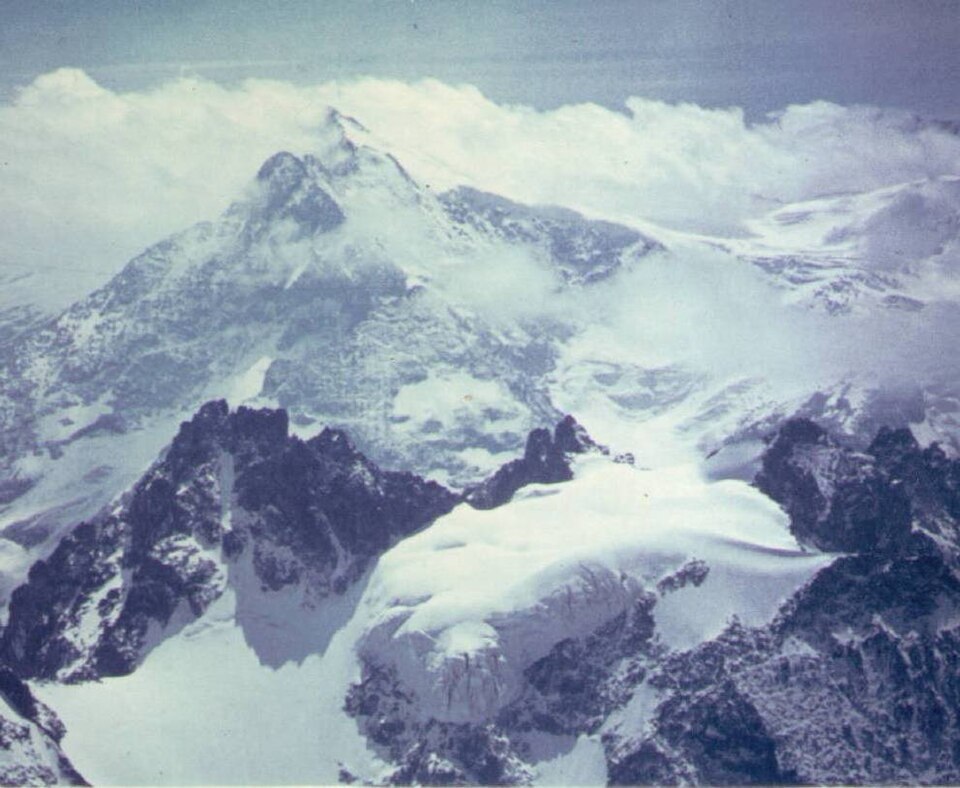
Position and Glacier Approach
Sustenhorn stands at 3,502 metres on the southern side of the Susten Pass, one of the high crossings in the Urner Alps that connects the cantons of Uri and Bern. The Swiss Alpine Club documents the approach to the summit from the Tierberglihütte, a mountain hut situated on the glacier-side terrain below the peak. The route from the hut crosses the glaciated western slopes before reaching the summit zone, a line that places Sustenhorn squarely within the tradition of glacier-based alpinism that characterised the high peaks of this part of the Alps throughout the nineteenth and early twentieth centuries. The Tierberglihütte itself serves as the reference point in the Club's current route documentation, providing a fixed geographic anchor for understanding the approach.
The First Ascent of 7 August 1841
The first recorded ascent of Sustenhorn took place on 7 August 1841, carried out by Gottlieb Studer together with Johann and Heinrich von Weissenfluh. The Swiss Alpine Club preserves this record, placing the ascent among the earlier systematic first ascents in the Urner Alps, predating the 1864 ascent of Dammastock and the 1845 ascent of Galenstock by several years and by more than two decades respectively. Gottlieb Studer was a significant figure in mid-nineteenth-century Swiss alpinism, and the participation of Johann and Heinrich von Weissenfluh — a family name also associated with the Dammastock first ascent over two decades later — reflects the continuity of local guiding expertise across the region's exploration.
Vorder Sustenhorn and Robert Helbling's Separate Work
A distinct mountain in the same area, Vorder Sustenhorn, has its own ascent history that must be kept separate from that of Sustenhorn proper. An SAC archive history connects Vorder Sustenhorn's south summit to an approach explored on 4 September 1898 by Robert Helbling, whose guide to the area was subsequently published in 1905. These dates — 1898 for the approach and 1905 for the guide's publication — apply specifically to Vorder Sustenhorn and to Helbling's work, not to Sustenhorn itself. The two mountains share a name and a geographic neighbourhood but carry independent ascent records, and the archive is careful to attribute Helbling's contributions to the correct peak.