
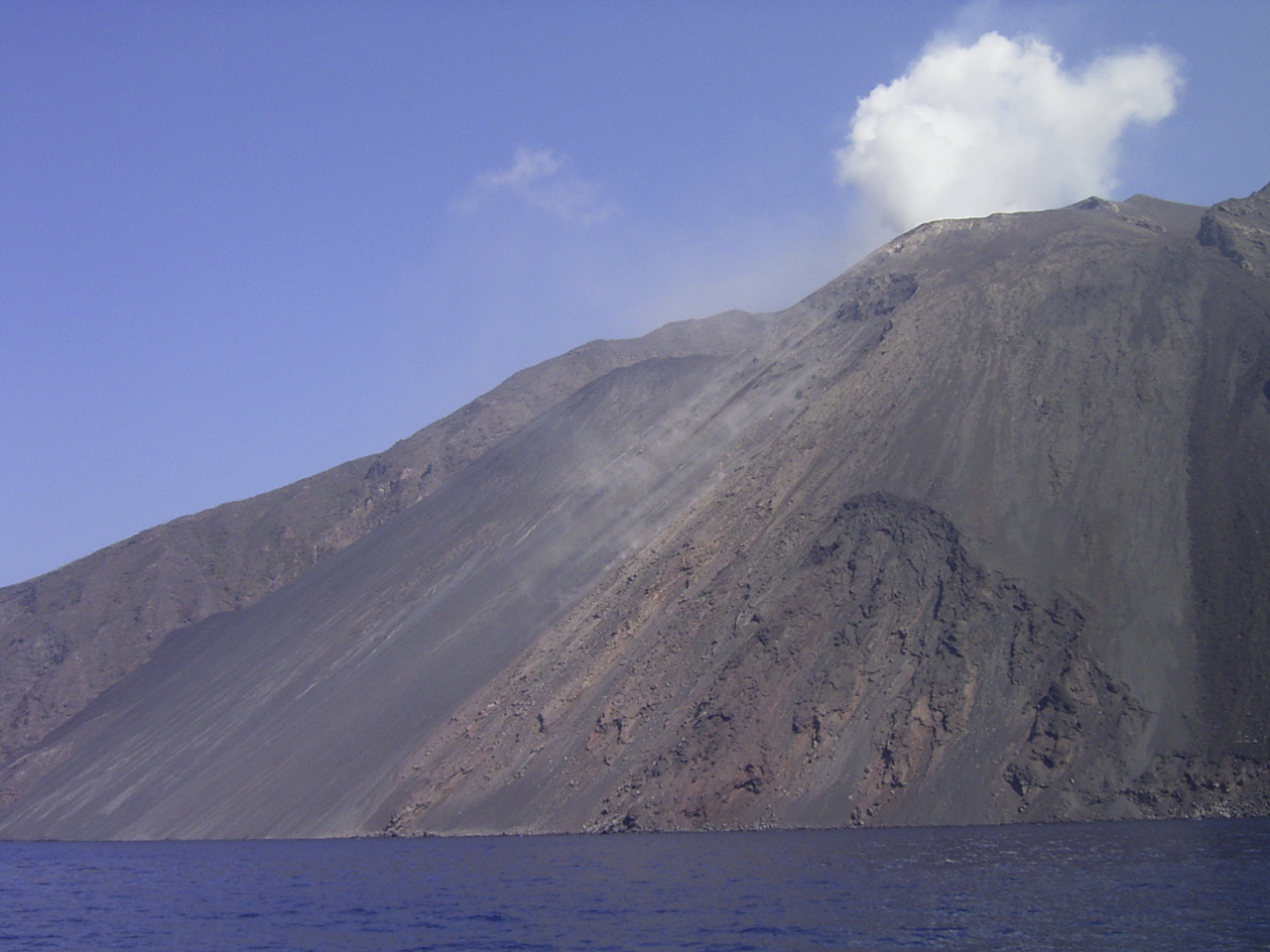
Geological architecture and edifice structure
The island of Stromboli is the emergent portion of a large submarine volcanic edifice. About 2 km away, the islet of Strombolicchio preserves traces of far older activity: it is a volcanic neck — the solidified remnant of a conduit — dating to approximately 200,000 years ago, while the activity of the emerged portion of the main island belongs to more recent phases. This chronological difference makes Strombolicchio a distinct geological archive from the main island, not an appendage of it.
The Sciara del Fuoco is the most recognizable morphological structure on the island: a large collapse depression on the north-western flank along which pyroclastic material, blocks, and — during periods of heightened activity — lava flows descending to the sea are channeled. Its shape is the result of sector collapse events that occurred during the geological history of the edifice, and it continues to be the main dispersal corridor for eruptive products into the Tyrrhenian Sea.
Eruptive activity: from normal behavior to paroxysms
The INGV draws precise distinctions between the different manifestations of Stromboli's activity. The persistent ordinary explosions — which emit bombs, lapilli, and ash from the summit craters — constitute the norm, with a frequency that can range from a few minutes to tens of minutes. These are supplemented, with lesser frequency, by major explosions and paroxysms: events of markedly greater intensity capable of projecting material over wide areas.
The event of 5 April 2003 is documented in the INGV's historical catalog as an example of a paroxysm: the blast dispersed material across the entire crater region and over the flanks of the edifice, generating a convective plume and a small pyroclastic flow that traveled part of the Sciara del Fuoco down to the sea. Episodes of this kind serve as a reminder that Stromboli's persistent regime does not preclude sudden transitions to states of far higher energy.
The name that defined a volcanological category
Stromboli's activity has been documented since at least the eighteenth century, and this long sequence of observations has had a direct consequence for scientific language: the island's eruptive behavior gave its name to the Strombolian type, characterized by rhythmic gas explosions that project incandescent material to moderate heights. Similarly, the nearby island of Vulcano provided the name for the Vulcanian type, distinguished by more violent and less frequent explosions. Stromboli is therefore, in a proper sense, one of the founding localities of modern volcanology as a descriptive discipline.
The inscription of the Aeolian Islands on the UNESCO World Heritage List, which took place in 2000, explicitly recognized this value: the site was included for the exceptional significance of its volcanic forms and processes, a living testimony to the mechanisms that shape the Earth's crust. Stromboli is its most dynamic element — a natural laboratory in which geology can be observed in real time.
The island in the context of the Aeolian archipelago
The Aeolian Islands form a volcanic archipelago in the southern Tyrrhenian Sea composed of seven main islands, each with its own geological history. Stromboli occupies the most northerly and easterly position in the group and represents the pole of persistent activity within the archipelago, in contrast to islands such as Lipari or Salina, whose surface activity belongs to more remote epochs. Strombolicchio, the neck lying about 2 km from the island, is at once the oldest visible testimony to the system's evolution and a landscape feature that defines the silhouette of the north-eastern sector of the archipelago.
The coexistence, within a small area, of volcanic morphologies of different ages and natures — the neck of Strombolicchio, the Sciara del Fuoco as a collapse structure, the active summit craters of the Vancori — makes the island an extraordinarily compact compendium of the processes that build and dismantle insular volcanic edifices. It is this variety of forms and dynamics, alongside its uninterrupted activity, that has sustained centuries of scientific observation and continues to fuel contemporary volcanological research by the INGV.