
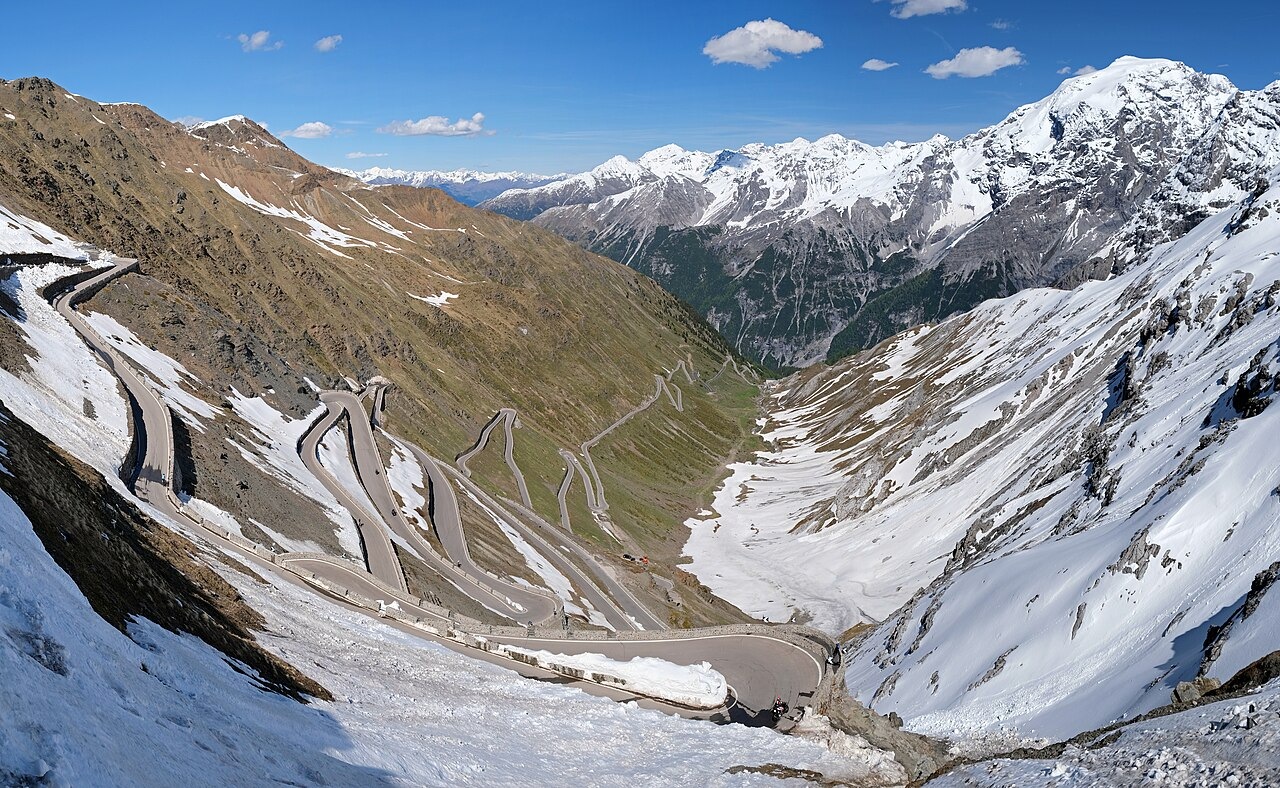
An Imperial Commission, 1820–1825
Austrian imperial authorities commissioned Carlo Donegani to build the crossing, completed between 1820 and 1825. The road ascends by means of hairpin bends that reverse direction at close intervals, each loop gaining a small increment of height against the slope. William Brockedon's 1828 print, inscribed The Pass of the Monte Stelvio and held at the Museo Etnografico Tiranese, depicts a gallery on the carriageway.
Galleries, Coaches, and Regular Service
Between 1826 and 1832, builders covered parts of the most exposed bends with wooden galleries that sheltered traffic from winter snow. A stagecoach preserved at the Museo Civico di Bormio carried up to eight passengers alongside the driver, with exterior luggage compartments and tools for repairs on board. Regular service from Milan toward Tyrol began in 1831, establishing the pass as a functioning transit corridor within years of the road's completion.
Coppi at the Stelvio, 1953
The Giro d'Italia crossed the Stelvio for the first time on 1 June 1953. Fausto Coppi began the day 1 minute 59 seconds behind Hugo Koblet in the overall classification, launched a counterattack on the climb, crossed the pass alone, won the stage, took the overall lead, and went on to claim his fifth Giro victory.