
Granite, from Plateau to Rim
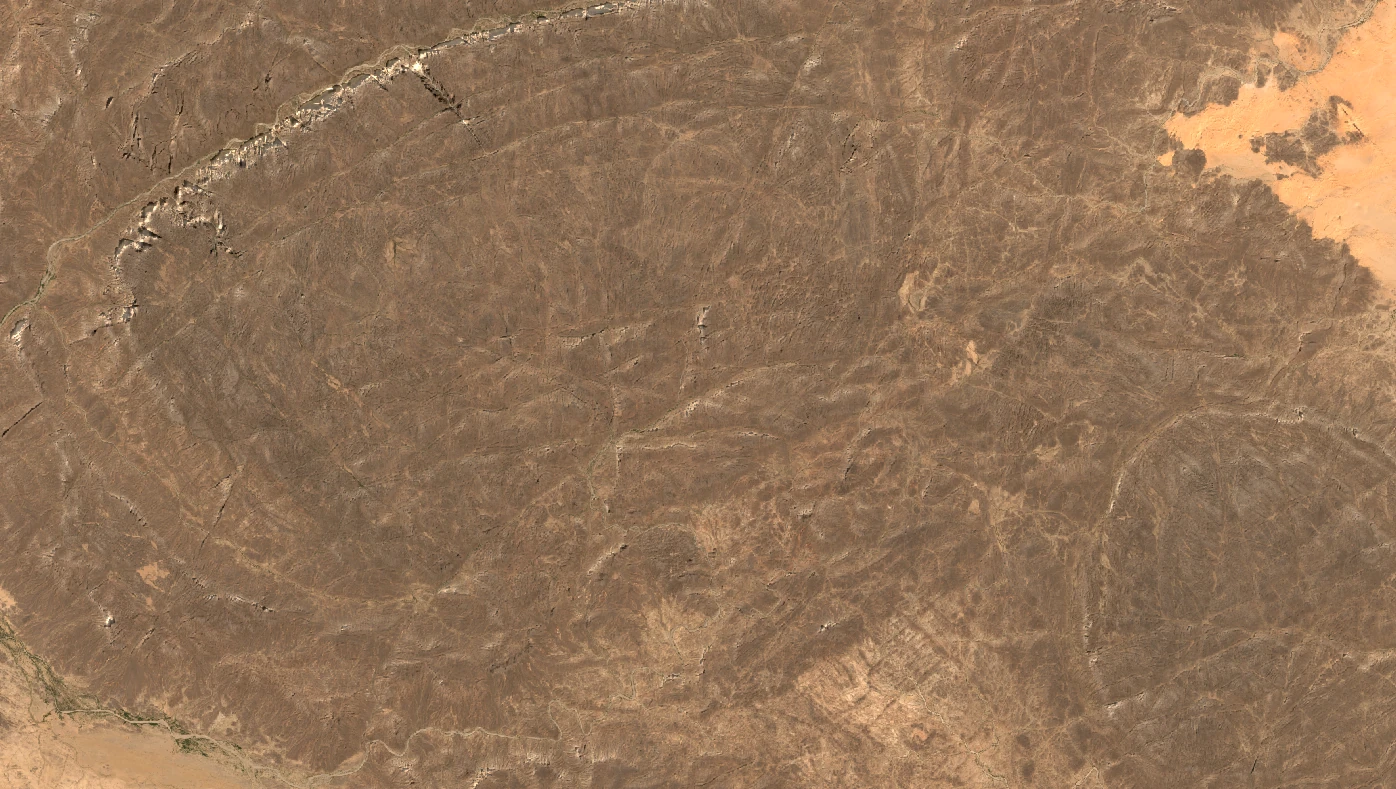
The Nigerien Ministry of Rural Development and ORSTOM mapped Tamgak as a ring-shaped granite intrusion during their 1976 campaign. Molten rock entered older bedrock and cooled beneath the surface. Erosion later exposed the granite. In the 15 February 2025 Sentinel-2C image, the weathered ridges of southern Tamgak lie below the curved gorge, with pale sand along the eastern edge.
The Iberkoum Catchment
The 1976 survey placed the headwaters of the Kori Iberkoum at about 1,860 metres on Tamgak’s southeastern edge. This seasonal stream runs steeply off the massif and joins the Kori Tamgak upstream of Iférouane. On 31 July 1976 the Iberkoum station recorded a peak flow of 29.3 cubic metres per second. The Tamgak station recorded no flood from the same storm.
Water and Settlements
In Exploration of Aïr, published in 1921, Angus Buchanan recalled travelling along Tamgak’s western foot through the valley he spelled Iberkom. After rain he saw green scrub, date palms and stone huts. A local guide pointed out a solitary rock tower used to orient travellers toward Iférouane. Buchanan later placed it closer to the settlement he called Zeloufiet.
Seasonal Water in a World Heritage Landscape
The Aïr and Ténéré Natural Reserves, which include Tamgak, entered the UNESCO World Heritage List in 1991. Hollows in the bedrock can retain water as pools known as gueltas after the channels below have stopped flowing. In 2001 the photographer Maximilien Bruggmann documented pools in the gorge and camel caravans travelling between its walls.