
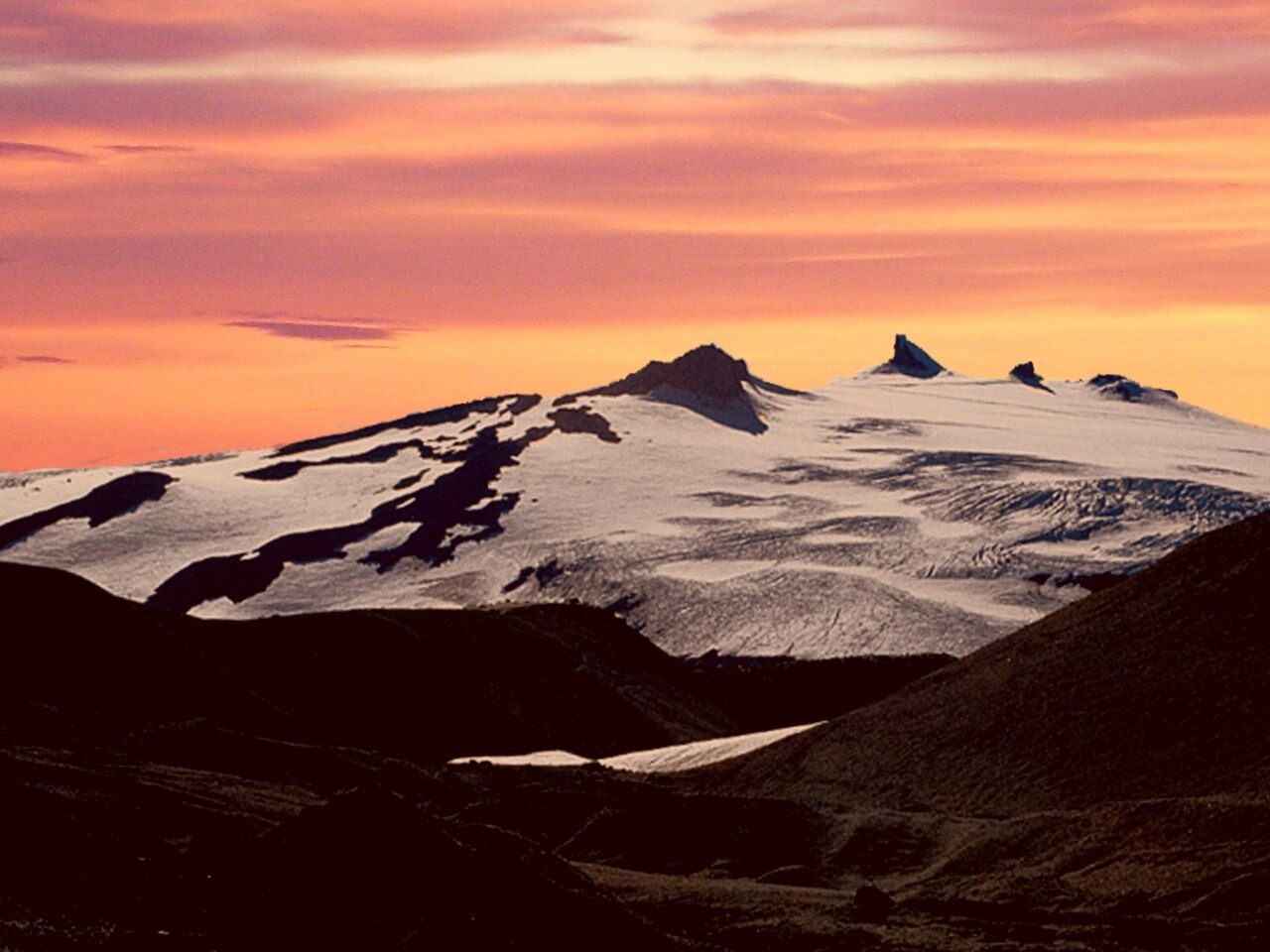
Volcanic Architecture and Lava Fields
The cone was built through repeated eruptions that deposited successive layers of lava and tephra. Among the most visible products of this history is the Háahraun lava field, which the Iceland Environment Agency attributes to the youngest large eruption, dated to roughly 1,800 years ago. Lava flows from that and earlier events extend from the flanks toward the coastline, shaping the terrain of the surrounding national park.
Eruption Record
The Smithsonian Institution's Global Volcanism Program places the youngest known eruption at around 200 CE, though with acknowledged uncertainty in the dating. The stratovolcano's eruptive history spans a considerably longer interval, with successive events progressively raising the cone to its present form. No claims about the current extent of glacier cover beyond what dated evidence supports are warranted here.
Literary Reception
In 1864 Jules Verne chose Snæfellsjökull as the fictional descent point in Journey to the Centre of the Earth, in which explorers enter through a crater on the summit. The Icelandic Natural History Museum documents this role in the mountain's cultural record. Verne's choice fixed a specific Icelandic peak, named and located, as the threshold of an underworld in European popular imagination, a distinction the volcano holds independently of its geological status.