
Elevation, Rank, and the Question of Prominence
Skiddaw's standing among England's highest mountains is less fixed than its absolute elevation might suggest. At 931 metres (3,054 ft), it is traditionally described as the fourth-highest peak in England, a ranking that has long been standard in walking literature. However, depending on what threshold of topographic prominence is considered meaningful, it can also be classified as third or as low as sixth. This ambiguity is a product of the clustered, plateau-like character of the highest ground in the Lake District, where subsidiary tops and satellite summits complicate simple linear rankings.
Position Above Keswick
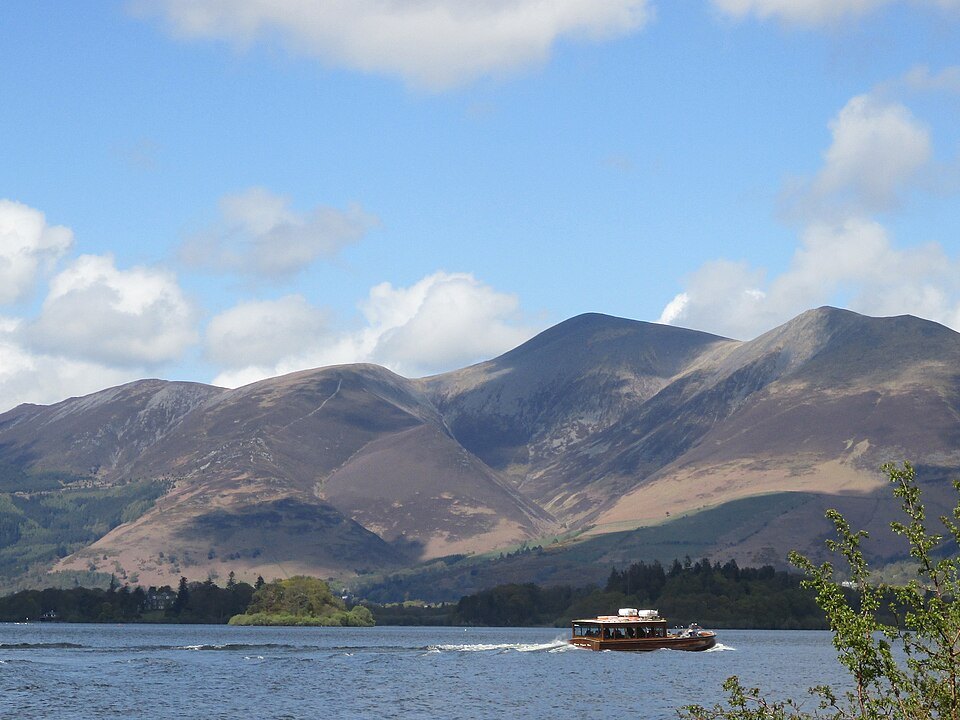
The mountain lies just north of Keswick, Cumbria, within the Lake District National Park, and its mass dominates the skyline across this portion of the northern lakes. Its relationship to Keswick is unusually immediate for a summit of this height—the town sits directly beneath the mountain's southern flanks, giving Skiddaw a presence in the town's daily horizon that few English peaks match. This position in the historic county of Cumberland places it in the northern sector of the Lake District, away from the more dramatic central fells.
Character of the Ascent
Among Lake District mountains of comparable elevation, Skiddaw is noted for the relative straightforwardness of its ascent. This characteristic has historically made it a reference point in guidebook literature, where it is frequently cited as the most approachable of the major Lakeland summits for walkers. That reputation is a consequence of the mountain's smooth, rounded profile—a reflection of the ancient Skiddaw Slate geology that underlies much of the northern Lake District—rather than the jagged volcanic rock that gives many central fells their more demanding terrain.